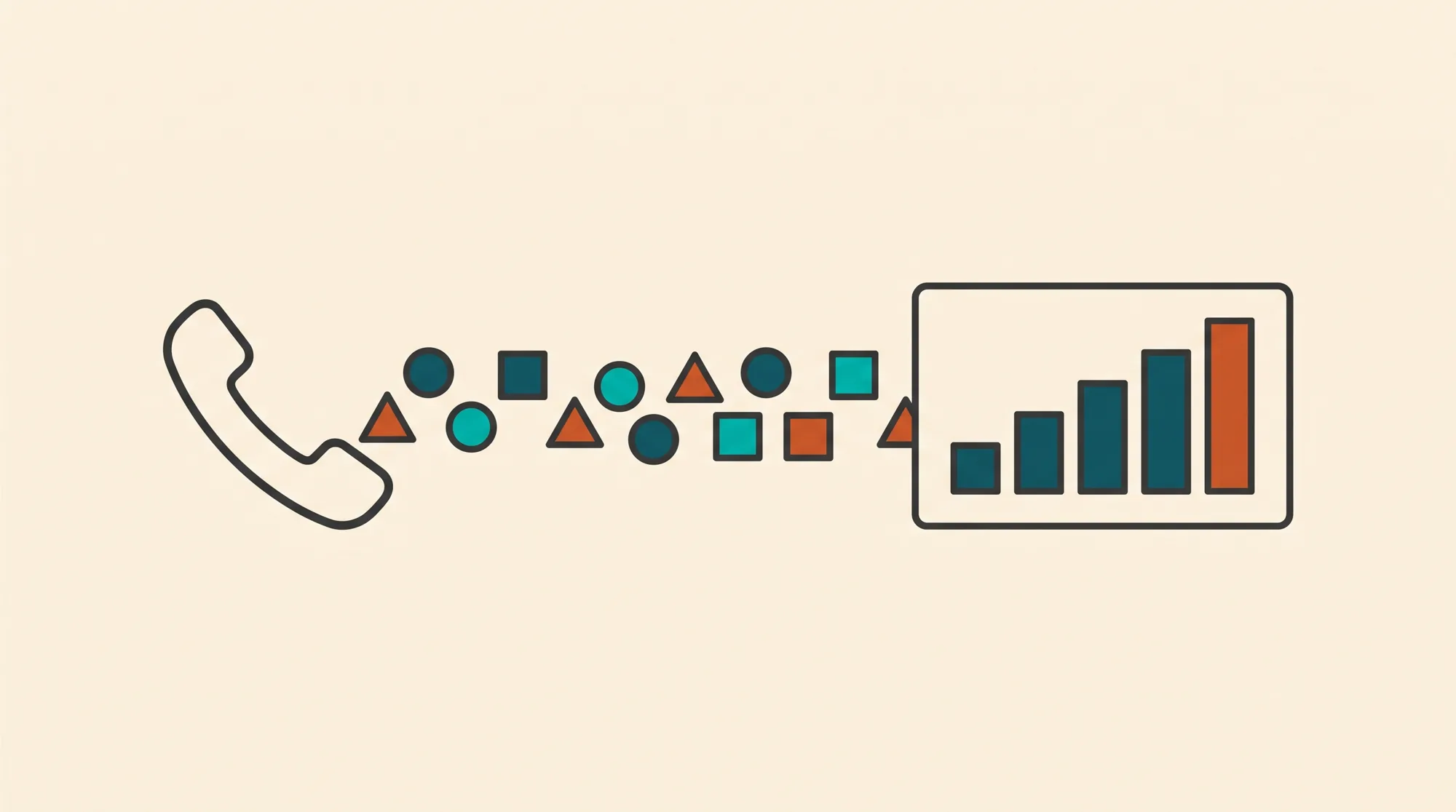
An AI agent answers a Hamilton plumber's phone for a month. It takes 140 calls, books the ones it can, and hands the rest to the plumber with a note. Ask him what those calls were about and he can tell you roughly. Ask him how many were about hot water cylinders, which suburbs they came from, what time of day people ring, or which question callers asked that nobody on his website answers, and he has no idea.
The recordings exist. The transcripts exist. Every one of those calls was converted into structured text on the way through. And then it sat there, because the system was bought to save labour and nobody thought to ask what it had heard.
This is the most common way we see AI undersold in New Zealand, by the people selling it and the people buying it. AI as a labour replacement is the weakest position the technology can hold. AI as an intelligence sensor is the strongest, and it comes for free with every system that was built to listen. This post is about the difference, what a sensor hears, and how to start reading it.
Why is "a cheaper pair of hands" the weakest position for AI?
Because it invites a price comparison, and price comparisons are always lost eventually. If the value of a system is that it does what a person did for less, then a competitor who does the same thing for slightly less again has the same value. The business buying it learns to shop on price, and the system gets treated like a phone plan.
Look at how most AI work is described, ours included until recently. Automated phone answering. Automated claims triage. Automated compliance follow-up. Every one of those sentences says: we do what you did, without the person. It is true and it is a real saving. It is also the most commoditisable claim in business, because the only question it leaves the buyer is "can I get that cheaper."
The thing being missed is that a system which handles a conversation has, by definition, understood the conversation. It classified the caller's problem. It rated the urgency. It noticed what they asked and whether it could answer. All of that is data, and it is data the business never had before, because nobody wrote down what the phone said.
| Framing | Labour replacement | Intelligence sensor |
|---|---|---|
| What the buyer asks | Can it do what my admin does | What will it tell me by Christmas |
| How it is compared | Against the cost of a person | Against what the business knows today |
| Value over time | Flat from day one | Compounds as the record grows |
| Who else can offer it | Anyone with the same tools | Only a system already inside your calls |
| What is measured | Hours saved | Decisions changed |
What does an AI system hear that nobody is writing down?
Everything a customer says before, during and after the thing they rang about. Why they called. When. What they asked that had no answer. What they mentioned in passing. Whether they were calm or stressed. Which brand, suburb, product or problem came up for the third time this month. A person answering the phone hears all of that and remembers almost none of it by Friday.
The plumber above has a market research department he does not know about. Fourteen hot water cylinder calls in a month, up from six, three mentioning the same brand, is a story about what is failing in his area and what he should be stocking on the van. Nine callers asking whether he does gas fitting is a service he should either offer or say clearly that he does not. Four calls after 6pm on Fridays from the same new subdivision is a marketing decision.
None of that needed a survey. It needed the calls to be read, and the calls were already being read.
Why was this data always there and never used?
Because it lived in a form software could not read. A phone call was audio. A rambling email was prose. The only converter available was the person who took the call, and they were paid to resolve it, not to log it. So the resolution happened and the intelligence evaporated, on every call, for decades.
AI made language programmable, and that changes the economics. A voice agent produces a transcript and a summary as a side effect of doing its job. The summary already has fields in it: reason for call, urgency, outcome, open question. Aggregating those fields across a month is a query, not a project. The conversion step that made the data impossible to collect is now the same step that handles the call.
This is why we say the sensor comes for free. The expensive part, turning speech into structured records, was already paid for when the system was built to answer the phone. Reading what it collected is the cheap part, and it is the part nobody schedules.
Which industries does this apply to?
Any business where customers talk to it, which is most of them. The shape of what the sensor hears changes by industry, but the pattern holds.
A property manager's after-hours agent learns which buildings generate the most urgent calls, which contractors take longest to confirm, and which tenants ring repeatedly about the same fault. That is a maintenance plan and a contractor review, waiting to be read. We described the call handling side of that in the after-hours playbook. The reporting side is the half we are arguing for here.
A compliance team running outbound follow-ups to overdue contractors learns which requirement confuses people most, which region is struggling and which contractors need help rather than reminders. An insurer's claims intake learns which device models fail in which way and which claim descriptions correlate with fraud. A dental clinic's recall agent learns which patients respond to a call and which need a text.
In every case the system was bought to do a task. What it learns while doing it is the more valuable output, and it is the one that a competitor selling the same task cannot replicate, because they are not inside your calls.
What does the sensor report look like in practice?
One page, monthly, in plain language, built from the fields the agent already fills on every call. Volume by reason for calling. Volume by hour and day. The top five questions the agent could not answer. Recurring problems, brands or locations. Escalations and why. Anything that moved by more than a third since last month, called out at the top.
The format matters less than the discipline of reading it. The report is a sensor reading. It has no value until someone looks at it and decides something, so the design goal is a page a busy owner will read in five minutes over a coffee, with the surprising number at the top.
The most useful single section in our experience is the list of questions the agent could not answer. Those are the gaps in the business's own knowledge of itself. A caller asking a question the system cannot handle is a caller asking a question the website does not answer, the quote template does not cover, or the staff have been answering inconsistently. Fix the top three each month and the escalation rate falls on its own.
How does the intelligence compound over time?
Month by month, in a way that labour savings never do. Labour savings are flat. The system saves the same hours in month twelve as in month one. Intelligence accumulates, because each month's record makes the previous months more useful. A spike means nothing on its own. A spike against eleven months of baseline is a signal.
The arc we describe to clients runs roughly like this. In month one, the system handles calls and the owner checks it is not making mistakes. By month three, the report shows a pattern the owner half suspected and now has numbers for. By month six, a decision gets made because of the report: a service added, a supplier changed, a page rewritten, a staff roster moved to match when the calls come. By month twelve, the owner is making choices they could not have made without a year of every call written down.
That arc is the reason the sensor framing is uncommoditisable. The record cannot be bought from someone else. It can only be accumulated, and the business that started earlier has more of it.
How do you start treating your AI as a sensor?
Decide what you want to know, make the agent capture it as fields on every call, and put a monthly reading in someone's calendar. Do this before launch if you can and next week if you cannot. Then act on the surprising number once a month. The whole practice is one hour a month once the fields exist.
There is a privacy dimension, and it is simpler than people fear. Callers should be told the call is recorded and handled by an AI. The reporting should be aggregate. Nobody needs a list of which tenant rang about what; they need to know that heating complaints tripled in June. The Privacy Act 2020 is comfortable with a business learning from its own customer contact when the customer knows it is happening and the data is used for the purpose it was collected for. Design the report at the aggregate level and most of the questions answer themselves.
If a system you already run produces transcripts and nobody reads them, that is where to start. If you are scoping a new one, ask the vendor what it will tell you by Christmas. A vendor with a good answer has built a sensor. A vendor without one has built a cheaper pair of hands, and you should price it accordingly.
Turning an AI system into a sensor: five steps
1. Name five things you want to know.
Why people call. When. What you cannot answer. What keeps recurring. Where the escalations come from. Be specific to your business, and keep it to five.
2. Make each one a field.
Reason for call as a fixed list. Time captured automatically. Unanswered question as free text. Recurring entity (brand, suburb, product) as a tag. Escalation reason as a fixed list.
3. Fill the fields on every call.
Including the routine ones. The value is in the aggregate, and the aggregate needs the boring calls counted too.
4. Produce one page a month.
Counts by field, the biggest change since last month at the top, the top five unanswered questions. Five minutes to read.
5. Decide one thing.
Every month, one action from the report. A page rewritten, a service added, a roster shifted. Log the decision next to the number that prompted it.
We build the reporting layer into every voice agent we deliver and into CallCover, because a system that hears every call and tells you nothing is leaving most of its value on the table. If yours is doing that, get in touch and we will help you read it.