Three quotes land in the same inbox for what sounds like the same job. One says $4,500. One says $28,000. The third says the scoping work alone is $35,000 and the build gets priced after that. All three are for a system that answers the phone, books the work, and writes it back into the job management software.
None of the three is lying. AI implementation cost in New Zealand has a spread that looks absurd until you see what each number is buying. That spread is widening, not closing, and it is widening for a reason worth understanding before you sign anything.
Below: what the money goes on in 2026, where the range comes from, what it costs to keep running once it is live, how much of it the government will cover, and how to read a quote so you know which of those three you are holding.
What does AI implementation cost an NZ SME in 2026?
A single-workflow AI build for a New Zealand SME sits between $5,000 and $25,000 as a fixed price, with running costs from tens to low hundreds of dollars a month. Multi-system builds carrying compliance or legacy integration requirements run $25,000 to $90,000. Advisory-only engagements are commonly quoted at $12,000 to $35,000.
Those are market ranges, gathered from what NZ consultancies are publishing and quoting this year. They are wide because the word "project" is doing a lot of work. One agent answering one phone line is a different animal to an agent that reads your Xero data, checks a compliance register, and updates three systems that were never designed to talk to each other.
| Scope | Typical NZ price | What it covers |
|---|---|---|
| Off-the-shelf subscription | $20 to $100 per user per month | Generic tasks. Preconfigured. No integration. |
| Single workflow, custom built | $5,000 to $25,000 one-off | One process, one or two integrations, tuned to your business |
| Multi-system programme | $25,000 to $90,000 | Several workflows, legacy systems, compliance requirements |
| Advisory and roadmap only | $12,000 to $35,000 | Process mapping, prioritised plan, costings. No build. |
The subscription row is the one people anchor on, and it is the row least likely to fit. Off-the-shelf works when your process is the same as everyone else's process. Most of the operational friction worth removing is friction that is specific to you, which is exactly the part a generic product cannot see.
Why is the technology getting cheaper while the projects are not?
Because the model is no longer the expensive part. Language model pricing has fallen to the point where the inference bill on a small business workload is a rounding error against the labour it replaces. What has not fallen is the cost of understanding a business well enough to wire an agent into it correctly.
Here is the arithmetic, because it makes the point faster than an argument does. Current frontier model pricing, in US dollars per million tokens:
| Model | Input per 1M tokens | Output per 1M tokens |
|---|---|---|
| Claude Haiku 4.5 | $1.00 | $5.00 |
| Claude Sonnet 5 | $2.00 | $10.00 |
| Claude Opus 5 | $5.00 | $25.00 |
A phone conversation that books a job might consume 3,000 tokens of input and 800 tokens of output. On Sonnet 5 that is six-tenths of a cent in and eight-tenths of a cent out. Call it a cent and a half per booked job, in US dollars, before you add telephony.
The model holding the conversation costs less than the paper you would have written the job card on. Meanwhile the median NZ AI project has got more expensive, because the projects that survive are the ones doing the integration work that pilots skip.
This is what sits behind the headline numbers in our state of AI in NZ business piece: 87% of NZ organisations use AI, 12% have scaled it. The 75% in the middle bought the cheap part and stopped there. AI deployment runs roughly 10% technology and 90% process, data and people. You can buy the 10% for a cent and a half. The 90% is where your money goes.
What are you paying for in an AI build quote?
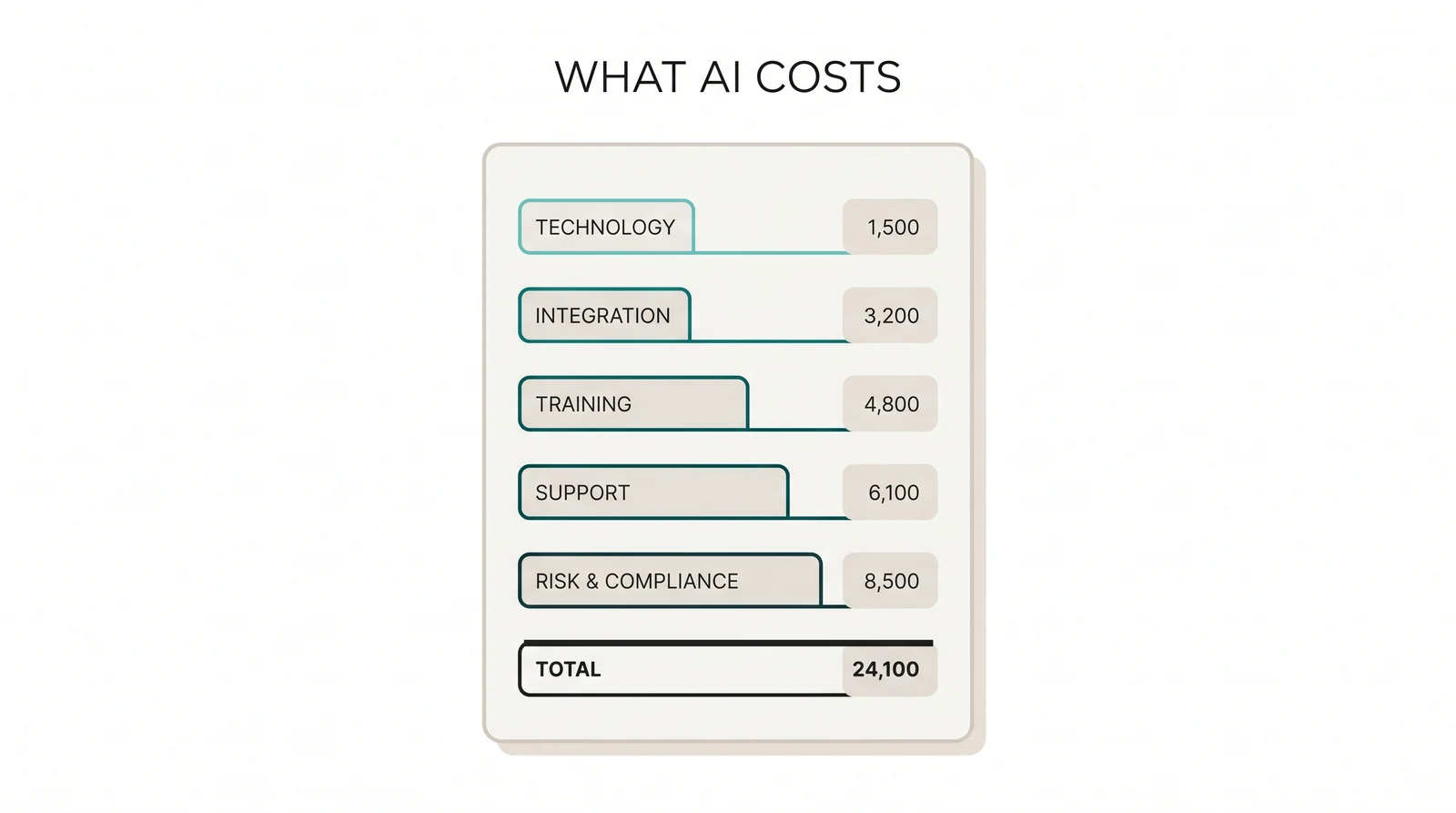
Five things, and the technology licence is usually the smallest of them. Discovery and scoping, integration engineering, the agent build itself, change management and training, then ongoing maintenance. A quote that does not separate these is hiding which one it has underestimated.
What does discovery and scoping involve?
Walking the process as it runs today, finding where the time goes, and deciding what is worth automating and what is not. It takes one to three weeks for a small business. It produces a written plan with costings, and it is the single best predictor of whether the build lands.
Skipping discovery is the most expensive saving available. An agent built against an assumed process gets rebuilt against the real one, and the rebuild is not cheaper than the original. Our AI Readiness Map exists as a standalone engagement for this reason. The plan is worth having whether or not you build with the people who wrote it.
What drives the integration cost?
Whatever your systems will and will not let you do. A modern platform with a documented API is a day or two of work. A 2009 on-premise database with an undocumented schema and a spreadsheet somebody maintains by hand is a fortnight, and no quote written before someone has looked at it is worth trusting.
Why does change management appear on the invoice?
Because an agent nobody trusts gets bypassed, and a bypassed agent returns nothing regardless of how well it was built. Training, documented escalation rules, and a fortnight of reading transcripts with the team are what turn a working system into a used one.
This is the line item most often cut to win a price comparison. It is also the line item whose absence explains most stalled pilots. Somebody has to sit with the person whose job has changed and show them what the machine does when it is unsure.
What does an AI system cost to run once it is live?
For a small business running one or two agents, budget $100 to $300 a month all-in. That covers model usage, telephony or messaging, hosting, monitoring and light maintenance. Usage-based costs scale with volume, but they scale gently. Doubling your call volume does not double the monthly.
The components are worth knowing separately, because vendors bundle them differently and the bundling is where surprises live.
| Running cost | What drives it | Rough shape |
|---|---|---|
| Model usage | Conversation volume and length | Cents per interaction |
| Telephony or messaging | Minutes, numbers, SMS volume | Per-minute, per-number |
| Hosting and monitoring | Uptime requirements | Flat monthly |
| Maintenance and tuning | Rate of change in your business | Flat monthly, or by the hour |
Maintenance is the one people forget to budget. Your business changes. Prices move, staff change, a supplier gets replaced, a new service gets added. An agent trained on last year's operation goes out of date the same way a printed price list does, and somebody has to keep it current.
For a fuller worked comparison against the cost of a person covering the same hours, we ran the numbers in AI receptionist vs human receptionist. The short version: the running cost is rarely the deciding number. The build fee and the change management are.
How much of this will the New Zealand government pay for?
Up to half of it, capped at $15,000. The MBIE AI Advisory Pilot, launched in January 2026 through the Regional Business Partner Network, co-funds up to 50% of the cost of developing an AI plan tailored to your business. Following strong demand it was extended to 150 businesses and now runs until 31 January 2027.
The detail that matters: it funds the plan, not the build. That is the advisory row from the first table, the discovery and scoping work, delivered by an approved consultant. Discovery is the part most likely to get cut for budget reasons and most likely to sink the project when it is, so having the government pay half of it is sensible sequencing.
Eligibility runs through the Regional Business Partner Network, so you need to be an existing customer of your regional partner, usually the local chamber of commerce. You also need to be able to fund your half. $765,000 was allocated to the pilot initially.
How do you tell a fair AI quote from a bad one?
A fair quote separates discovery, build, integration, training and monthly running costs into named line items with a number against each. It states what happens when the agent cannot handle something. It says who owns the resulting system. A quote that gives you one number and a launch date is a hope, not a quote.
Seven questions to ask before you sign
1. What are the separate line items for discovery, build, integration, training and monthly?
Good answer: five numbers, each with what it covers.
Red flag: one number and a timeline.
2. Have you looked at our systems, or is this priced from the description?
Good answer: they have asked for API documentation, an export, or a screen-share of the system.
Red flag: a fixed integration price quoted off a phone call.
3. What happens when the agent does not know the answer?
Good answer: a defined escalation path, to a named person, with the transcript attached.
Red flag: "it handles everything".
4. Who owns what you build?
Good answer: you do, including the configuration and the prompts, and you can take it with you.
Red flag: the system lives inside their platform and stays there when you leave.
5. What is the monthly, and what is in it?
Good answer: an itemised monthly with the usage assumptions written down.
Red flag: "usage-based, depends on volume", with no worked example.
6. What does month three look like?
Good answer: a tuning session, reporting, and a named person who reads the transcripts.
Red flag: launch is the last milestone on the plan.
7. What did you decide was not worth automating?
Good answer: a specific process, with the reason.
Red flag: everything is worth automating.
That last question is the most useful one on the list. Anybody who has done this work properly has a list of things they talked a client out of. Somebody selling you a licence does not.
The honest summary of AI implementation cost in 2026 is that the technology has become cheap and the work around it has not. NZ SMEs using AI reported average FY25 revenue uplifts of roughly $400,000 against non-adopters, which is a real number and a large one, and it accrues to the firms that paid for the boring 90%. Our own pricing is fixed and agreed before any work starts, for the same reason we tell clients to insist on it. A number you sign off in advance is the only kind you can plan against.
Frequently asked questions
- How much does AI cost for a small business in New Zealand?
- A custom single-workflow AI build for an NZ SME typically costs $5,000 to $25,000 as a fixed price, plus $100 to $300 a month to run. Off-the-shelf subscriptions run $20 to $100 per user per month but do not integrate with your existing systems. Multi-system builds with compliance requirements run $25,000 to $90,000.
- Does the New Zealand government fund AI for small businesses?
- Yes. The MBIE AI Advisory Pilot co-funds up to 50% of the cost of developing a tailored AI plan, capped at $15,000. It runs through the Regional Business Partner Network until 31 January 2027 and supports up to 150 businesses. It funds the planning and advisory work rather than the build itself.
- Why are AI project quotes so different from each other?
- Because they price different amounts of work. A quote covering only the agent build looks cheap against one that includes discovery, integration with existing systems, staff training and ongoing tuning. Ask for line items. The gap between two quotes is usually the integration and change management work, not the technology.
- What are the ongoing costs of running an AI agent?
- Model usage, telephony or messaging, hosting and monitoring, plus maintenance. For one or two agents in a small business this totals $100 to $300 a month. Model usage is the smallest component, often cents per interaction. Maintenance is the one most commonly left out of budgets and the one businesses most often need.
- Is it cheaper to buy an off-the-shelf AI tool than build one?
- Cheaper upfront, yes. Whether it is cheaper overall depends on how much of your process is generic. Off-the-shelf products handle common tasks well and cannot see the parts of your operation specific to you. If staff still re-key data after the tool runs, the subscription has not removed the labour it was bought to remove.