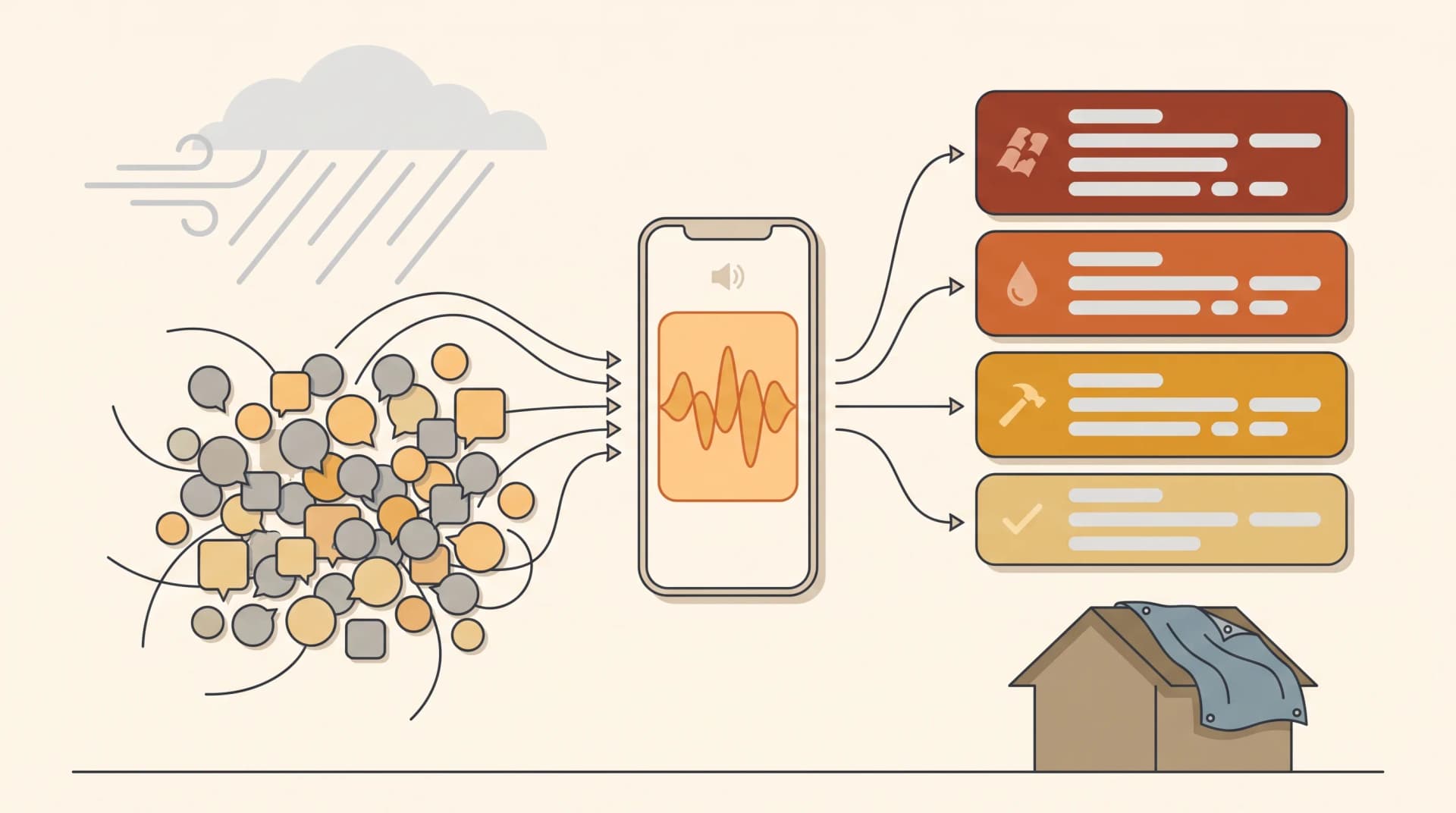
The front that came through on the last Tuesday of July stripped long-run steel off a pole shed in Ōtaki and put a macrocarpa limb through a tile roof in Waikanae. By 6am Wednesday, MetService had a severe weather warning issued for the lower North Island, and every roofing contractor from Levin to Island Bay woke to a phone that had started ringing before the sun came up.
At one Porirua firm, the office manager cleared 38 voicemails before 8am. She has run storm weeks for eleven years and she is very good at them. The problem is arithmetic, not skill. Each callback takes four or five minutes, and while she works through the list, new calls roll to voicemail behind her. By mid-morning the queue has grown faster than she can shrink it, and somewhere in it is the caller with water coming through a light fitting.
That caller is why storm-week triage matters. A saturated ceiling near live wiring is an emergency. A damp patch on the laundry ceiling is a job for the following week. On the phone, both callers use the same words and the same tone, because to each of them, theirs is the worst leak in Wellington.
We build AI phone systems for exactly this week. CallCover came out of answering phones for New Zealand trades, and roofing in a storm is the sharpest version of the problem: heavy call volume, wildly uneven urgency, and a schedule that has to be rebuilt every few hours.
This post covers what happens to a roofing company's phone when a warning turns orange, how an AI agent works out which callers need a tarp today, why a photo beats any description a homeowner can give, how tarp-first prioritisation reshapes the run list, and what the whole thing costs against what it earns.
Why does a storm turn the phone into the hardest job in roofing?
Because a single orange warning compresses a month of enquiries into 48 hours, and the phone gives you no way to tell which of them can wait. Call volume at a Wellington roofing firm can jump tenfold during a serious front. Every caller sounds urgent, and the phone only lets one conversation happen at a time.
What happens to call volume when a warning turns orange?
It spikes within hours of the wind arriving and stays high for days after the sky clears. The first wave is active leaks, rung in while the rain is still horizontal. The second wave, often bigger, is everyone who climbed into the ceiling at the weekend and found daylight.
The winter southerlies that rake the Wellington coast and the ex-tropical systems that arrive in summer both produce the same shape: a wall of calls, then a long tail of them. A firm that fields fifteen calls on a normal Tuesday can take well over a hundred across a bad Wednesday and Thursday. Nobody staffs an office for the worst two days of the year, so most of that wall hits voicemail.
Voicemail is where the money goes. A homeowner with water coming into the lounge does not wait for a callback. They ring the next roofer on Google, who is also flat out and also not answering, and then the one after that. The job goes to whoever picks up, and during a storm, almost nobody picks up.
Why can't callers tell you how urgent their leak is?
Because urgency in roofing is technical, and callers describe feelings rather than flashings. "Water everywhere" can mean a failed internal gutter dumping litres a minute, or a windowsill drip that has been there since March. The details that decide the schedule almost never arrive unprompted.
An experienced roofer or office manager gets there by asking. Where is the water coming in? Is it near the switchboard or a light fitting? Is the ceiling bulging? What kind of roof is it? How long has it been coming in? Those answers separate the make-safe from the Tuesday booking in under a minute.
The knowledge is not the bottleneck. The channel is. One skilled person can triage one call at a time, and storm week delivers them forty at once.
How does AI leak triage sort a hundred calls into a workable list?
An AI agent answers every call on the first ring, asks the same questions an experienced roofer would, and scores each job for urgency before a human touches it. The output is a ranked list: make safe now, tarp today, repair this week, quote when the rush settles. The phone stops being a lottery.
What does the AI ask that a voicemail can't?
A voicemail collects a name and a plea. A triage agent runs a structured conversation: where the water is entering, what it is near, how fast it is coming in, whether the ceiling is holding, roof type, single or two storey, and whether anyone has been up there. Each answer moves the job up or down the list.
This is the shift that large language models brought. AI made language programmable, so a caller's rambling description of water "coming in around the thing above the garage" becomes structured fields a scheduler can sort: entry point, rate, proximity to power, access. The caller talks like a person. The system files like a database.
Safety sits inside the same conversation. Water tracking into a light fitting or near the switchboard gets the caller told to flip the circuit off at the board, and the job flagged to the top of the list with a note to bring an electrician into the loop. A bulging ceiling gets the advice every roofer gives anyway: put a bucket under it, poke a small hole, let it drain before it comes down in one piece.
How do photos turn a description into a decision?
The agent texts the caller a link during the call, and photos come back within minutes. A shot of the ceiling and, where it is safe to take one, the roofline from the ground tells a roofer in ten seconds what twenty questions cannot.
Lifted ridge capping on a concrete tile roof, a sheet of long-run peeled back at the fixings, underlay flapping where tiles used to be. A vision model classifies the obvious cases and attaches a confidence score, and a human glances at the borderline ones. The point is speed of sorting, and the sorting is what storm week runs on.
The "where it is safe" clause is doing real work. Nobody should be on a wet roof holding a phone, and the request wording matters: from the ground, from the street, from a window. A surprising number of homeowners will otherwise fetch the ladder, and a roofer's storm week does not need an extra ambulance in it.
Those photos keep paying off after the sorting is done. Time-stamped images from the day of the storm become the start of the insurance file, which matters weeks later when an assessor asks when the damage occurred.
What is tarp-first prioritisation and why does it change the run list?
Tarp-first means the schedule optimises for making roofs watertight, and permanent repairs wait for clear weather. In storm week, a crew that tarps eight houses in a day protects more homes than a crew that fully repairs two. It is the difference between a triage desk and a booking sheet.
Why do tarps come before repairs in storm week?
Because water damage compounds by the hour. A leak that needed a $600 flashing repair becomes a five-figure insurance claim once the ceiling, insulation and carpet are saturated. A tarp or a run of sarking tape stops the compounding for a few hundred dollars and buys everyone time.
The numbers make the case on their own. A make-safe call-out in the Wellington region typically runs $450 to $800. Replacing a collapsed ceiling, wet batts, gib and paint in one room can pass $10,000 before anyone touches the roof itself. Every tarp that goes on early is a claim that stays small, and homeowners and insurers both remember who kept it small.
There is a safety argument stacked on top of the financial one. Permanent repair work on wet steel in a 90 km/h gust is a WorkSafe incident waiting for a date. Tarps are fast, low-exposure work, and they let the skilled repair hours land in the calm days that follow.
How does the ranked list reach the crews?
Straight into the job management software the business already runs. The triage layer writes each job into Tradify, Fergus, AroFlo or ServiceM8 with the urgency score, address, photos and access notes attached, grouped by suburb so a crew is not crossing town between tarps.
Clustering matters more than it sounds. A Titahi Bay run of five make-safes beats five jobs scattered from Plimmerton to Wainuiomata, and the grouping falls out of data the agent already collected. The crews open the app they were already using and drive the list top to bottom. Embedded, not bolted on.
The office manager's morning changes shape. She reviews a ranked list and re-orders it with the judgement no model has: she knows the customer in Cannons Creek is 84 and on her own, and she knows which Paremata street floods at high tide. The eleven years of experience get spent on decisions now, with the switchboard work already done.
How does the system capture insurance details without slowing the call down?
It asks three questions in about twenty seconds: are you claiming, who is your insurer, and is there a claim number yet. That is enough for the make-safe work to start and for the invoice to land cleanly against the insurer's file later.
What should be captured on the first call?
Insurer name, claim status and claim number if one exists, plus the photos already gathered during triage. Storm damage to a house is a private insurance matter, so the claim number is the thread that ties the roofer's invoice to the insurer's file. Capturing it on day one saves a fortnight of email tennis.
Most policies expect the homeowner to prevent further damage, which is exactly what a tarp does, so make-safe work rarely waits on an assessor. Where a claim has not been lodged yet, the agent notes the insurer and tells the caller what to expect, and the time-stamped photos from the triage conversation become the evidence the claim opens with.
The quiet win is consistency. On a hundred-call day, a human under pressure captures insurance details on some calls and forgets on others, and nobody blames her. The agent asks every single time, identically, on call one and call one hundred.
Where does the Privacy Act 2020 fit?
Photos of someone's home and their insurance details are personal information, and the Privacy Act 2020 applies to a roofing business collecting them. The obligations are workable: collect only what the job needs, tell people why, store it properly, and do not keep it forever.
A well-built triage system makes this easier to get right. Every caller hears the same short line about what the photos are for and where they go. If calls are recorded, callers are told up front. The data lands in one system with access controls, which is a better story than storm photos scattered across three crew members' camera rolls.
Retention deserves one deliberate decision. Keep the file for the job and the claim, then cull on a schedule. A folder of five-year-old photos of strangers' ceilings serves nobody, and the Act takes the same view.
What does storm-week triage cost, and what does it earn?
A missed storm week costs a roofing business more than any software will. The visible loss is the make-safe call-outs that went to whoever answered. The larger one is the repair and re-roof work that follows a well-handled emergency, which lands months later and rarely gets attributed to the phone.
What does a missed call cost during a storm?
Run the arithmetic on one bad day. Forty calls hit voicemail, and if a quarter of them were live jobs at an average of $900 in make-safe and repair work, that is $9,000 gone in a day. The storm does the marketing; the phone decides who collects.
The tail is worth more than the day. Storm emergencies convert into repairs at $600 to $1,500, and a share of those homes were already near the end of their roof's life. A full re-roof on a standard three-bedroom in the Wellington region sits somewhere between $20,000 and $45,000, and homeowners hand that job to the firm that turned up with a tarp at 7am in the rain. So do their neighbours, who watched it happen from the kitchen window.
What does AI triage cost to run?
As at mid-2026, off-the-shelf AI phone answering for trades runs from roughly $100 to $400 a month. A bespoke build with photo classification, urgency scoring and job-software integration is a five-figure project, commonly $10,000 to $25,000 depending on scope, with per-call running costs measured in cents per minute.
For comparison, a human after-hours answering service charges $2 to $4 a minute to take a message, and a message is where the triage work starts, not where it ends. The AI does the sorting itself, at 3am, on all forty calls at once.
The same system earns its keep between storms. On a quiet Tuesday in November it is an after-hours receptionist booking moss treatments and gutter cleans. When the next orange warning goes up, it becomes a triage desk without anyone flicking a switch. We scope builds like this as part of our consulting work, and the storm-week maths is the first thing we put on the table.
Practical Takeaway
You can move toward this in three steps, and the first two cost nothing. First, write your storm-week triage script down: the six questions that separate a make-safe from a Tuesday booking, on one laminated page by the phone, so anyone in the office can run them. Second, set up a photo path, even if it is a dedicated mobile number that texts callers a request for two shots from the ground.
Third, when the volume is beyond what people can answer, automate the front end. Before buying anything, measure one storm week: calls in, voicemails left, jobs actually booked. If the gap between the first number and the last is wide, the arithmetic will make the decision for you. If you want a second pair of eyes on those numbers, talk to us.
Frequently asked questions
- How does AI leak triage tell a real roofing emergency from a routine leak?
It asks the same questions an experienced roofer would: where the water is entering, what it is near, how fast it is coming in, and whether the ceiling is holding, then backs the answers with photos texted in during the call. Water near electrical fittings, active flows and bulging ceilings rank as make-safe jobs. Slow drips and old stains book into the normal schedule.
- Will homeowners talk to an AI when their roof is leaking?
In our experience, yes, because the alternative during a storm is voicemail. A caller with water coming in wants two things: to describe the problem to something that responds, and to know a roofer is coming. An agent that answers on the first ring, asks sensible questions and gives a clear next step delivers both. Hang-up rates in storm conditions are low.
- Does AI phone triage integrate with Tradify, Fergus or ServiceM8?
Yes. A well-built triage layer writes jobs directly into the job management software the business already uses, including Tradify, Fergus, AroFlo and ServiceM8, with urgency score, photos, insurance details and access notes attached. Crews keep working from the app they know, and the office reviews a ranked list instead of a voicemail queue.
- Is it legal under the Privacy Act 2020 for an AI to record calls and collect photos?
Yes, provided the business tells callers what is being collected and why, uses the information for the job and any related insurance claim, stores it securely, and does not retain it indefinitely. The Privacy Act 2020 applies to roofing firms like any other business. A consistent AI script arguably makes compliance easier, because every caller hears the same notification every time.