Anthropic has started interviewing people about how AI (artificial intelligence) shows up in their lives. An AI interviewer asks the questions, you answer, and they publish what they learn across everyone who takes part. I did one recently.
The questions were better than I expected. Answering them made me put words to something I've been saying for four years: AI made language programmable. That shift is why I build software the way I do now. It's also why my kids think a bot called Sam is a generous friend, and why there are a couple of things I won't hand to a model.
This post walks through my answers. The moment it clicked, what it looks like at home, the project where it didn't work, and where I draw the line.
What does "AI made language programmable" mean?
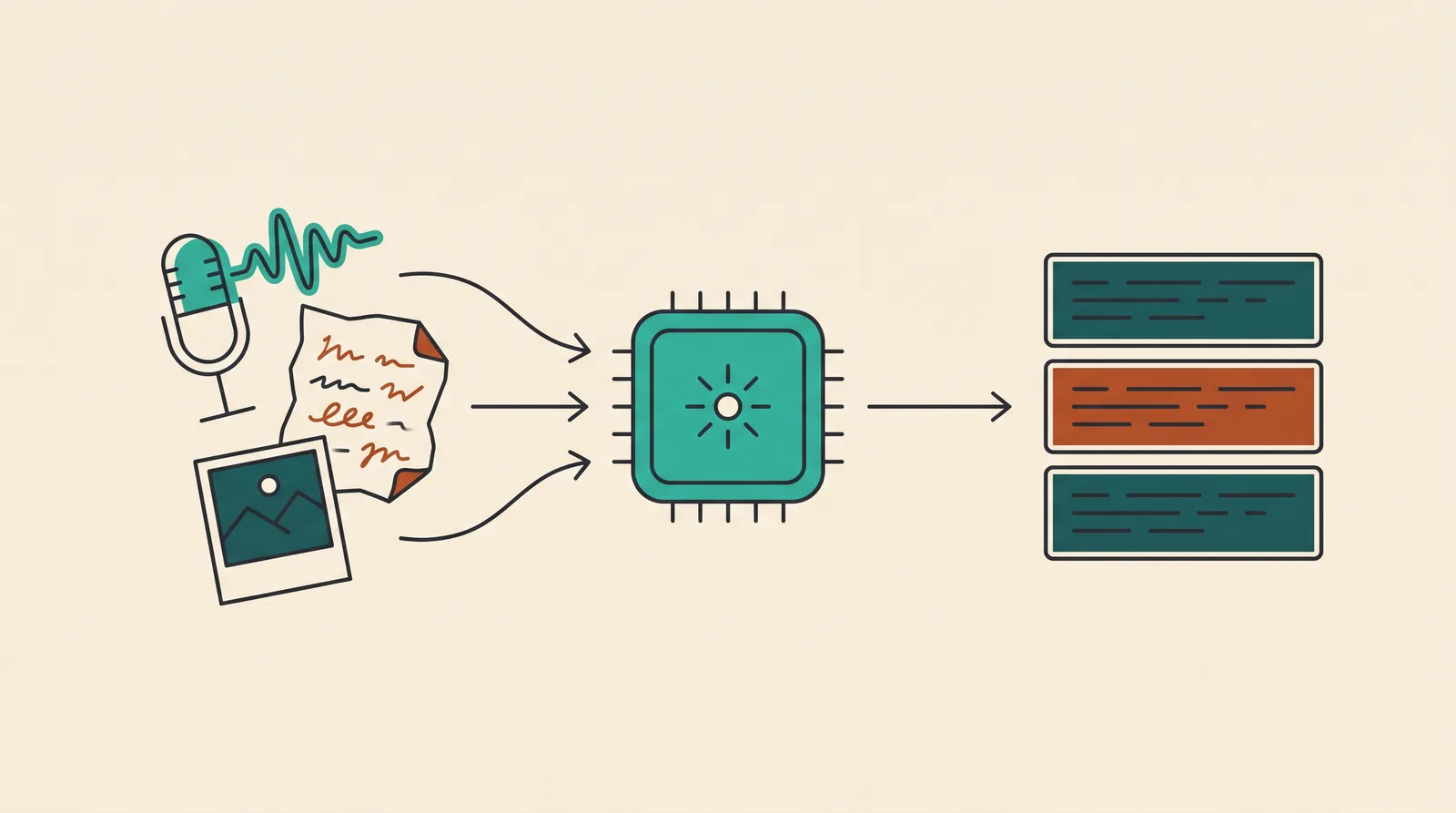
It means software can now accept messy human input, like a voice note, a photo or a rambling email, and turn it into consistent structured data. Before large language models, a program needed a checkbox, a dropdown or a correctly typed field. Now a model sits between the person and the code and does the translation.
Traditional software is fussy. It wants a true or false, a date in the right format, a number where a number goes. Hand it anything else and it falls over, or it makes a human retype the thing into a form.
For most of my career, that was the ceiling. I spent 16 years at Connect NZ, where we grew a device repair operation from around 200 jobs a year to over 27,000. I built a lot of the tooling that made that possible. Every piece of it had the same limit: someone had to turn what a customer said into data the software could use.
In 2022 that limit went away. I realised I could take a voice recording, transcribe it, and get a structured data object back. Long text worked too. I could pull out the logical meaning automatically and feed it straight into the next step of the process. Then photos. Sight became programmable as well.
The effect was that a process could get further along on its own than it ever had before. The data-entry barrier that had sat at the front of every workflow I'd built was gone. I told the interviewer my programming future had become infinitely unstuck. It sounds dramatic. I'd still stand by it. I've written the longer version of this argument in AI made language programmable.
What does programmable language look like at home?
At our place it looks like a photo of a birthday invitation. One photo creates the calendar entry, buys and ships a gift within a set budget, and prints a themed card for the kids to colour in. The party admin disappears, and my wife and I get that time and headspace back for the weekend.
Our kids have a social calendar that would exhaust a touring band. There are stretches of the year where every weekend has a friend's birthday party in it. Each one comes with its own small pile of admin.
So I built a tool. When one of the kids brings an invitation home, we take a photo of it. From there:
- It reads the invite and adds the party to our family calendar, address and details included.
- It infers anything else it can from the invite, such as the theme.
- It searches for a gift within a $30 budget, buys it, and has it shipped to our house.
- It designs a birthday card to match the party's theme and prints it for our kid to colour in.
Then we go to the party.
The part I didn't plan for was the kids' reaction. The tool is called Sam, and they have decided Sam is excellent at presents. When a parcel turns up, they wait to find out what Sam has bought their friend this time. Sam has a better reputation in our house than I do, and Sam has never once remembered to bring the sunscreen.
This is the whole thesis in miniature. An invitation is messy, unstructured human input, and every parent writes theirs differently. A model turns it into structured data. After that, it's ordinary software doing ordinary things: a calendar, a shop, a printer. The same pattern sits under most of the AI agents we build for clients, with a job sheet or a phone call in place of a party invite.
What happens when the models aren't ready yet?
You spend more time fixing the model's mistakes than the automation saves. I learned this building an insurance claim assessment tool before the models and the surrounding tooling were ready. Accuracy was the entire point of the project, and the errors took so long to trace that it stalled before it shipped.
Not every story in the interview was a good one. Earlier on, I was building an application to assess business insurance claims for technology devices. The idea was sound. It had the potential to make those assessments much faster and more accurate.
The models, and the harness around them, weren't there yet. The tool made mistakes, and in claims assessment a mistake is expensive to find. Undoing one meant working backwards through what the model had decided and why. That took a frustratingly long time.
I never finished it. I left that role, pitched the idea afterwards, and moved on to other work. I still think about it.
What I took from it is that an idea can be right and the timing wrong. The models have improved a great deal since, and so has the tooling that keeps an agent honest: evaluation, logging, and human review at the points where a wrong answer costs money. If I picked that project up today, I'd build the checking first and the clever part second.
Where do I draw the line with AI?
Two places. I keep personal information and sensitive business data out of models unless there's a clear reason and a clear boundary. And I'm wary of AI replacing thinking. Compliance and rule-following are strong candidates for automation, but writing the rules and judging the outcome should stay with people.
The first line comes from the day job. I build software for other businesses, so protecting my clients' data, and my own, is part of the work. PII (personally identifiable information) handed to a model can surface somewhere nobody planned for. I'd rather design that risk out at the start.
The second is harder to engineer around. Checking work against a set of rules is repetitive and precise, which makes compliance a strong fit for automation. Deciding what the rules should be is a different job. So is judging whether they've been followed in a situation nobody anticipated. I want people doing both.
Under that sits my bigger worry. AI has an answer for everything, and it's quick about it. If people stop exercising their own thinking, they lose the habit of questioning what they're handed. That opens a trust problem around bias, influence and culture that clever software won't fix. Brains need the workout.
The rule I work to
Automate the checking, and keep people on the deciding.
I also told Anthropic two things I'd like from them. An easier way to audit the growing stack of instruction files I keep for my AI coding tools. And a clear commitment that company and personal data won't be used for anything harmful, or anything that could turn harmful later.
What should a New Zealand business owner take from this?
Look for the places where messy human input enters your business: phone calls, photos, emails, handwritten forms. Each one is a point where a person translates language into data. Those are your first automation candidates. Keep sensitive data tightly scoped, and keep a person on any decision where a wrong answer is expensive.
Start with a list. Walk through a normal week and note every point where someone reads, listens to or looks at something, then types it into a system. Quote requests, job notes, supplier invoices and voicemails are common examples.
Rank them by volume and by what it costs when they're wrong. High volume with a low cost of error is the place to begin. A high cost of error is where you build in review and move slowly. The insurance project taught me that one the hard way.
Then look at what data each one touches. If customer details are involved, decide up front where that data goes and where it doesn't.
If you'd like a second pair of eyes on that list, get in touch. You can also see how the pattern plays out in real builds in our case studies, or read more on AI automation for NZ businesses.
Frequently asked questions
- What does it mean that AI made language programmable?
Software used to need neatly formatted input, like a checkbox or a date field. Large language models can take unstructured input, such as a voice note, an email or a photo, and return consistent structured data. That lets software act on the way people communicate, without someone retyping everything into a form first.
- Can AI turn photos and voice notes into structured data?
Yes. Current models can read text in a photo, interpret a transcribed voice recording, and return the details as structured fields such as dates, addresses and amounts. The output still needs validation where accuracy is important, but the translation step that used to require a person can now be automated.
- Is it safe to give AI tools customer information?
Not by default. Treat personal information as something to minimise. Send a model only the data it needs for the task, check where your provider stores and uses that data, and design the system so sensitive details stay out of places they don't belong. Decide these boundaries before you build.
- Does AI automation mean staff no longer need to think?
No, and that's a common misconception. AI is good at repetitive checking and translation work. Setting the rules, handling situations nobody anticipated, and questioning an answer that looks wrong are still human jobs. The best builds free people from data entry so they have more time for judgement.
- Where should a small New Zealand business start with AI automation?
Find the highest-volume point where someone turns messy input into data entry, such as quote requests, job notes or voicemails. If mistakes there are cheap to fix, it's a good first project. Keep a person reviewing anything where an error would be expensive.