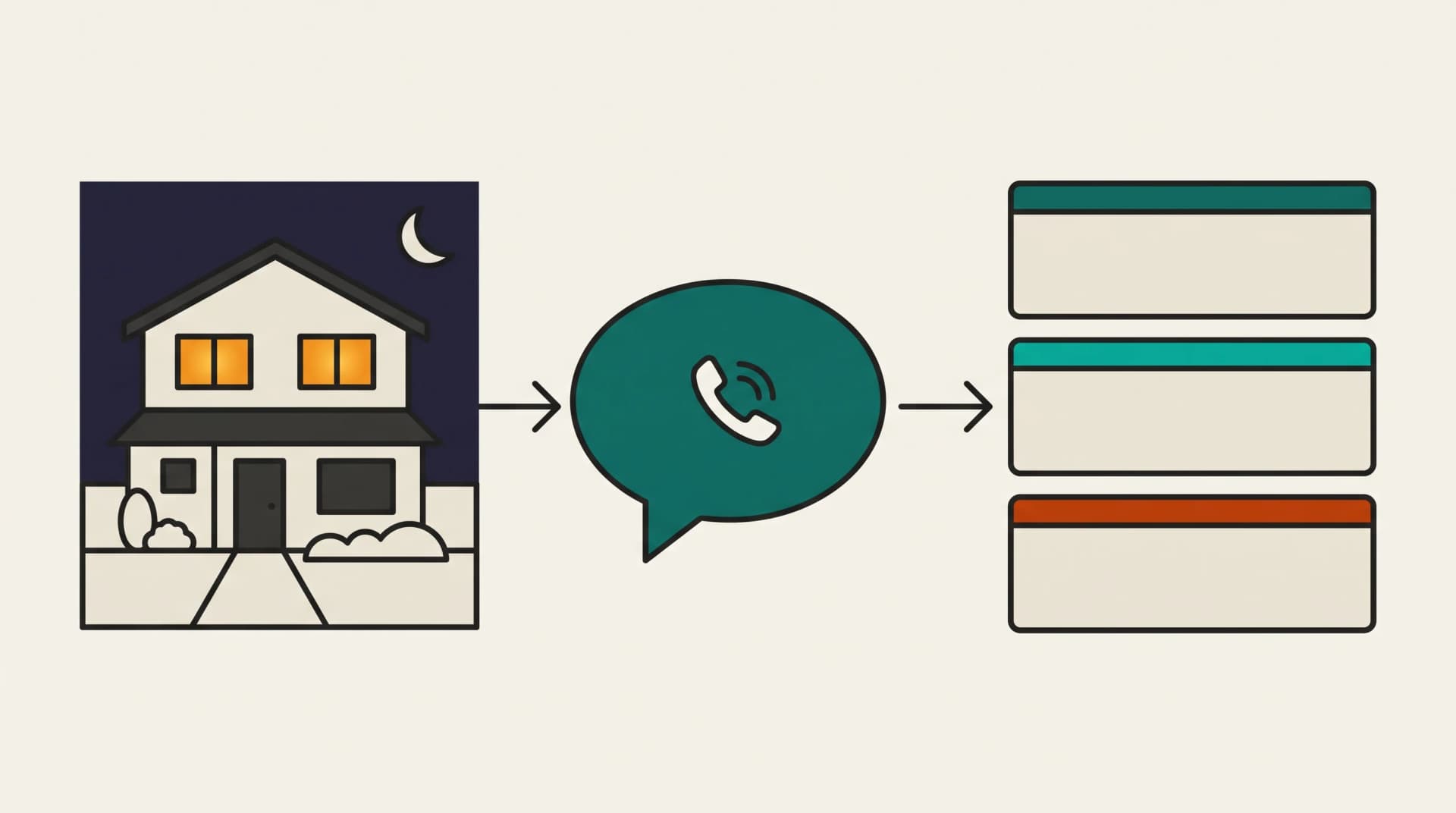
The phone goes at 11:40 on a Sunday night. A tenant in a two-bedroom unit has water coming through the hallway ceiling and can hear it running inside the wall. Whoever is on the roster answers from bed, in the dark, and has about ninety seconds to work out four things. Is this one of ours. Is anyone in danger. Does it need a plumber tonight. And who is going to pick up if we ring them now.
That is the whole job, repeated five to ten times a week for a mid-sized portfolio. It is not complicated work. It is work that has to be done correctly by a tired person at an hour when nobody is at their sharpest, and it has to be written down afterwards so Monday morning makes sense.
We build voice AI agents that carry this. Not an answerphone with a better greeting, but an agent that answers every call, works out which tier the problem sits in, gives the tenant something useful to do in the meantime, rings contractors until one confirms, and writes the whole thing into the job record before anyone wakes up.
This is the playbook. What actually happens on these calls, how to write triage rules that hold at 3am, how the contractor cascade works, what the Privacy Act asks of you, and what you need in place before any of it is worth building.
What actually happens on an after-hours tenant call?
Strip the call back and there are four gates, in a fixed order. Every one of them has to close before the next one opens.
The first is identity. Which property, and is it on our rent roll. This sounds trivial and it is where a surprising amount of night-time effort goes, because tenants give the street name and not the number, or they give the suburb they think they live in, or they are ringing about their mother's flat which is managed by someone else entirely.
The second is safety. Water near a switchboard, a gas smell, a door that will not lock, a person who cannot get out. These change the answer regardless of what the maintenance issue turns out to be.
Third is classification. Genuine emergency, urgent-but-morning, or routine. Get this wrong in one direction and you pay a plumber call-out rate for a dripping tap. Get it wrong in the other and a slow leak becomes a ceiling on the floor and an insurance claim.
Fourth is the handover. Somebody has to be told, something has to be recorded, and the tenant has to be left knowing what happens next and roughly when.
Four gates, ninety seconds, at midnight. It is a structured decision wearing the costume of a phone call, which is exactly the kind of thing an agent does well.
Why does the same problem get triaged differently by different staff?
Because triage quality tracks alertness, and alertness at 2am is a lottery. The same burst hose gets a plumber dispatched on Tuesday and a "we'll sort it in the morning" on Thursday, depending on who answered and how deeply asleep they were.
There is a second reason, quieter than the first. Experienced staff carry the thresholds in their heads and never write them down. When they take leave, or move on, the thresholds go too, and the person covering the roster is rebuilding judgement from scratch on live calls.
Writing the rules down is worth doing whether or not you ever automate them. It is also the thing that makes automation possible, because an agent can only apply a policy that exists.
How do you write triage rules that hold up at 3am?
Three tiers is enough. More than that and the boundaries blur under pressure, which defeats the point.
Tier one, contractor tonight. Active uncontained water. No power to the whole property. No heating in winter where an occupant is elderly, very young or unwell. Sewage inside. Gas smell. Property not securable. Anything where waiting until morning makes the damage materially worse or leaves someone unsafe.
Tier two, first thing tomorrow. Hot water gone. A single circuit out. A leak that is caught in a bucket and staying caught. An oven that has died. Real problems, not overnight ones.
Tier three, normal maintenance queue. Everything else. The dripping tap, the sticky window, the fence palings.
The useful discipline is writing each boundary as a question the agent can put to the tenant and get a clean answer to. "Is the water still coming, or has it stopped?" beats "how bad is it?" every time. Tenants are not assessors and should not be asked to be. Ask them what they can see.
What questions should the agent ask before it classifies anything?
A short fixed set, then branches. Address and unit number. Is anyone hurt or unable to leave. Is water or power involved. Can you see it now, and is it getting worse while we talk. Is the property secure.
Everything after that depends on the branch. A water branch asks whether the mains toby has been turned off and talks the tenant through finding it. An electrical branch asks whether it is one room or the whole property, and whether the switchboard is wet. A security branch asks whether the tenant is currently inside and whether they feel safe there.
The thing to resist is a long intake script. Every extra question is another twenty seconds of a distressed person answering a machine, and the marginal question rarely changes the tier.
Should the agent give the tenant safety advice?
Yes, within a tightly bounded set, and the boundary matters more than the content.
Locating and turning off the mains water toby is fine. Not touching a wet switchboard, and leaving the property if there is a gas smell, are fine. Anything involving climbing, tools, or the electrical system itself is not. In the genuinely dangerous categories the correct output is short: leave, ring 111 or the gas emergency line, we will handle the rest.
Write this list explicitly and keep it small. An agent that improvises safety advice is a liability, and the fix is a closed set of approved responses rather than a cleverer prompt.
How does contractor dispatch work when nobody answers?
This is the part most after-hours systems skip, and it is where the actual time goes. Classifying the call takes ninety seconds. Finding a plumber at midnight takes twenty minutes.
The pattern that works is a ranked cascade per trade. Plumbing has a first call, a second, a third. Electrical has its own list. So do locksmiths, glaziers and restoration. Each contractor has after-hours availability recorded against them, because the plumber who takes 2am work in July is not always the one who takes it in December.
The agent rings the first name on the list, states who it is calling for, describes the job and the address, and asks for a yes or no on attendance tonight. No answer inside a set number of rings, or a no, and it moves down the list. It keeps going until it has a confirmed attendance or the list is exhausted, and only then does it wake a human, with a full account of everything it tried.
Two details decide whether contractors like this or resent it. The first is that the call has to carry everything they need in the opening fifteen seconds: who, where, what, and whether there is access. The second is that it must be obvious it is an automated call from a firm they work with, said plainly at the start. Contractors we have worked with came round to structured dispatch calls quickly, mostly because a machine reading from a job record gets the address right and a woken property manager sometimes does not.
What happens when the cascade runs out?
It escalates, and how it escalates is worth designing on purpose rather than leaving to a default.
The escalation should reach a named human, on a channel they will actually notice at that hour, with a summary rather than a raw transcript. Tenant, address, tier, what was tried, who declined, what the tenant has been told, and what the agent recommends. The person waking up needs to be able to act inside thirty seconds of opening their phone.
The escalation path is the most important part of the whole build and the part most often left as an afterthought. Everything else is the happy path. This is the moment the system admits it cannot finish the job, and how it behaves there is what your team will judge it on.
What does the Privacy Act 2020 require for recorded tenant calls?
Recording is not compulsory. Most firms want it anyway, because after-hours calls generate the "what did we agree" conversations that arrive three weeks later.
If you record, four things need to be true. Callers are told at the start of the call, in plain words. You collect only what the job needs, which means resisting the temptation to hoover up everything for future analysis. Access is limited to the people who need it. And there is a retention schedule that actually deletes things, ninety days being a common choice for audio with the structured summary kept longer.
The point that catches people is that tenant call recordings often contain health information. "My daughter is asthmatic and the room is damp" is a health disclosure, and it raises the care standard for how that recording is stored and who can reach it. Worth a conversation with whoever handles your privacy obligations before you switch recording on portfolio-wide.
There is also the Residential Tenancies Act side of this. The Act allows a tenant to arrange urgent repairs themselves and reclaim reasonable costs when the landlord cannot be contacted after reasonable attempts. An agent that answers every call is a direct answer to that risk. Check the current thresholds and process on tenancy.govt.nz rather than working from memory, because the detail moves.
What do you need in place before building any of this?
Four things, and none of them are AI.
A property list an agent can query, with unit numbers, in one place. A contractor list with trades, after-hours availability and a ranking. Your three tiers written down as boundaries, not vibes. And a decision about where the human boundary sits, which for most firms means the agent owns information transfer and a person owns anything involving negotiation or judgement.
Those four are worth doing on their own merits. A portfolio where the after-hours policy lives only in one person's head is fragile for reasons that have nothing to do with software.
Once they exist, the build is not large. We covered a working version of exactly this in our Brenda Currie Property Management case study, where a 180-property Palmerston North portfolio moved from a rotating on-call roster to an agent handling every call, and emergency response went from a variable fifteen to twenty-five minutes down to under five.
How long does a build like this take?
Weeks rather than months, for a single portfolio with the four items above in place. The long pole is almost never the voice agent. It is the property and contractor data, and the number of rounds it takes to get the triage boundaries agreed between the people who have been making those calls by instinct for years.
That argument is worth having properly. It is the difference between an agent that reflects how your firm actually decides things and one that reflects how somebody guessed you decide things.
Where this sits in a property management operation
The on-call roster does not disappear. Its job changes. Staff stop being first responders and become the escalation point, which means they are woken for the calls that genuinely need a person and left alone for the ones that do not.
The second-order effect is the one firms tend to notice later. Every after-hours interaction becomes structured data. Which properties generate emergency calls, which contractors actually turn up, what the hot water cylinders are doing in their eighth winter. That record is worth something on its own, and it did not exist when the notes were on a pad by the bed.
We work with firms across the insurance and property sector on exactly this pattern, and it is the same one behind CallCover for smaller operations that want the answering and triage without a bespoke build. If you want to talk through where the boundary should sit for your portfolio, get in touch.
Frequently asked questions
- Can voice AI legally answer tenant calls in New Zealand?
Yes. There is no rule against an automated system answering, and the Residential Tenancies Act is concerned with whether a tenant can reach the landlord or their agent, which an always-answering system helps with. If you record calls, the Privacy Act 2020 expects you to tell callers at the start, collect only what the job needs, restrict access and delete on a set schedule.
- What counts as an urgent after-hours repair for a rental property?
In practice: uncontained water, loss of power to the whole property, no heating in winter for a vulnerable occupant, sewage inside, a gas smell, or a property that cannot be secured. The common test is whether waiting until morning makes the damage materially worse or leaves someone unsafe. Write your own boundaries down and apply them consistently.
- Will an AI agent decide whether to spend money on a call-out?
It applies the tier rules you set and dispatches within them. Anything outside those rules, or any situation where the cost or the judgement is unusual, escalates to a named person with a summary of what has happened so far. The spending policy stays yours.
- How do contractors react to being dispatched by an AI agent?
Better than most people expect, provided the call says plainly at the start who it is calling for and that it is automated, and provided the first fifteen seconds carry the address, the job and the access details. A structured dispatch call from a job record gets the address right every time.
- What size portfolio makes an after-hours voice agent worth it?
It tracks call volume rather than door count. Once a portfolio is generating roughly five or more after-hours calls a week, the roster cost and the triage inconsistency are usually enough to justify a build. Below that, a SaaS answering and triage product is generally the better fit.