Every workshop has the list. Somewhere in SAM, MechanicDesk or a shoebox of job cards, there are hundreds of vehicles whose WOF came due and never came back. The reminder text went out. Nobody replied. The hoist sat quiet on a Tuesday while a customer of eight years got their warrant at a testing station because it was next to the supermarket.
AI WOF reminders change the shape of that problem. A reminder text is a message into the void. A phone call is a conversation that ends with a booking, and until recently, nobody had the front-desk hours to ring three hundred lapsed customers. Now an AI voice agent can work through the whole list, book the ones who answer straight into the diary, and tell you which ones are genuinely gone.
This post covers where the reminder leak comes from, how an AI agent runs the WOF and service cycle end to end, what the calls sound like to your customers, and how to work out whether the numbers stack up for your workshop.
Why do WOF reminders leak bookings for NZ workshops?
Because a WOF is a deadline the customer forgets and the workshop only whispers about. Most workshops send one text, maybe two, then move on. Anyone who misses those messages drifts to whichever option is most convenient the day they notice their warrant has expired, and convenience rarely picks the workshop across town.
The cycle is generous to whoever shows up in it. A car first registered after 2000 needs a WOF every year once it turns three; older vehicles are on six-month cycles. Add servicing on kilometres or six-month intervals and every customer on your books has two to four natural contact points a year. Each one is a booking sitting there waiting to be claimed.
The leak is invisible for the same reason missed calls are. We wrote about this for trades in what missed calls cost NZ trades businesses, and the pattern holds in automotive: no line in Xero records the WOF that went to the testing station down the road.
What does one lapsed customer cost a workshop?
Far more than a warrant fee. The WOF itself might be sixty or seventy dollars, but the value sits in what the inspection finds and what follows it: the tyres, the brake pads, the cam belt at 100,000 km, the annual service that rides alongside. A retained customer is a stream of work, and the WOF is the appointment that keeps the stream flowing.
Run a conservative example. Say the average WOF visit, across the ones that need nothing and the ones that need brakes, carries $250 of attached work, and a retained customer also books one $400 service a year. A workshop with 300 lapsed vehicles on its books is looking at roughly $195,000 of annual work that used to walk through the door on its own.
Those numbers are assumptions, and yours will differ. The point survives any reasonable inputs: the list of lapsed WOF customers is the most valuable document in the building, and most workshops never look at it.
How does an AI agent run the WOF reminder cycle?
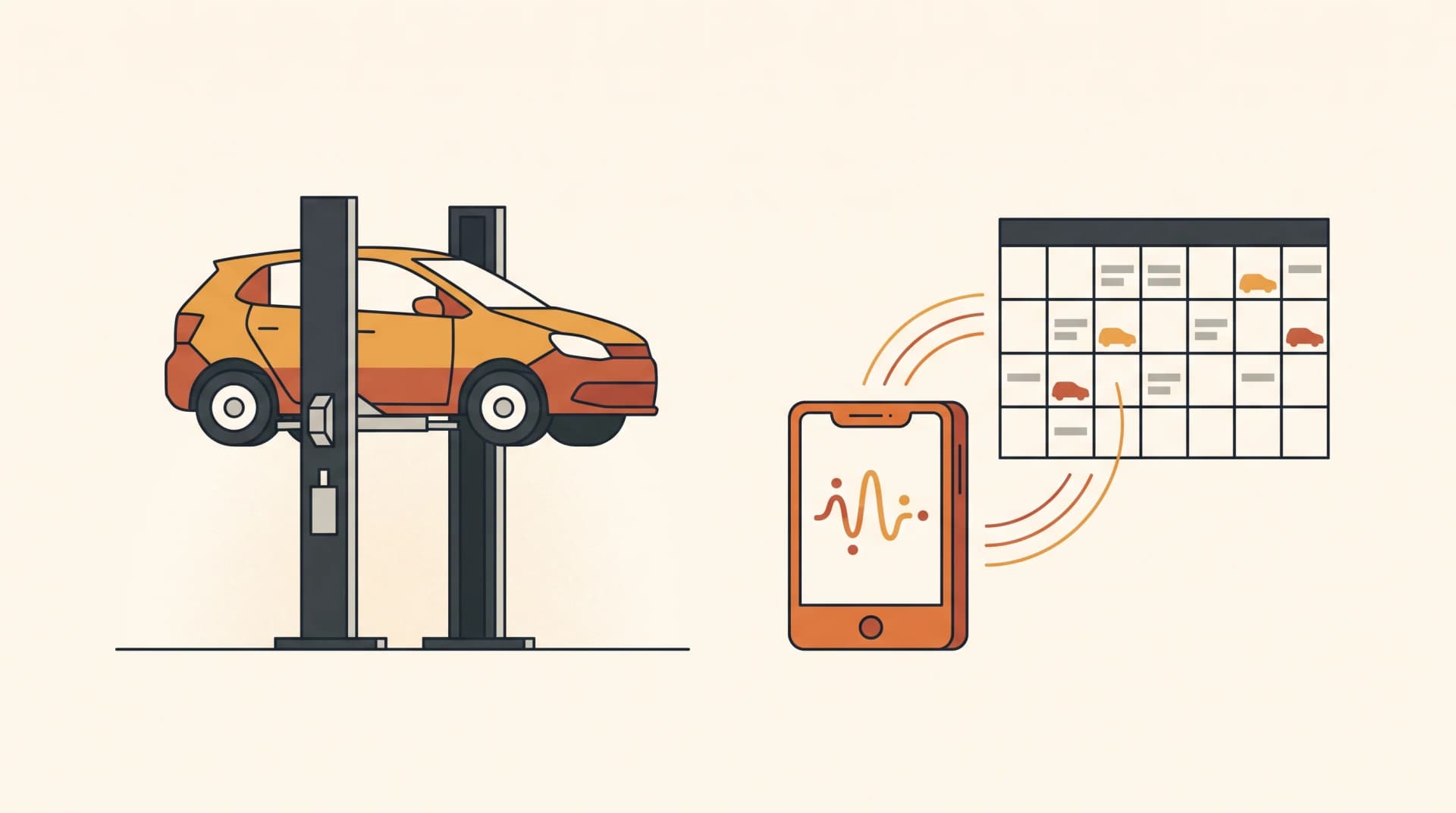
It reads due dates from your workshop management system, rings each customer at a sensible time a few weeks before the WOF or service is due, and books the job into your diary during the call. The whole loop runs without the front desk touching it.
The agent runs a simple ladder. A call first, because calls convert and texts get buried. No answer means a text with a booking link and a retry a few days later at a different time of day. Still nothing after a respectful number of attempts, and the vehicle gets flagged for a six-month win-back round.
It also knows who it's talking to. The agent sees the vehicle, the plate, the last visit and the notes, so the call opens with "the Hilux is due" and can answer the obvious questions: how long a WOF takes, whether a loan car is free that day, what a service roughly runs for that vehicle.
What happens when the customer answers?
The call ends in a diary slot. The agent offers two or three specific times against your real capacity, books the one that fits, confirms drop-off or wait, and sends a confirmation text with the date. The job lands in SAM or MechanicDesk the same way a front-desk booking would, with the call summary attached.
How is this different from the reminder texts you already send?
| Reminder text | AI reminder call | |
|---|---|---|
| What arrives | A message to act on later | A conversation happening now |
| Booking step | Customer must ring or click | Booked during the call |
| No response | Silence, forever | Retried, then flagged for win-back |
| Lapsed customers | Never revisited | Worked as a separate list |
| What you learn | Delivery receipt | Booked, declined, moved away, or gone |
The last row is the quiet win. Every call ends with information: booked, will call back, sold the car, moved to Palmerston North, uses their brother-in-law now. Your database gets cleaner with every round, and the win-back list becomes a list you can ring.
What does the call sound like to the customer?
Short, familiar and specific. The agent opens by saying it's the booking assistant for your workshop, names the vehicle and why it's calling, and offers times. Thirty to forty seconds for a straightforward booking. It never pretends to be a person, and anyone who wants the owner gets put through or called back.
Will customers hang up on an AI?
Some will. The agent logs it and follows up with a text. Our experience with CallCover, our AI phone answering product for trades, is that most callers stop noticing within the first half minute provided the agent listens, knows the details and follows through. A reminder call carries an extra advantage: it arrives with a reason the customer recognises as legitimate. Their car is due. Someone noticed.
The standard the agent has to meet is the standard your front desk sets on a good day: right vehicle, right history, real diary slots, no hard sell. Anything it cannot handle goes to a human with a note, and the customer hears "I'll have Dave call you back".
What should a workshop owner do with this information?
Pull three numbers before spending anything: how many vehicles on your books are overdue, what your average invoice runs when a WOF visit finds work, and how many bookings a week your quiet season is short. Those three numbers tell you whether reminders are a real leak or a rounding error, and they take an afternoon to find.
If the lapsed list runs past a couple of hundred vehicles, the maths gets compelling quickly. A build like this typically comes in between $6,000 and $12,000 NZD with monthly running costs of $150 to $300, which is the attached work from a handful of recovered customers. That's the engagement model we run at EmbedAI: a short discovery against your lapsed list, a narrow first build, and wider automation only once the first piece has earned its keep. The same recall pattern is already working in other appointment businesses, including dental clinics chasing overdue hygiene visits.
Four numbers to pull before you spend a dollar
1. How many vehicles on file have no visit in 12+ months?
Your workshop software can report this in minutes. Past 200, keep reading.
2. What does a WOF visit earn when it finds work?
Average invoice across your last fifty WOF jobs, attached work included.
3. How many empty bays a week does your quiet season carry?
Count the winter Tuesdays. That's the capacity reminders can fill.
4. What did your last reminder round achieve?
If you can't answer, that's the answer. Texts you never measure are texts you can't defend.
Frequently asked questions
- Do AI reminder calls work better than WOF reminder texts?
- Calls convert meaningfully better because the booking happens inside the conversation instead of relying on the customer to act later. The practical pattern is both: a call first, a text with a booking link for non-answers, and a win-back round for the long-lapsed. Every contact ends with a status.
- Can an AI reminder agent book directly into SAM or MechanicDesk?
- Yes, where the workshop management system exposes an API or calendar integration, the agent reads due dates and writes bookings directly, with the call summary attached to the job. Where integration is not available on day one, the agent works from an exported due list and a shared diary, and the software connection comes later.
- Is it legal to make automated reminder calls in New Zealand?
- Calling your own customers about their vehicle's due date is a normal business communication, and the agent discloses that it is an AI assistant at the start of each call. The Privacy Act 2020 governs how contact details and recordings are handled, so a proper build limits collection, discloses recording, and honours any request to stop contact.
- What does an AI reminder system cost for a small workshop?
- A typical build for an independent workshop comes in between $6,000 and $12,000 NZD, with running costs of $150 to $300 a month for telephony and hosting. Against a lapsed list of a few hundred vehicles, recovering even ten percent of them generally covers the build within the first few months.