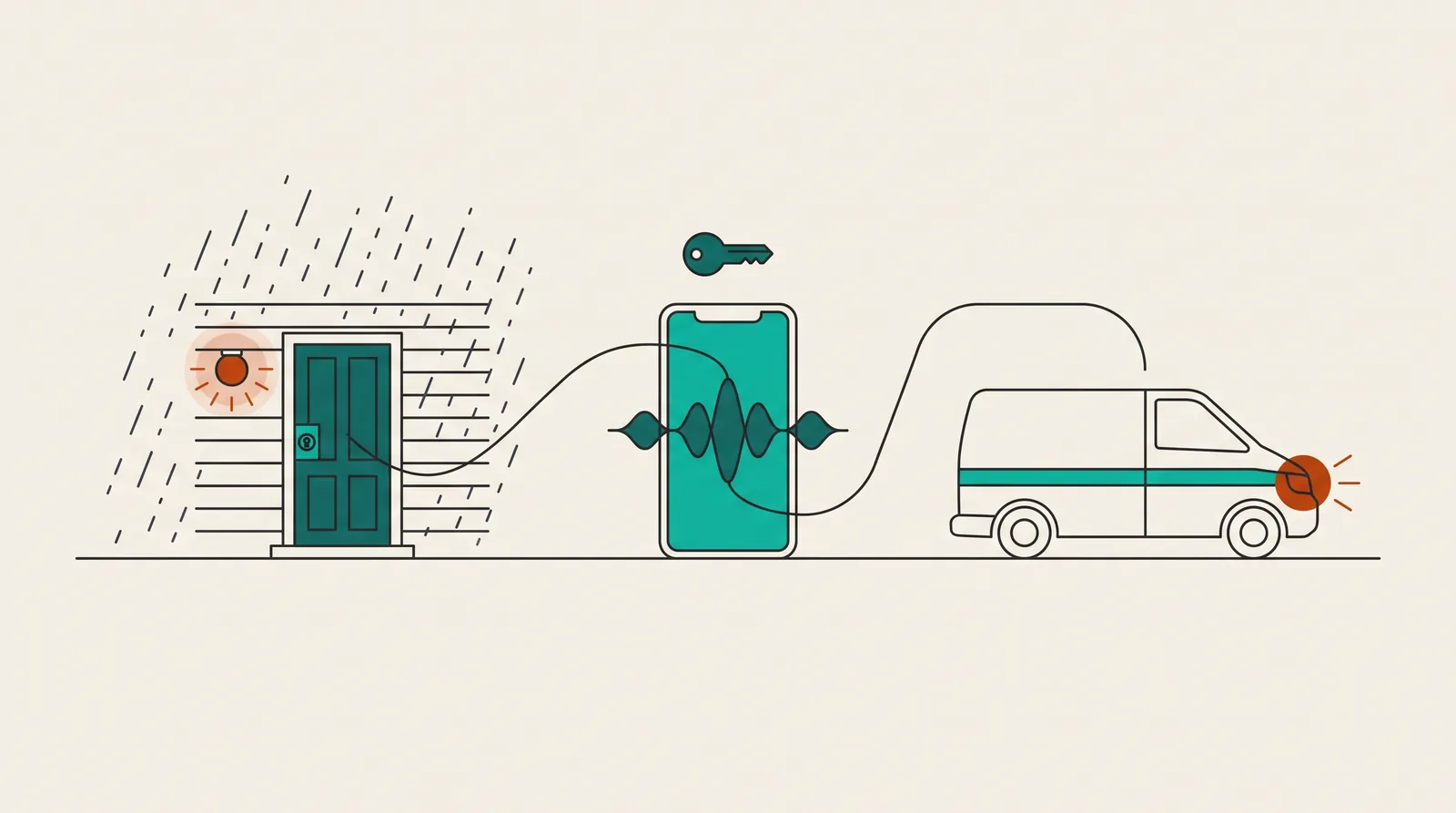
It is 11:40 on a wet Sunday night in Porirua. A nurse coming off a late shift is standing on her own doorstep with a bag of groceries and no keys. They are on the kitchen bench, visible through the glass panel beside the door. She searches for a locksmith, taps the top result and listens to it ring.
The locksmith on call is in Tawa, kneeling at a back door with a cylinder half out and a torch in his teeth. His phone buzzes in his pocket. By the time his hands are free, she has rung someone else.
After-hours lockout work goes to whoever picks up. Locksmiths know this better than anyone, which is why so many carry the on-call phone themselves and answer it from under a porch light or out of a warm bed. The skill in that call is real: calming a stressed caller, working out whether it is a snapped key or a jammed deadlock, and deciding whether this person has any business asking you to open that door.
We build AI agents that carry the first part of that load. The agent answers every call, asks the questions a good locksmith asks, collects the evidence that the caller belongs at the address, and hands the technician a job card with everything settled except the decisions that need a human on the doorstep. Below we walk through what the call has to achieve, where the agent stops and the locksmith starts, how to handle ownership checks, and what you need in place before any of it earns its keep.
Why do after-hours lockout calls go to the next number?
Because the caller is standing outside in the dark and ringing is the one thing they can do while they wait. A lockout caller who reaches voicemail rarely leaves a message. They go back to the search results and try the next listing, and the job belongs to whoever answers first.
That is a hard pattern for a one- or two-van business to beat on effort. The person carrying the on-call phone is usually the person doing the work, and a locksmith with both hands in a door cannot also be the receptionist. The calls that go unanswered tend to arrive when the business is busiest. We covered the wider version of this in what missed calls cost NZ trades, and lockouts are the sharpest case of it.
What is an after-hours lockout worth?
Published NZ pricing puts an after-hours residential lockout somewhere around $150 to $400 all up, depending on region, time of night and what it takes to get in. Business-hours call-out fees commonly sit around $110 to $150 plus GST. Treat those figures as indicative and check them against your own rate card.
The single job is only part of it. A lockout handled well often turns into a lock change the following week, a set of keyed-alike cylinders, or a property manager who puts your number on the list for their whole portfolio. The first call opens the door to all of that.
What does a lockout caller need in the first minute?
Four things: an answer, confirmation that someone is coming, a rough arrival time and a clear call-out fee. Everything else can wait for the technician. The first minute is about keeping the caller on the line.
Speed matters more than polish here. A calm voice asking sensible questions in a sensible order does most of the work. The caller can hear that there is a process, and people who can hear a process tend to stay put.
What does an AI dispatch agent do on a lockout call?
It answers on the first ring, works out what kind of job it is, takes the address and access details, gathers the evidence the locksmith will need at the door, states the call-out fee, and sends the job to the on-call technician. The technician gets a notification with the whole job laid out and one decision to make: accept it or pass it on.
Voice agents suit this call because the conversation has a stable shape. The address, the door, the lock, what happened, the name, the number. Language models are good at pulling that structure out of a stressed, rambling caller, and the result arrives in your job system as fields you can use, with no voicemail to transcribe at midnight.
Which questions sort a lockout from a lock change?
A short set, asked in a fixed order. Are you locked out right now? Is anyone or anything inside that needs urgent help? What kind of property is it, which door, what happened to the key, and what does the lock look like? The answers separate the 11pm emergency from the "can someone rekey my rental on Thursday" call, which the agent books into normal hours.
Lock descriptions from the public are unreliable, and that is fine. The agent asks the caller to text a photo of the lock and the door edge, then attaches it to the job so the technician can see the hardware before leaving. We would not have the agent identify the lock or predict the entry method from a photo taken by phone torch. It is the same split we use in fault triage for electricians: the agent collects, the tradesperson judges.
When does the agent hand straight to a person?
Whenever the call is about safety. A child or vulnerable person locked inside, a baby in a locked car on a warm day, a caller who sounds unwell, or someone describing a break-in in progress. The agent tells the caller to ring 111 for anything life-threatening, then puts the call straight through to the on-call locksmith or a backup number.
Write those triggers down before the build and keep the list short. The agent should also hand over when it cannot get a usable address after a couple of attempts, when the caller asks for a person, or when the caller is plainly distressed. How that handover feels to the caller matters a great deal, and we have written about it at length in the escalation experience.
How do you confirm the caller owns the property?
Gather evidence on the call and leave the decision with the locksmith at the door. The agent can take a name, check it against the address, request a photo of ID and ask who else can vouch for the caller. It cannot look the person in the eye, compare the face to the photo, or notice that the story does not fit the house.
This is where locksmithing differs from almost every other trade. A plumber who turns up at the wrong house fixes a stranger's tap. A locksmith who opens the wrong door has let someone into a home that is not theirs. Reputable NZ locksmiths ask for proof of ownership or tenancy before they open anything, and a good dispatch agent makes that step faster by starting it before the van leaves.
What evidence can the agent collect before the van leaves?
Enough to make the doorstep check quick. For a house, the caller's full name, whether they own or rent, the landlord or property manager for a rental, and a photo of their ID sent by text. For a car, the registration and a description. For a business, the caller's role and a second contact who can confirm it.
The agent also tells the caller what the technician will want to see on arrival: ID showing the address, a document with their name at the property, or a neighbour or landlord who can confirm who they are. Genuine callers who hear that in advance tend to have it ready. A caller who turns evasive at that point is worth a note on the job card.
Why does the final decision stay with the locksmith?
Because evidence is only as good as the judgement applied to it, and that judgement needs someone standing at the door. A licence photo can be borrowed. A tenancy can have ended last month. The technician sees the person, the property and the story together, and can walk away if something is off.
We build the agent so it never tells a caller they have been "verified" or "approved". It tells them what the locksmith will check on arrival. That keeps the promise honest and leaves the responsibility with the person who carries it.
How should the agent handle price and arrival time?
State the call-out fee clearly, explain that labour and any parts are quoted on site, and give an arrival window once the technician accepts. That covers what a caller needs to decide, and it matches how most NZ locksmiths already price on the phone.
Price is where after-hours work can sour, and consistency helps. The agent quotes the same call-out fee from your rate card every time, at the correct after-hours or public-holiday tier, and records that the caller heard it. The next morning's "nobody told me it was that much" conversation gets much shorter.
Should the agent promise how the door will be opened?
No. It can say the technician will look for the least damaging way in and will talk through options before doing anything that costs extra. Whether a lock can be picked, bypassed or has to be drilled is decided on the doorstep with the hardware in hand, and any promise made on the phone is one the technician then has to keep.
How does the customer know when the van is coming?
Once the job is accepted, the agent texts a confirmation with the technician's first name, the call-out fee and the arrival window. If the technician is running late, a tap in the app or a quick voice note is enough for the agent to pass an updated time to the customer. Some field service apps offer live map tracking. For most small operators, a well-timed text does the job.
What do you need in place before this works?
Three things: a written rate card, a clear on-call roster, and agreed rules for identity checks and safety escalations. Get those onto paper and the build is a few weeks. Skip them and the agent will be quoting prices and making promises nobody has agreed to.
The rate card needs business-hours and after-hours call-out fees, what the fee includes, and your public-holiday rate. The roster needs a primary and a backup number for every hour of the week, because an agent that cannot reach anyone has nowhere to send the job. The identity and escalation rules are the ones described above, written in your own words.
Which systems does the agent connect to?
Whatever you already run jobs through. ServiceM8, Fergus and simPRO all offer ways to create jobs from outside the app, and a plain text message to the on-call phone works as a starting point if you would rather not change anything yet. The job fields are thin: name, number, address, job type, door and lock notes, photos, verification notes and the quoted call-out fee.
How does this sit with the Privacy Act 2020?
Carefully, because the agent may hold a photo ID alongside a home address and the knowledge that the house is empty right now. The Privacy Act 2020 expects you to tell people what you are collecting and why (principle 3), keep it secure, and keep it no longer than you need it (principle 9).
In practice that means a short disclosure at the start of the call, ID photos deleted once the job is closed, and call audio removed on a set schedule while the structured job record stays. An ID photo sitting in a shared inbox for two years is a risk to the customer and a liability for the business. Set the deletion rule before the first call goes live.
Where do licensing and industry bodies fit?
Installing or repairing security devices such as alarms, safes and special locks is security technician work under the Private Security Personnel and Private Investigators Act 2010, and needs a licence or certificate of approval from the Private Security Personnel Licensing Authority. Where your own work sits is worth confirming with the Authority directly. The Master Locksmiths Association of Australasia covers both countries and vets members, including police checks. If you hold either, the agent can say so early in the call, which helps with trust in that first minute.
Practical Takeaway
Start with the ownership check. It is the part of the job with the highest stakes and the part most businesses have never written down, and everything else in this post is simpler once it exists on paper.
Here is the sequence we would work through. First, write the rate card as you want it said on the phone, including the after-hours call-out fee and what it covers. Second, write your identity rules: what you accept as proof for a house, a rental, a car and a business, and what makes you walk away. Third, list your safety triggers and who gets the call when one fires. Fourth, set a deletion rule for ID photos and call recordings.
Those four steps are worth doing whether or not you ever build an agent. They make your after-hours service consistent regardless of who is holding the phone that night.
Once they are in place, the agent build is small: a voice line that answers every call, a text flow for photos and ID, a job card pushed to the on-call technician, and a handover path for safety calls. It is the same shape we built CallCover around for NZ trades. If you want to talk through what that looks like for your business, get in touch.
Frequently asked questions
- Can an AI agent answer after-hours locksmith calls in New Zealand?
Yes. A voice agent can answer every lockout call, take the address and job details, collect a photo of the lock and ID by text, state your call-out fee and send the job to the on-call technician. Safety calls, such as a child locked inside, go straight to a person and the caller is told to ring 111.
- Does the AI decide whether to open the door?
No. The agent gathers evidence, such as the caller's name, ID photo and a second contact, and tells the caller what the technician will check on arrival. The locksmith at the door compares that evidence with the person and the property and makes the decision.
- How much does an after-hours lockout cost in New Zealand?
As an indicative range, an after-hours residential lockout runs around $150 to $400 all up, depending on region, time of night and the work needed to get in. Business-hours call-out fees commonly sit around $110 to $150 plus GST.
- Do locksmiths need a licence in New Zealand?
Installing or repairing security devices such as alarms, safes and special locks counts as security technician work under the Private Security Personnel and Private Investigators Act 2010 and needs a licence or certificate of approval from the Private Security Personnel Licensing Authority. Check with the Authority where your own work sits.