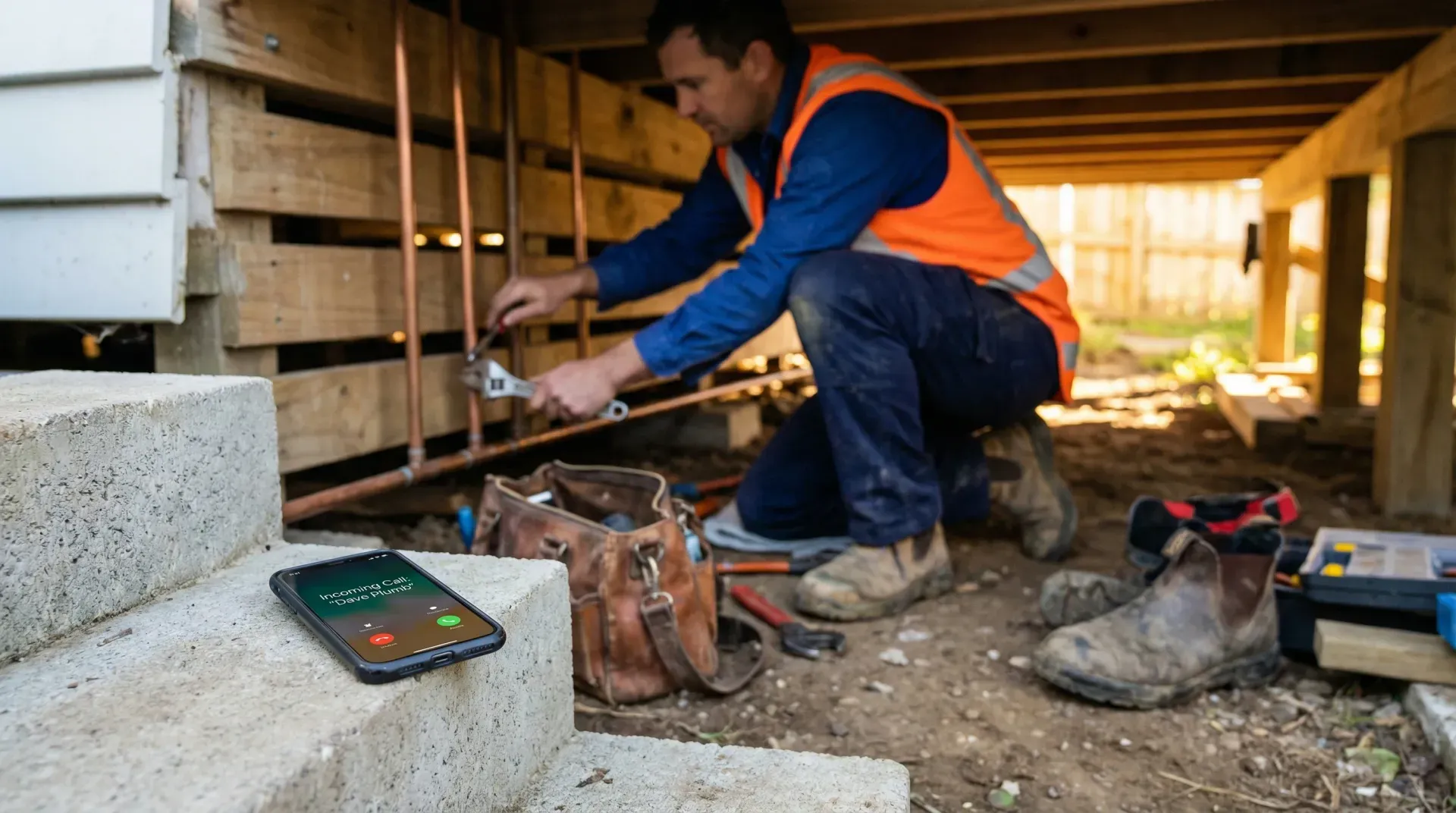
A plumber in Porirua doesn't have a receptionist. Neither does the sparkie in Silverdale, the landscaper in Lincoln, or the painter in Petone. Seventy-one percent of New Zealand businesses have zero employees. That's over 430,000 enterprises run by a single person who is simultaneously the technician, the salesperson, the accountant, and the person whose phone rings while they're under a house or halfway up a ladder.
The conversation about AI and employment keeps circling the same drain: will the machines take our jobs? But for most small businesses in this country, the AI receptionist isn't replacing anyone. It's filling a role that was never filled in the first place.
This post argues that the "AI replacing jobs" narrative fundamentally misunderstands who actually benefits from voice AI, and why the real opportunity sits with the businesses that never had the headcount to begin with.
Why does the "AI replacing jobs" narrative miss the mark for small business?
The fear that AI will displace workers is aimed squarely at large organisations with deep headcounts and repetitive task structures. For small and micro businesses, the framing is wrong. There is no receptionist to replace. The dominant narrative around AI and employment is built on enterprise assumptions that do not translate to a one-person operation running out of a van.
Harvard Business School research published in early 2026 found that companies laying off staff in the name of AI were doing so based on AI's potential, not its actual performance. Gartner reported that only one in five customer service leaders had actually reduced agent headcount. And an MIT Sloan study introduced the EPOCH framework, identifying five categories of uniquely human capabilities that AI cannot replicate, and concluding that AI is far more likely to complement human workers than substitute for them.
Those findings matter. But they describe a world of corporate contact centres and enterprise service desks. They describe Salesforce cutting from 9,000 support staff to 5,000, or Ikea retraining call centre workers. They describe businesses that had the headcount to cut in the first place.
In New Zealand, 97% of enterprises have fewer than 20 employees. Micro businesses, those with five or fewer staff, make up 79% of all Kiwi SMEs. In construction, roughly 90% of businesses have between zero and five employees. These people are not worried about AI taking their receptionist's job. They are worried about missing the call that pays for their week.
What is the actual cost of not having someone answer the phone?
Research consistently shows that small businesses miss between 27% and 62% of inbound calls, depending on industry and methodology. For trades and home service businesses, the numbers sit at the higher end. A study by 411 Locals that monitored 85 businesses across 58 industries found they answered only 37.8% of calls. That means nearly two out of every three potential customers never spoke to a person.
The financial impact compounds fast. Industry data from Invoca puts the cost of a missed call in home services at roughly $1,200 in lost revenue. Ambs Call Center's 2025 analysis calculated an average direct cost of $12.15 per missed call, with annual losses for SMBs exceeding $26,000 even at conservative estimates. Other analyses push the figure past $100,000 for businesses with higher call volumes.
But the numbers that should concern trades business owners most are the behavioural ones. Around 85% of callers who don't get through will not try again. They'll call the next result on Google. Of those who hit voicemail, 80% hang up without leaving a message. The caller doesn't leave a trail. You don't know they called. You don't know you lost the job.
I spent 16 years scaling a repairs management business from 200 to over 27,000 jobs annually. The pattern was always the same: the businesses that answered their phones grew. The ones that didn't stayed stuck, or worse, blamed their marketing for not generating enough leads when the leads were there all along, ringing out.
Why is voice AI the right interface for sole operators?
Chat widgets assume the business owner is sitting at a desk. Email assumes they have time to read and respond between jobs. Neither assumption holds for someone whose hands are full of tools and whose next job is a 20-minute drive away. This is why voice AI is the interface small businesses actually need, not another dashboard or chat widget.
Voice is how these businesses already communicate. Their customers call. Their suppliers call. Their subbies call. The phone is the primary interface. It always has been. What's changed is that the phone can now answer itself with something better than a voicemail that nobody will listen to.
A modern AI receptionist picks up in under five seconds, 24 hours a day, 365 days a year. It handles the questions that eat up a sole operator's time: opening hours, service areas, pricing ballparks, availability. It captures the caller's name, number, and what they need. It can book appointments against a calendar. And it does all of this for somewhere between $29 and $99 a month, compared to roughly $35,000 a year for a human receptionist, a cost that was never justifiable for a business turning over $150,000.
The Vida SMB survey found that only 22% of small businesses have adopted AI voice agents so far. But of those that have, 97% reported increased revenue and 80% saved five or more hours per week. Voice agent usage grew ninefold in 2025 according to Speechmatics. The technology has crossed the reliability threshold. It works.
This is not about replacing humans. A sole trader plumber never had a human answering their phone. This is about giving that plumber a capability that was previously only available to businesses large enough to employ office staff.
How does this apply specifically to New Zealand trades businesses?
New Zealand's business landscape is unusually weighted toward sole operators and micro businesses. Construction alone accounts for over 80,000 enterprises, with the vast majority being small operators. MBIE's 2022 sector report found 46% of construction business owners were struggling to recruit tradespeople, let alone office staff. Half of NZ sole traders work six to seven days a week. They are time-poor, stretched thin, and the phone keeps ringing.
The trades sector has a specific set of characteristics that make voice AI particularly useful. Calls are time-sensitive: someone with a burst pipe or a broken window needs help now, not tomorrow. The work is physical: you cannot stop mid-job to answer your phone. And the competition is local: if you don't answer, the caller will find someone who does, usually within the same suburb.
I work with trades businesses across the Kapiti Coast and wider Wellington region who face this exact problem. The ones who have moved to AI phone answering are not losing jobs. They are catching jobs they previously never knew existed. The after-hours call from a property manager. The Saturday morning enquiry from someone who just got a quote from a competitor. The call that came in while they were on the roof.
The economics work differently here than they do for a corporate call centre. For a sole operator, even one additional captured job per week at $300 can mean $15,000 in additional annual revenue. Against a monthly cost of $50-100 for AI phone coverage, the ROI is not subtle.
What should a New Zealand trades business do with this information?
If you are a sole operator or small trades business in New Zealand, the starting point is simple: find out how many calls you are actually missing. Most modern phone systems can tell you. If you do not have that data, that is itself informative, because it means calls are disappearing without a trace.
AI phone answering is not a replacement for the staff you have. It is coverage for the gaps you cannot fill. After hours. Weekends. The middle of a job when both hands are occupied. The technology exists, it is affordable, and it works. The question is not whether voice AI will become standard for small businesses. It is whether you want to be early or late.
If you want to understand how voice AI fits into your specific business, talk to us about integration options. We work with New Zealand trades businesses to set up AI phone answering that sounds natural, captures leads, and routes urgent calls to your mobile, so nothing falls through the cracks.
Frequently asked questions
- Will an AI receptionist replace my office staff?
No. AI phone answering is designed to cover the gaps where no one is available to answer: after hours, weekends, and during jobs. For businesses with existing staff, it handles overflow. For sole operators, it provides a capability that did not previously exist.
- How much does an AI receptionist cost for a small business in NZ?
Most AI phone answering services for small businesses cost between $29 and $150 per month, depending on call volume and features. This compares to $35,000 or more annually for a full-time human receptionist, making it accessible for trades businesses of any size.
- Can AI handle calls for trades businesses like plumbers and electricians?
Yes. Modern voice AI can answer common questions about service areas, availability, and pricing, capture caller details, book appointments, and escalate urgent calls directly to your mobile. It is particularly suited to trades businesses where calls are time-sensitive and owners are physically unable to answer during jobs.
- Do callers know they are speaking to an AI?
Current voice AI technology uses natural-sounding speech and conversational patterns. Some callers may notice, but most respond positively because they prefer getting an answer immediately over leaving a voicemail that may never be returned.
- How many calls does a typical NZ trades business miss?
Research suggests small service businesses miss between 27% and 62% of inbound calls. For sole operators who are on-site most of the day, the figure is likely at the higher end. Eighty-five percent of those callers will not ring back.