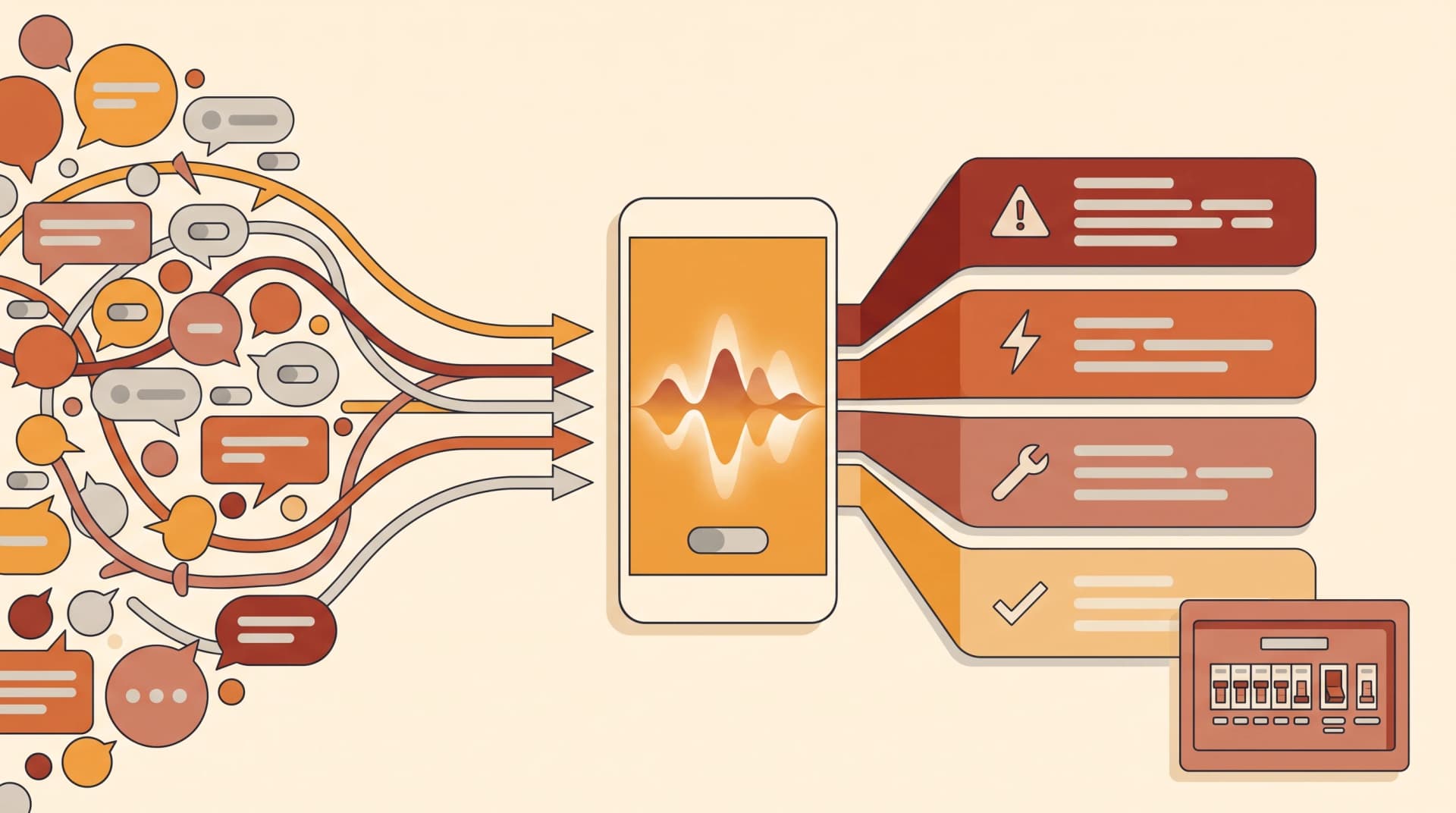
Tuesday afternoon in Levin, and a sparky is flat on his back in a ceiling cavity, one arm threaded through a joist, feeding cable to a downlight. His phone is in his pocket. It buzzes three times over twenty minutes, and there is no version of this job where he answers it.
By the time he's back down the ladder, the damage is done. Call one was a property manager in Waikanae with a dead switchboard in a tenanted rental, and she needed someone inside the hour. Call two was a homeowner wanting two extra powerpoints in the garage for a new freezer and a battery charger. Call three was someone selling him a website. The property manager left no message. She rang the next electrician on Google, and that company now holds the maintenance work for her whole portfolio. The powerpoint enquiry left half a message and a number with a digit missing.
Two real jobs, one of them urgent, both gone. The frustrating part is that a two-minute conversation would have sorted the order of everything: switchboard first, freezer circuit quoted for next week, website man politely declined. We build AI phone agents that have exactly that conversation. They answer every call, work out whether it's a no-power emergency or a quote request, and route each one where it should go, while the electrician stays in the ceiling.
This post walks through how AI fault triage works for electrical contractors: why inbound calls are a harder sorting problem for sparkies than for most trades, how an AI agent classifies a fault over the phone, what happens after classification, how it connects to tools like Fergus and Tradify, and what it costs against what it returns.
Why Is Call Triage Harder for Electricians Than for Most Trades?
Electrical work has the widest spread of urgency of any trade. The same phone line carries genuine hazards, total power loss, partial faults, and quote requests that could wait a month. A plumber's emergencies mostly announce themselves as water on the floor. An electrician's emergencies hide behind the same opening words as routine work: "the power's not working properly."
What Does a Typical Week of Inbound Calls Look Like?
For a two-to-four person electrical contracting business, most weeks bring 30 to 60 inbound calls. A handful are urgent faults, a larger group are quote requests and bookings, and the rest are suppliers, existing customers chasing progress, and cold sales calls. Nearly all of them arrive while everyone is on the tools.
The mix matters because each category has a different clock on it. A no-power call decays in minutes, since the caller keeps dialling electricians until one answers. A quote request decays in days. A supplier call can wait until smoko. Treating all of them as one ringing phone means the most patient caller wins, and the most patient caller is rarely the most urgent one.
There's also a sorting problem unique to electrical work. "No power" might mean a network outage that belongs to Powerco or Wellington Electricity, a tripped RCD the caller can reset themselves, or a failing main switch that needs a registered electrician today. Three different responses, one identical opening sentence.
What Does a Missed Emergency Call Cost?
A missed emergency call costs the job itself, typically $400 to $900 for an after-hours fault callout once you count the $150 to $250 callout fee plus time on site at $130 to $160 an hour. The larger cost is the relationship, because emergency callers who get answered tend to become repeat customers.
Run the numbers on the Waikanae property manager. One switchboard fault might be a $700 job. A property manager with 80 rentals generates dozens of electrical jobs a year, from healthy homes compliance checks to full rewires on older stock. Losing that first call to voicemail can quietly cost tens of thousands in annual work, and nobody ever finds out, because the phone log shows a 40-second missed call and nothing else.
Quote requests leak too, more slowly. A garage powerpoint enquiry that waits three days for a callback has often been quoted by someone else already. At $2,500 to $4,500 for a switchboard upgrade and $300 to $500 for small additions, a couple of leaked quotes a week adds up to a real hole by December.
How Does AI Fault Triage Tell an Emergency From a Quote Request?
An AI phone agent classifies a fault the same way an experienced electrician does on the phone: by asking a short sequence of diagnostic questions and listening to the answers. Whole house or one circuit, RCD tripped or not, anything burning or sparking, neighbours affected or not. The classification takes under two minutes.
AI made language programmable. That's the whole trick here. The caller describes their problem in ordinary words, sometimes flustered, sometimes vague, and the agent converts that description into structured fields a business can act on: fault type, urgency, address, access notes, callback number, all captured while the conversation is still happening.
What Questions Does the AI Ask to Classify a Fault?
The agent works through the same checklist a sparky runs from the driver's seat. Is the whole property without power or one area? Are the neighbours' lights off too? Has anything tripped at the switchboard, and does it stay on when reset? Did the fault start after plugging in a particular appliance? Each answer narrows the fault.
The neighbours question alone does serious work. If the whole street is dark, that's a network outage, and the agent can tell the caller to check their lines company or retailer, saving a pointless callout and a pointless invoice. If it's one property, the fault is on the private side and it's a real job. If it's one circuit that trips the moment it's reset, the agent flags a likely appliance or wiring fault and books it as urgent-but-stable.
Hot water is its own classic. No hot water with everything else running is often ripple control or an element, worth a scheduled visit, while an electrician's Saturday night is better spent on a switchboard that's dead. The agent knows the difference because it asks, every time, with the patience of something that has never once been annoyed by the question.
How Does It Handle Burning Smells and Genuinely Dangerous Faults?
Safety-critical calls skip triage and trigger immediate escalation. If a caller mentions a burning smell, visible sparking, smoke from the switchboard, or electric shock, the agent gives clear safety instructions, turn the main switch off if it's safe to reach, keep everyone clear, ring 111 if there's fire, and then puts the call straight through to the on-call electrician.
This is the part of the system that deserves the most conservative engineering. The agent is deliberately trigger-happy on danger words. A false alarm costs an interrupted dinner. A missed one costs a great deal more, so anything ambiguous gets treated as urgent and a human hears about it within seconds.
Fallen lines get their own script. Anything involving lines down near a property means keep well clear, call the lines company's faults line, and stay away from anything the line is touching. The agent isn't there to be clever with those calls. It's there to say the safe thing consistently and pass the details on fast.
What Happens After a Call Is Classified?
Classification is only useful if something happens next. Once the agent has sorted a call, emergencies reach the on-call electrician immediately by phone transfer and SMS, urgent jobs are booked into the next available slot, and quote requests arrive as complete, structured leads with everything needed to price the work.
How Do Emergencies Reach the On-Call Electrician?
A confirmed emergency triggers a live transfer to the on-call phone, backed by an SMS containing the address, fault summary and callback number. If the transfer isn't picked up, the system retries, then works through an escalation list. The caller is told help is being arranged, which keeps them from dialling the competition.
That last point is worth dwelling on. Emergency callers ring multiple electricians because silence feels like rejection. A caller who has been asked sensible questions, given a safety instruction, and told "I've sent this to Dave, he'll ring you within ten minutes" stops dialling. The job is held before anyone has driven anywhere.
Everything is logged. The on-call sparky arrives knowing it's a full outage, the switchboard is in the garage, there's a dog, and the tenant's number ends in 442. Small things, but they're the difference between a smooth callout and twenty minutes of doorstep discovery at 11pm.
What Happens With Quote Requests and Routine Bookings?
Quote requests are captured in full while the caller is engaged: address, what they want done, roughly where things need to go, access details, preferred times. The agent can text the caller a link for photos of the switchboard or the garage wall. The result is a lead that can be priced, sometimes without a site visit.
For the garage powerpoint caller from the opening, that means describing the job once, at the moment they care most. The electrician gets a complete brief that evening and sends a price the next morning. Speed wins quotes in the trades, and speed here comes from capture at the moment of enquiry.
Routine work books straight into available slots. Healthy homes checks, smoke alarm replacements, the caravan plug before Christmas at the Kāpiti holiday park. None of it needs a callback, and every callback that doesn't need making is time back on the tools.
How Does This Fit the Tools Electricians Already Use?
AI fault triage works best embedded in the systems a contracting business already runs, not bolted on beside them. Calls become jobs in Fergus, Tradify or simPRO through their APIs, emergencies reach the existing on-call roster, and nothing about quoting, invoicing or scheduling has to change to accommodate it.
Which Job Management Systems Can It Feed?
Most NZ electrical contractors run Fergus, Tradify or simPRO, and all three accept jobs and leads through their APIs. A triaged call arrives as a draft job with the customer record, fault description and urgency already filled in. Invoicing flows through to Xero the same way it always has.
The practical effect is that nobody re-types anything. The phone conversation becomes the job card. When we build these pipelines at EmbedAI, the integration work is usually half the project, because the answering is only valuable if the output lands where the business already looks every morning.
It also means reporting comes free. Once every call is classified and logged, you can see how many emergencies came in last winter, what proportion of quotes converted, and which suburbs generate the most after-hours work. Most electrical businesses have never seen that data, because it used to evaporate the moment the phone stopped ringing.
What About the Privacy Act 2020 and Recorded Calls?
Recorded and transcribed calls are personal information under the Privacy Act 2020, so the system has to be upfront and careful. Callers hear at the start that they're speaking with an AI assistant and that the call is recorded. Recordings are stored securely, kept only as long as needed, and available if a caller asks for them.
None of this is onerous, but it does need to be deliberate. Collection should be limited to what the business needs to do the work, which is one reason a well-designed agent asks about the switchboard and never about anything it doesn't need. Retention should have an actual policy behind it, ninety days is common, with job-related details living on in the job system.
Disclosure is also good manners, quite apart from the law. Most callers don't mind talking to an AI at 9pm if it's competent and honest about what it is. What annoys people is pretending.
What Does AI Fault Triage Cost, and What Does It Return?
For a small NZ electrical contractor, AI call answering and triage typically runs a few hundred dollars a month, in the territory of one modest after-hours callout. The return shows up as recovered emergency jobs, faster quote turnaround, and hours of interrupted time handed back to the people on the tools.
How Much Does a System Like This Cost to Run?
Subscription systems built for trades, like CallCover, price monthly with call volume tiers, and most small contracting businesses land in the low hundreds per month. A fully bespoke build with deep integrations costs more up front, and makes sense once call volume or complexity justifies it.
The comparison that matters is against the alternatives. A human answering service handles messages, and asking whether the RCD stays on when reset sits outside their script. Hiring office staff for phones costs $50,000 or more a year and still doesn't cover 9pm on a Sunday. The AI agent's job is narrower than either: answer, sort, route, capture, around the clock.
There's an honest limit to state as well. The agent triages and dispatches, but a registered electrician still does every inspection and repair, and complex or upset callers still get handed to a human. The technology earns its keep in the sorting, and the sorting is the part that was being done by a phone in a pocket in a ceiling cavity.
How Do You Measure Whether It Earns Its Keep?
Four numbers tell the story: answered-call rate, time from emergency call to electrician contact, quote requests captured per week, and quote conversion rate. Baseline them from current phone records before switching anything on, then compare after sixty days. If the system can't beat the baseline, it hasn't earned its place.
Treat this as an operations problem, not a technology project. The interesting question is whether the Waikanae property manager stays a customer, whether the garage powerpoint gets quoted within a day, and whether the on-call roster gets woken only for real faults.
Most businesses find the missed-call number is the one that shocks them. Phone providers will give you the log. Count the calls that rang out in the last month, classify them yourself with the benefit of hindsight, and put a dollar value beside each one. That exercise costs nothing and settles the business case one way or the other.
Practical Takeaway
Start with a fortnight of evidence, then decide. Pull the call logs, count what was missed, classify each missed call as emergency, quote or noise, and price it. If the total is comfortably above a few hundred dollars a month, AI fault triage will very likely pay for itself, and the logs will tell you which features matter most for your business.
From there, the path is short. Pick whether a subscription product or a bespoke build fits your call volume. Write down your on-call roster and escalation order, because the AI can only dispatch to a structure that exists. Decide your safety scripts for burning smells and lines down, and make them boringly conservative. Then run the sixty-day scorecard against your baseline and let the numbers make the call.
The electricians getting the most out of this treat the agent as a new team member with a very narrow job description: answer everything, sort accurately, escalate fast, write everything down. Held to that standard, it either earns its keep or it goes. That's the same bar the rest of the team is held to, and it's the right one. If you want help working out what your missed calls are costing, talk to us.
Frequently asked questions
- Can an AI really tell a power emergency from a routine quote request?
Yes, because the distinction comes from answers to simple questions, whole property or one circuit, neighbours affected, anything burning, does the RCD hold when reset. An AI phone agent asks the same diagnostic sequence an electrician would, on every call, and classifies the fault in under two minutes. Ambiguous calls are treated as urgent and escalated to a human.
- What happens if the AI gets a call wrong?
The system is designed so that errors fall in the safe direction. Anything mentioning smoke, sparking, shocks or fallen lines escalates immediately, and uncertain classifications are marked urgent by default. Every call is recorded and logged, so misclassifications are visible and the triage rules improve over time. The realistic worst case is an unnecessary escalation, and the on-call sparky decides from there.
- Do callers know they're talking to an AI?
They should, and in a well-built system they do. Callers are told at the start of the call that they're speaking with an AI assistant and that the call is recorded, which keeps the business on the right side of the Privacy Act 2020 and keeps callers' trust. In practice most people are happy to talk to anything competent that answers at 9pm.
- Will AI call triage work with Fergus, Tradify or simPRO?
Yes. All three have APIs that accept jobs, leads and customer records, so a triaged call arrives as a draft job with the fault description, urgency and contact details already filled in. Invoicing carries on through Xero as normal. The answering layer sits in front of your existing systems, and nobody has to change how they quote, schedule or invoice.