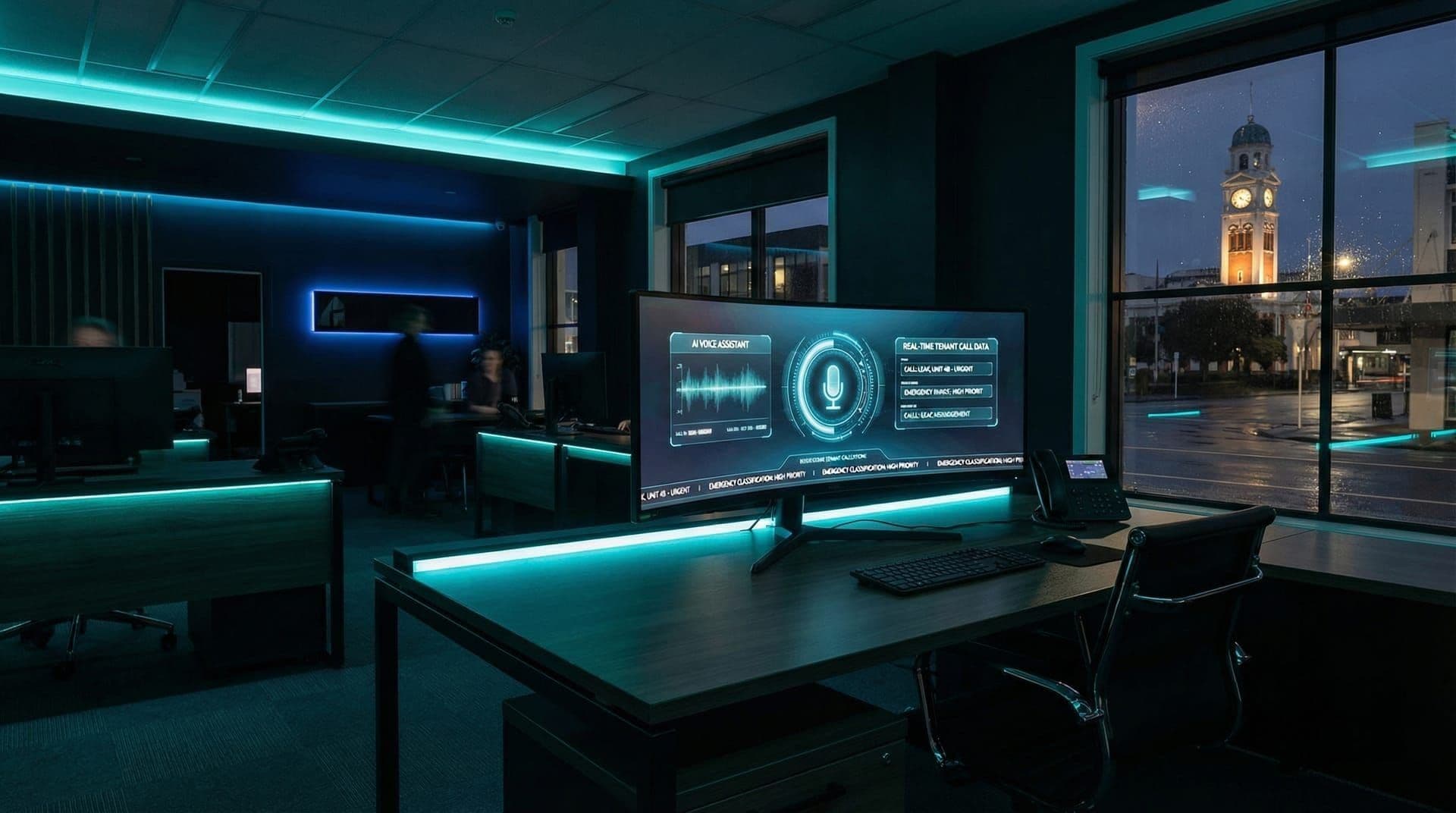
Property management AI is not about replacing property managers. It is about giving them their nights back. Brenda Currie Property Management in Palmerston North manages 180 residential properties across the Manawatu region. Their after-hours operation used to run on willpower: a rotating on-call roster where staff answered tenant calls through the night, triaged emergencies by gut feel, and rang tradespeople at 2am hoping someone would pick up. We built "Liam", a bespoke after-hours voice AI assistant that now handles every tenant call, classifies urgency, provides safety guidance, and dispatches contractors automatically. The system went live and immediately changed how the business operates after dark.
This is the story of how we turned a property manager's worst operational headache into a system that runs itself.
Why are Palmerston North property managers losing sleep to after-hours tenant calls?
After-hours voice AI for NZ property management solves a problem that has persisted since the first rental agreement was signed: tenants have emergencies outside business hours, and someone has to respond. For a firm managing 180 properties, that means 5 to 10 nighttime calls every week, each one pulling a staff member out of sleep, away from family, and into a high-stakes triage decision on limited information.
The manual process at Brenda Currie Property Management followed a pattern familiar to every property manager in New Zealand. A tenant calls at 1am about water coming through the ceiling. The on-call staff member answers, half-awake, and starts asking questions. Where is the property? Is it one of ours? What exactly is happening? Is anyone in danger? The staff member makes a judgement call: is this an emergency that needs a contractor tonight, or can it wait until morning?
If it is an emergency, the next step is ringing the plumber. Then the electrician. Then the backup plumber because the first one did not answer. Each call takes minutes. The tenant is waiting. Water is still coming through the ceiling.
The compound cost goes beyond the phone bill. Staff on the on-call roster reported fatigue that bled into their daytime work. Triage quality varied depending on who answered and how alert they were. Some calls were logged thoroughly. Others were scrawled on notepads and half-remembered the next morning. Contractor dispatch was inconsistent. One staff member might try three plumbers before giving up. Another might send a text and hope for the best.
Then there is the cost that does not show up on any spreadsheet. The property manager who cannot commit to a weekend plan because they might be on call. The partner who gets woken up alongside them. The Sunday morning that starts with a 4am pipe burst instead of rest. For a Palmerston North business where the team knows the tenants by name, this is not abstract operational friction. It is the grinding, personal cost of running a service business that never truly closes.
We estimated the weekly time cost at 8 to 12 hours of disrupted sleep and reactive work across the team. At 52 weeks a year, that is over 500 hours annually spent on a process that could be structured, automated, and improved. This pattern is not unique to Brenda Currie. We see it across the insurance and property management sector in New Zealand.
How does EmbedAI turn after-hours chaos into structured emergency response?
EmbedAI built Liam as a purpose-built after-hours voice AI assistant that answers every tenant call, validates the property against the managed portfolio, classifies urgency using property management-specific logic, delivers safety guidance, and dispatches contractors via automated outbound calls, all without a human touching the phone.
We started from the outcome and worked backward. The desired end state was simple: Brenda Currie's team arrives Monday morning to a complete, structured log of every after-hours interaction, with emergencies already handled, contractors already dispatched, and tenants already reassured. Everything between the tenant picking up the phone and that Monday morning summary needed to be automated.
The architecture has four layers, each solving a specific part of the problem.
How does Liam understand what tenants are actually saying?
Liam uses Deepgram for speech recognition and OpenAI for conversation intelligence, a combination chosen for reliable performance with New Zealand accents and property management terminology. The system transcribes tenant descriptions in real time, extracts structured data like property addresses and issue severity, and makes classification decisions modelled on how an experienced property manager triages calls.
Deepgram was chosen specifically for its performance with NZ English. Tenants say "hot water cylinder" not "water heater". They reference street names in Palmerston North that a US-trained model would butcher. Deepgram's accuracy on local proper nouns and place names was measurably better than alternatives we tested.
The conversation intelligence layer uses OpenAI to process the tenant's description, extract structured data (property address, issue type, severity indicators, occupant details), and make classification decisions. We engineered the prompts to mirror how an experienced property manager thinks about triage. Is there water actively flowing? Is there a safety risk? Are there children or elderly occupants? Is the property habitable tonight?
What role does Supabase play in real-time property validation?
Supabase serves as the operational backbone, storing the managed property database, contractor directory, on-call rosters, and call history. When a tenant provides their address, Liam queries Supabase in real time to validate whether the property is in Brenda Currie's managed portfolio. This check happens within the conversation flow, so the tenant experiences no delay.
If the address is not in the system, Liam politely advises the caller to contact their own property manager. This single validation step eliminates a category of wasted time that plagued the manual process: staff spending 15 minutes on a call only to discover the property is not one of theirs.
The Supabase layer also drives the contractor dispatch logic. Each trade category (plumbing, electrical, locksmith, glazier) has a ranked list of contractors with contact details and on-call availability. When Liam classifies a call as an emergency, the system knows exactly who to ring first, and who to try next if the first contractor does not answer.
How does automated contractor dispatch actually work at 2am?
Liam's contractor dispatch system makes outbound phone calls to tradespeople on behalf of the property manager, describes the emergency, provides the property address, and confirms attendance. If the first contractor is unavailable, the system cascades through the on-call roster automatically until dispatch is confirmed or the situation is escalated to a human.
This is where the system goes beyond a sophisticated answering service. When Liam classifies a call as an emergency requiring immediate contractor attendance, the system does not send a text message and hope for the best. Liam makes an outbound phone call to the contractor.
The outbound dispatch call follows a purpose-built prompt. Liam identifies itself as calling on behalf of Brenda Currie Property Management, describes the emergency, provides the property address, and asks the contractor to confirm they can attend. The voice synthesis runs through ElevenLabs, producing a calm, natural NZ voice that contractors recognise as the property management firm's after-hours system.
If the first contractor does not answer or cannot attend, Liam moves to the next contractor on the roster. The system continues down the list until it secures a confirmed dispatch or exhausts the available options, at which point it escalates to the on-call property manager with a full briefing of everything attempted.
Twilio handles all telephony, both inbound tenant calls and outbound contractor dispatch. The choice of Twilio was pragmatic: reliable NZ number provisioning, solid call quality, and straightforward integration with the rest of the stack. We needed a telephony layer that would work at 3am on a Saturday without supervision.
The web dashboard, built in Next.js, gives Brenda Currie's team full control over the operational data that drives Liam's decisions. They update the contractor roster when a new plumber comes on board. They adjust on-call schedules weekly. They add new properties as their portfolio grows. The AI adapts to whatever the dashboard reflects, which means the team manages their business, not the technology.
What happened when Liam went live across 180 Palmerston North properties?
Liam delivered immediate, consistent emergency response from the first night of operation. Every after-hours call answered. Emergency response time dropped from 15 to 25 minutes to under five minutes. Staff fatigue from overnight on-call duty effectively eliminated. The system now handles 5 to 10 nighttime calls per week across 180 managed properties without a single missed call.
When Liam went live, the first call came through on a Tuesday night. A tenant reported a significant water leak in the bathroom. Liam answered in under two seconds, confirmed the property address against the managed portfolio, asked targeted questions about the severity, classified it as an emergency, provided the tenant with instructions on locating and turning off the mains water supply, and dispatched a plumber. The plumber confirmed attendance within three minutes of the tenant's original call. Total elapsed time from tenant dialling to contractor confirmed: under five minutes.
The previous manual process for that same scenario would have taken 15 to 25 minutes on a good night. On a bad night, with missed calls and voicemail tag, it could stretch past an hour.
The numbers across the first months of operation tell a clear story. Every after-hours call answered. Every single one. No missed calls at 3am because someone slept through the ring. No tenant leaving a voicemail that gets picked up six hours later when the damage has already compounded. Emergency response time went from variable and unpredictable to immediate and consistent.
Brenda Currie's team described the change in terms that had nothing to do with technology.
"The first Monday morning after Liam went live, I came in and there was a complete summary of every call from the weekend. Transcripts, recordings, what Liam decided, which contractors were dispatched. I did not have to chase anyone for notes or ring the on-call person to find out what happened at 2am. It was just there. I actually did not believe it worked that well until I listened to the recordings myself." -- Brenda Currie, Director, Brenda Currie Property Management
The on-call roster still exists, but its function has fundamentally changed. Staff are no longer the first responder. Liam handles the conversation, makes the triage decision, dispatches the contractor, and only escalates to the human when the situation requires judgement that goes beyond the system's classification logic. The staff member on call receives a notification when a contractor is dispatched, but they are not being woken at 2am to answer a call about a dripping tap that could wait until morning.
Staff fatigue dropped. Triage consistency went from variable to uniform. Every tenant receives the same calm, structured interaction whether they call at 7pm or 4am. The morning handover became a five-minute dashboard review instead of a 30-minute debrief. And the contractors reported something unexpected: they preferred getting a clear, structured dispatch call from Liam over a groggy 2am call from a property manager trying to relay details from memory.
For a Palmerston North property management firm operating in a market where reputation is everything, the tenant experience improvement matters as much as the operational efficiency. This is what our approach to AI integration is built around: outcomes that change how a business feels to run, not just how it performs on a spreadsheet. Tenants calling in distress get immediate, competent guidance. They do not sit on hold. They do not leave a voicemail wondering if anyone will call back. They get Liam, who answers every time, asks the right questions, and gets help on the way.
What technology powers Liam's after-hours voice AI system?
The system combines six core technologies, each chosen for a specific role in the pipeline from tenant call to contractor dispatch. This is a bespoke AI integration built to the operational requirements of a New Zealand property management firm, not a generic chatbot deployment.