Most business owners I talk to have the same reflex when revenue grows: hire someone. More customers means more staff. More work means more hands. It feels obvious. It is also, increasingly, wrong.
I have spent the last few years building embedded AI systems for NZ businesses. Trades companies, insurers, property managers, professional services firms. The pattern is consistent. The businesses that scale without hiring are not lucky. They are deliberate. They embed AI into the work itself, so their existing team operates at two or three times their previous capacity.
This is not about replacing people. It is about stopping the hire-to-grow cycle that bleeds small businesses dry. Here is how it works in practice.
Why does every growth plan default to more headcount?
Every growth plan defaults to hiring because businesses have always scaled by adding people. When work increases, the instinctive response is to divide it among more hands. But this model carries hidden costs that most business owners underestimate until they are already committed.
The assumption runs deep. When a plumber gets busy, they hire another plumber. When an insurance firm gets more claims, they hire another claims handler. When a trades company starts missing calls, they hire a receptionist.
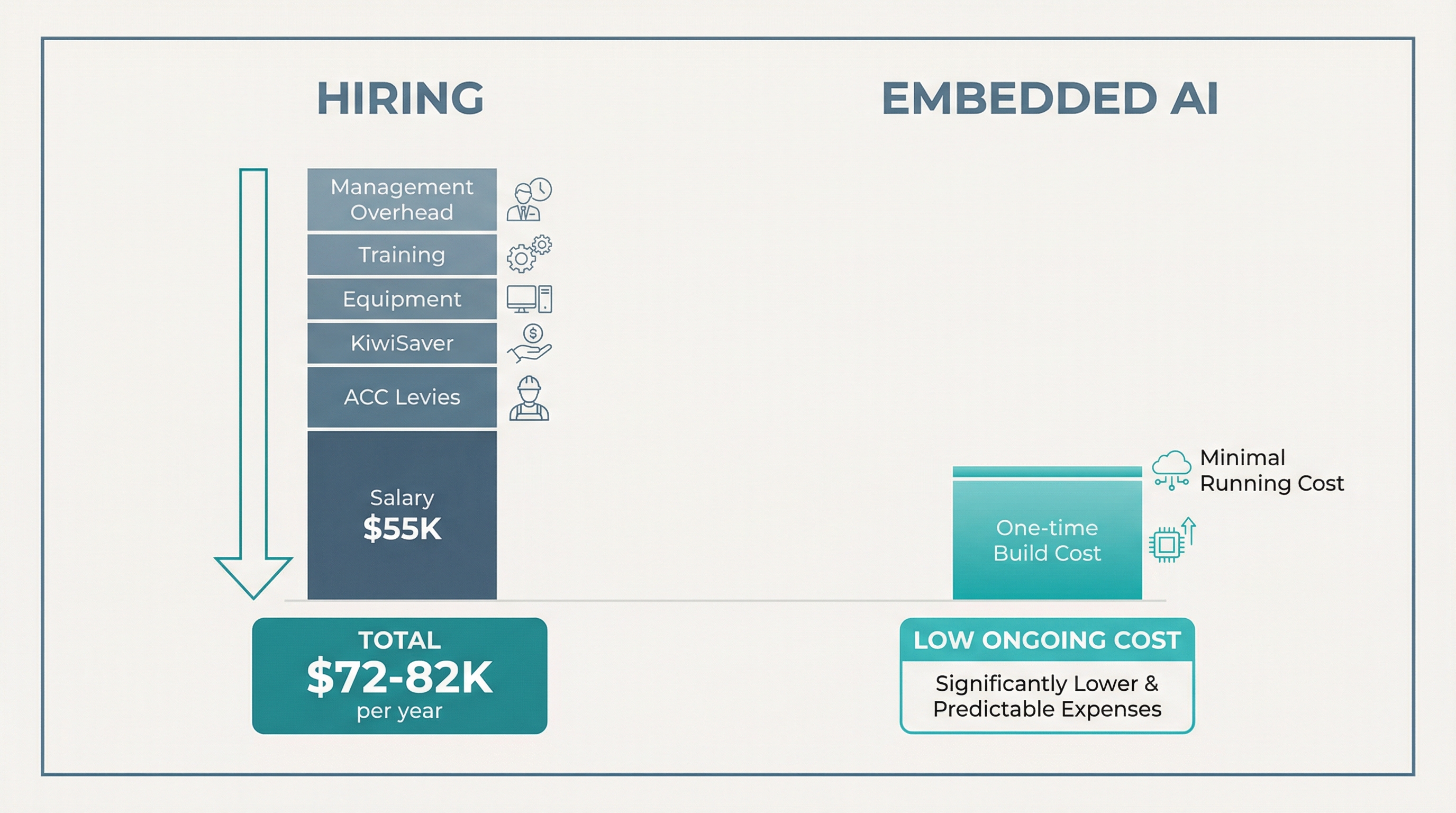
Except hiring is expensive. In New Zealand, the true cost of an employee runs at roughly 1.3 to 1.5 times their salary once you factor in ACC levies, KiwiSaver contributions, equipment, training time, and management overhead. A $55,000 receptionist actually costs $72,000 to $82,000 per year. And that is before you account for sick leave, annual leave, and the three months it takes before they are fully useful.
The real question most business owners skip is: what exactly am I hiring this person to do? Not in general terms. Specifically. Because when you break down the tasks, a surprising proportion of them are repetitive, rule-based, and predictable. Exactly the kind of work AI handles well.
That does not mean you never hire again. It means you should interrogate the assumption before you act on it.
What does "embedded AI" mean, and how is it different from buying another SaaS tool?
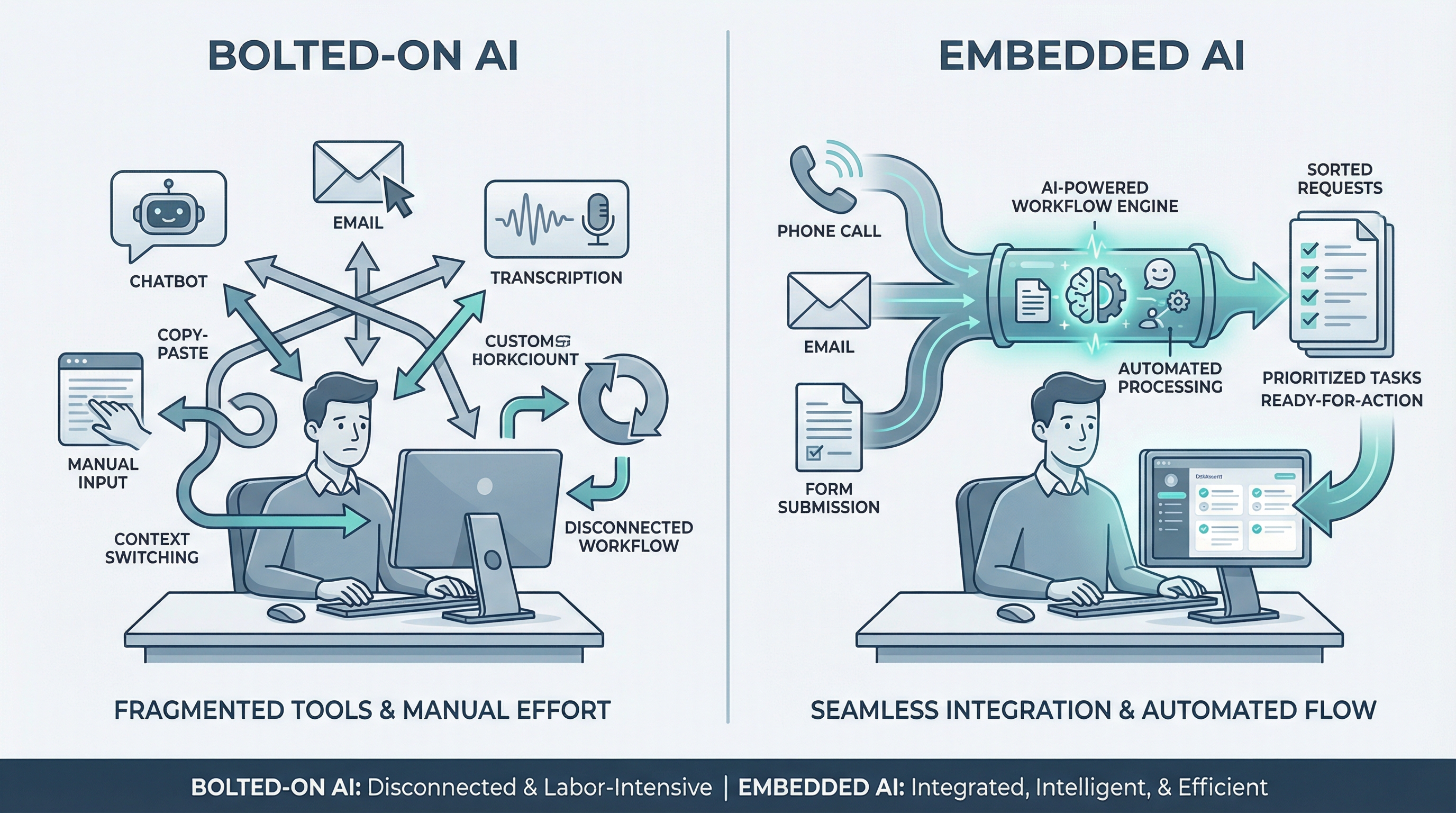
Embedded AI refers to artificial intelligence systems built directly into a business's existing workflows and processes, rather than added as a separate tool that staff must learn and manage. The distinction matters because bolted-on AI creates more work, while embedded AI removes it.
Most businesses have tried some version of AI by now. A chatbot on the website. ChatGPT for writing emails. Maybe an AI transcription tool for meetings. These are bolted-on tools. They sit alongside your work. You have to remember to use them, copy information between systems, and manage yet another login.
Embedded AI is different. It sits inside the workflow itself. It does not require your team to do anything differently. The AI intercepts the work at the point it arrives, whether that is a phone call, an email, a claim submission, or a booking request, and handles it according to rules you have defined.
Think of it like plumbing (appropriate, given half my clients are plumbers). A bolted-on tool is a bucket you put under a leak. Embedded AI is fixing the pipe. The water still flows, your team still works, but the problem that was consuming time and creating errors simply stops happening.
When I built CallCover for a plumbing company on the Kapiti Coast, their office manager did not need to learn a new system. Calls still came in on the same number. The AI answered, triaged, and either dispatched urgent jobs or queued routine ones. The office manager's phone stopped ringing at 5pm. That is what embedded looks like.
Where are NZ businesses replacing headcount with embedded AI right now?
New Zealand businesses are using embedded AI to handle customer phone calls, process insurance claims, manage incentive programmes, and automate back-office administration. These are not experimental pilots. They are production systems running daily across trades, insurance, and professional services.
This is not theoretical. These are systems I have built, deployed, and maintained for real businesses. Here is where embedded AI is doing the heaviest lifting.
How does AI handle customer phone calls without a receptionist?
AI phone agents answer inbound calls, understand what the caller needs through natural language processing, triage requests by urgency, and either resolve them directly or route them to the right person. A well-built AI phone agent handles 70 to 90 percent of routine calls without human intervention.
This is where I see the biggest immediate impact for trades and services businesses. A plumber, electrician, or property manager missing calls after hours is not just an inconvenience. It is lost revenue. Every unanswered call is a potential customer who rings the next company on the list.
CallCover answers those calls. It asks the right questions. It works out whether the job is urgent (burst pipe at 11pm) or routine (quote for a bathroom renovation). Urgent jobs get dispatched immediately. Routine ones get queued with full details for Monday morning.
One plumbing company on the Kapiti Coast was losing an estimated $42,000 a year in missed after-hours calls. That is not a rounding error. That is a full-time employee's salary vanishing into voicemail.
The AI phone agent cost a fraction of a receptionist's salary to build, and nothing close to $72,000 a year to run. It does not call in sick. It does not need training when your service list changes. And it works at 2am.
Can AI actually process insurance claims faster than a team?
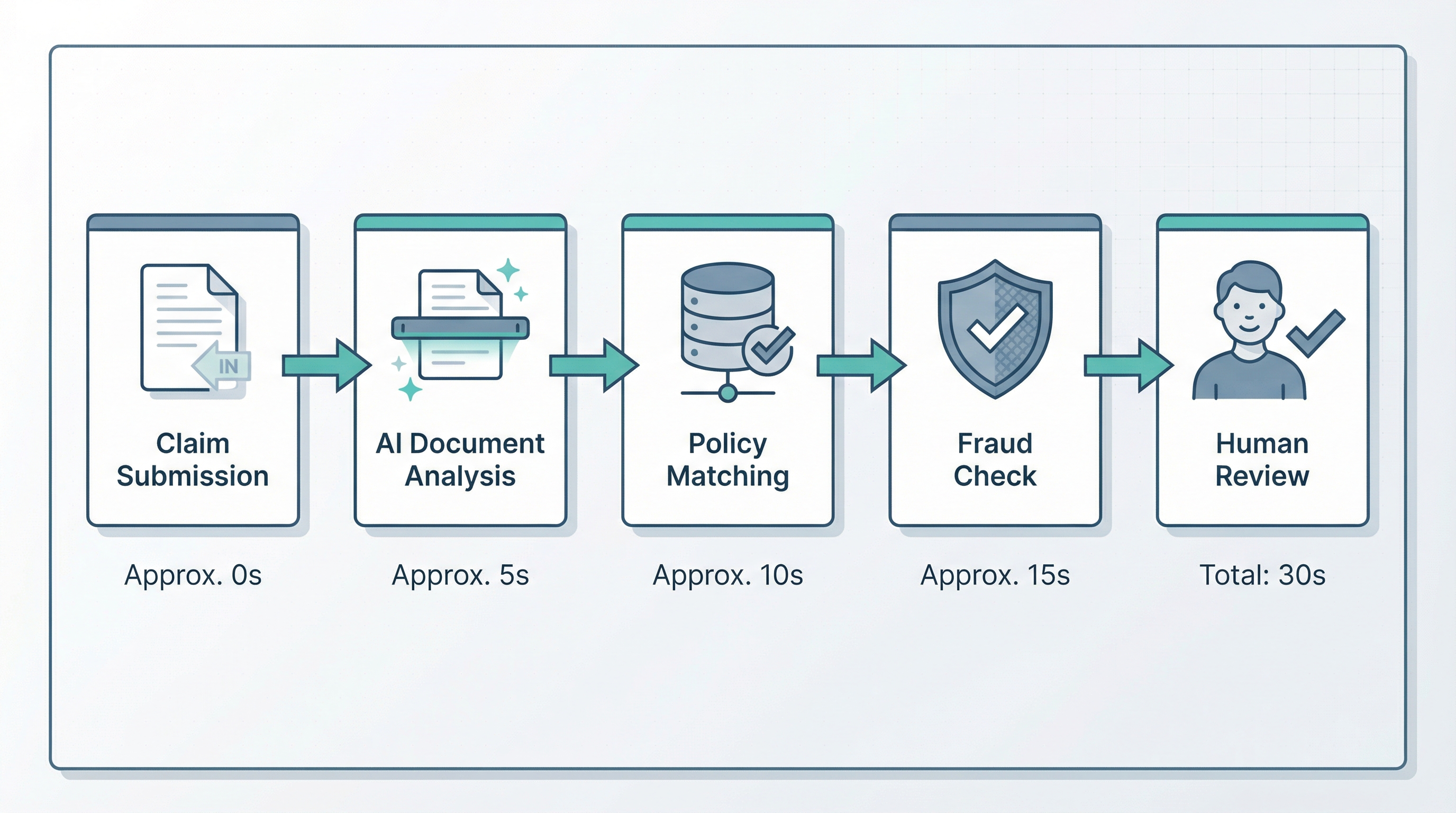
AI claims processing systems can assess, validate, and route insurance claims in seconds rather than days. By combining document analysis, policy matching, and fraud detection, embedded AI reduces claims processing time by 80 to 95 percent while improving accuracy and consistency.
Insurance is one of the most document-heavy industries in New Zealand. A single claim can involve photos, receipts, policy documents, assessor reports, and correspondence chains. Processing all of that manually takes time, and time is where errors creep in.
I have built claims automation systems that read incoming claim documents, extract the relevant data, match it against the policy terms, flag anything suspicious, and present the claims handler with a pre-assessed summary and recommended action. The handler still makes the final call. But instead of spending 45 minutes per claim, they spend five.
The same team that used to process 30 claims a day now processes 150. Not because they are working harder. Because the AI has removed the repetitive grunt work that consumed 85 percent of their time.
What about the back-office work that eats half your week?
Back-office automation through embedded AI handles data entry, document processing, reporting, scheduling, and compliance tasks that typically consume 15 to 25 hours per week for a small business owner or office manager. These systems pull data from existing tools and complete administrative work without manual intervention.
This is the unglamorous end of AI, and probably the most valuable for small businesses.
Every business I work with has some version of the same problem. Information comes in through one channel (email, phone, website form), needs to be entered into another system (accounting, CRM, job management), and then referenced later for reporting or compliance. That transfer step, the manual re-keying, the copy-paste, the "I will update that spreadsheet later", is where time disappears and mistakes happen.
One client was spending eight hours a week manually converting XML data from emails into their internal system. Eight hours. Every week. The automation I built handles it in seconds, runs unattended, and has not missed an entry in years.
That is eight hours a week back. Over a year, that is 400 hours. At $35 an hour, you are looking at $14,000 in recovered productive time. From a single automation.
Multiply that across invoicing, scheduling, compliance documentation, and reporting, and you start to see why some businesses are operating at twice their previous capacity without a single new hire.
What is the actual limit of a small team with embedded AI?
A small team with properly embedded AI can operate at three to five times its natural capacity. The practical limit depends on how many repetitive, rule-based processes the business runs and how well the AI is integrated into existing workflows. Most NZ SMEs have enough automatable work to double their effective headcount within 12 months.
I have a three-phase framework for working this out: Discovery, Build, Operate. The Discovery phase exists specifically to answer the question "how much of your work can AI actually handle?" before anyone writes a line of code.
The honest answer varies. A business where 60 percent of the work is repetitive and rule-based (trades scheduling, claims processing, data entry) can see dramatic gains. A business where most of the work requires human judgement and relationship management (high-end consulting, complex negotiations) will see smaller but still meaningful efficiency improvements.
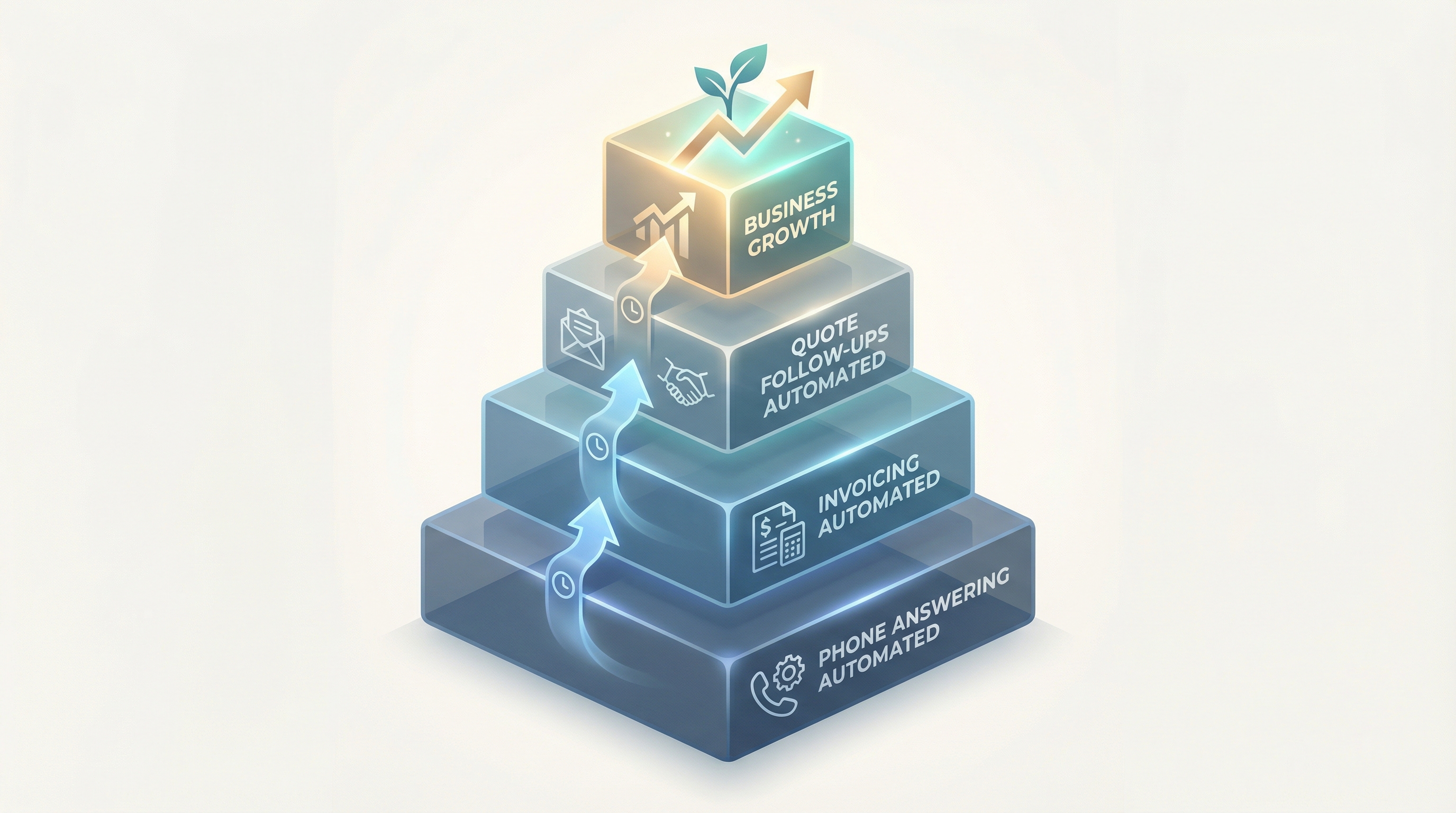
But here is what most people underestimate: the compounding effect. When you automate phone answering, your office manager has time to chase up unpaid invoices. When you automate invoicing, they have time to follow up on quotes. When you automate quote follow-ups, they have time to actually grow the business instead of just keeping it running.
Each automation does not just save time. It frees capacity for higher-value work that was previously squeezed out by admin.
What should a growing NZ business do before hiring their next person?
Before hiring, NZ businesses should audit their current workflows to identify which tasks are repetitive and rule-based, calculate the true cost of those tasks in staff hours, and compare that against the cost of automating them. In most cases, automating two or three key processes costs less than one new hire and delivers more capacity.
Here is the framework I use with every client. Before you write that job ad, answer three questions:
-
What exactly will this person spend most of their time doing? Write it down. Be specific. "Answering phones and doing admin" is not specific enough. "Answering 30 calls a day, entering job details into Tradify, sending quotes via email, and chasing overdue invoices" is.
-
How much of that work follows a predictable pattern? If 70 percent of the calls are the same five questions, that is automatable. If every call is a unique, complex negotiation, it is not.
-
What would your existing team do with the time AI gives back? This is the important one. Automation is only valuable if the freed-up time goes somewhere productive. If your best person is buried in data entry, getting them out of that creates more value than a new hire ever could.
If you want help running this analysis, that is literally what my Discovery process exists for. A few thousand dollars to find out whether you need a $70,000 hire or a $15,000 automation. The maths usually speaks for itself.
Frequently asked questions
- Does embedded AI replace employees in NZ businesses?
No. Embedded AI handles repetitive, rule-based tasks so existing staff can focus on higher-value work. It replaces the need to hire additional people for administrative and process-heavy roles, but it does not replace skilled workers. The goal is to make a team of three operate like a team of ten.
- How much does it cost to embed AI into a small business in New Zealand?
Costs vary depending on complexity, but most embedded AI projects for NZ SMEs range from $8,000 to $25,000 for the initial build. EmbedAI prices builds at half the annual cost of the problem being solved, so the investment pays for itself within 12 to 24 months.
- Is AI automation only useful for large companies?
This is a common misconception. Small businesses often benefit more from AI automation than large enterprises because the owner or a small team is typically doing everything. Automating three or four repetitive processes can free up 15 to 25 hours a week, which is transformative for a five-person company.
- What NZ industries benefit most from embedded AI?
Trades and services, insurance, property management, and professional services see the strongest returns. Any business with high call volumes, document-heavy processes, or repetitive administrative tasks is a strong candidate for embedded AI automation.
- How long does it take to set up AI automation for a business?
A typical embedded AI project takes four to eight weeks from Discovery through to a working system. The Discovery phase takes one to two weeks, the Build phase takes two to four weeks, and the system is live and handling real work by the end of that period.