You know AI could help your business. You have read the articles. You have seen what your competitors are doing (or claiming to do). But every time you look into it seriously, the same questions come up. How much will it cost? What if it does not work? Who fixes it when something breaks?
These are the right questions. And the fact that most AI vendors dodge them is exactly why so many projects end up as expensive shelf-ware.
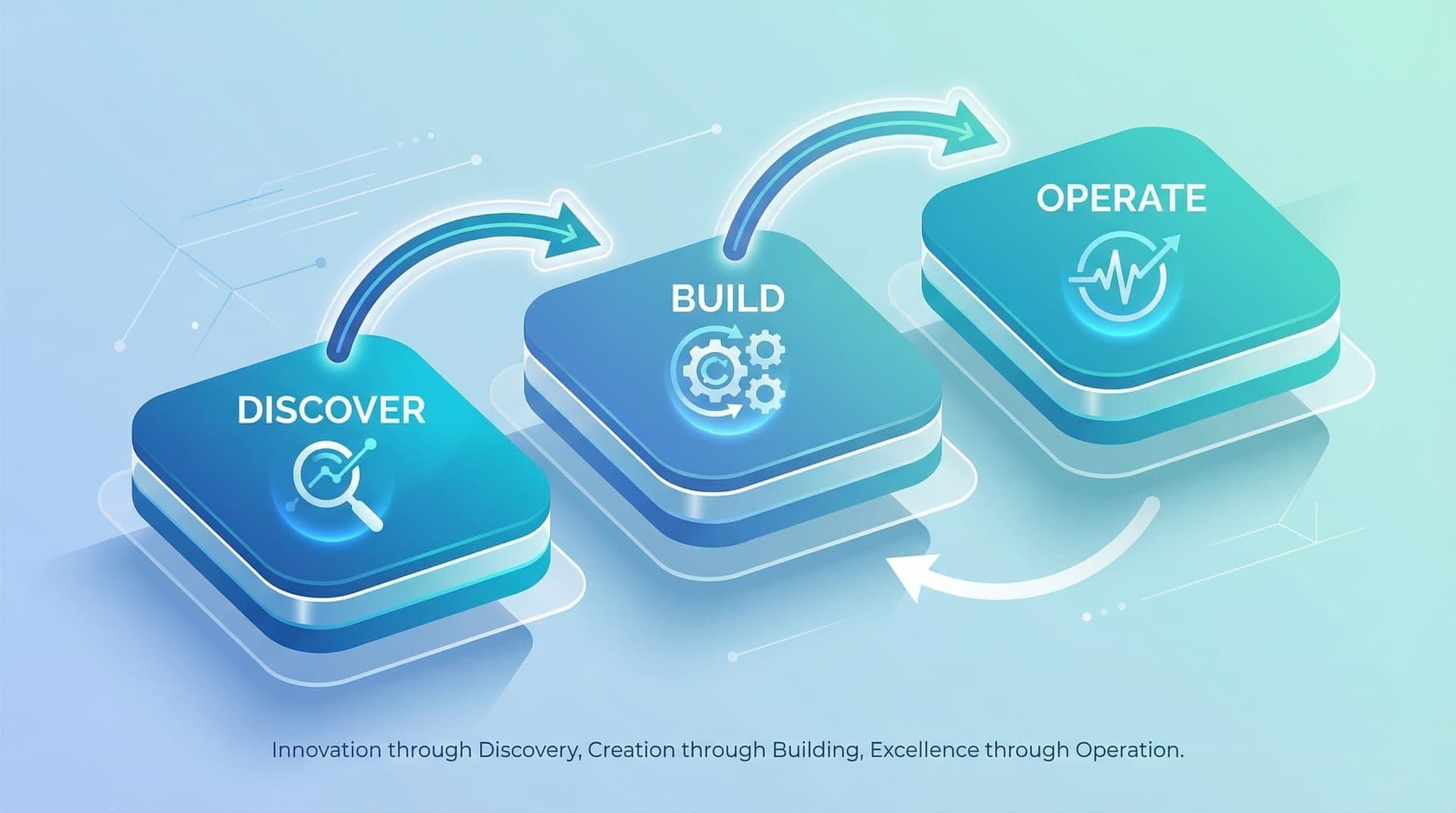
We built a three-step process to answer those questions upfront: Discovery, Build, Operate. Think of it like building a house. You would not pour a foundation without plans. You would not move in without a building warrant. And you would not skip the maintenance just because the build is finished. Same logic applies to AI.
Why do so many AI projects go wrong?
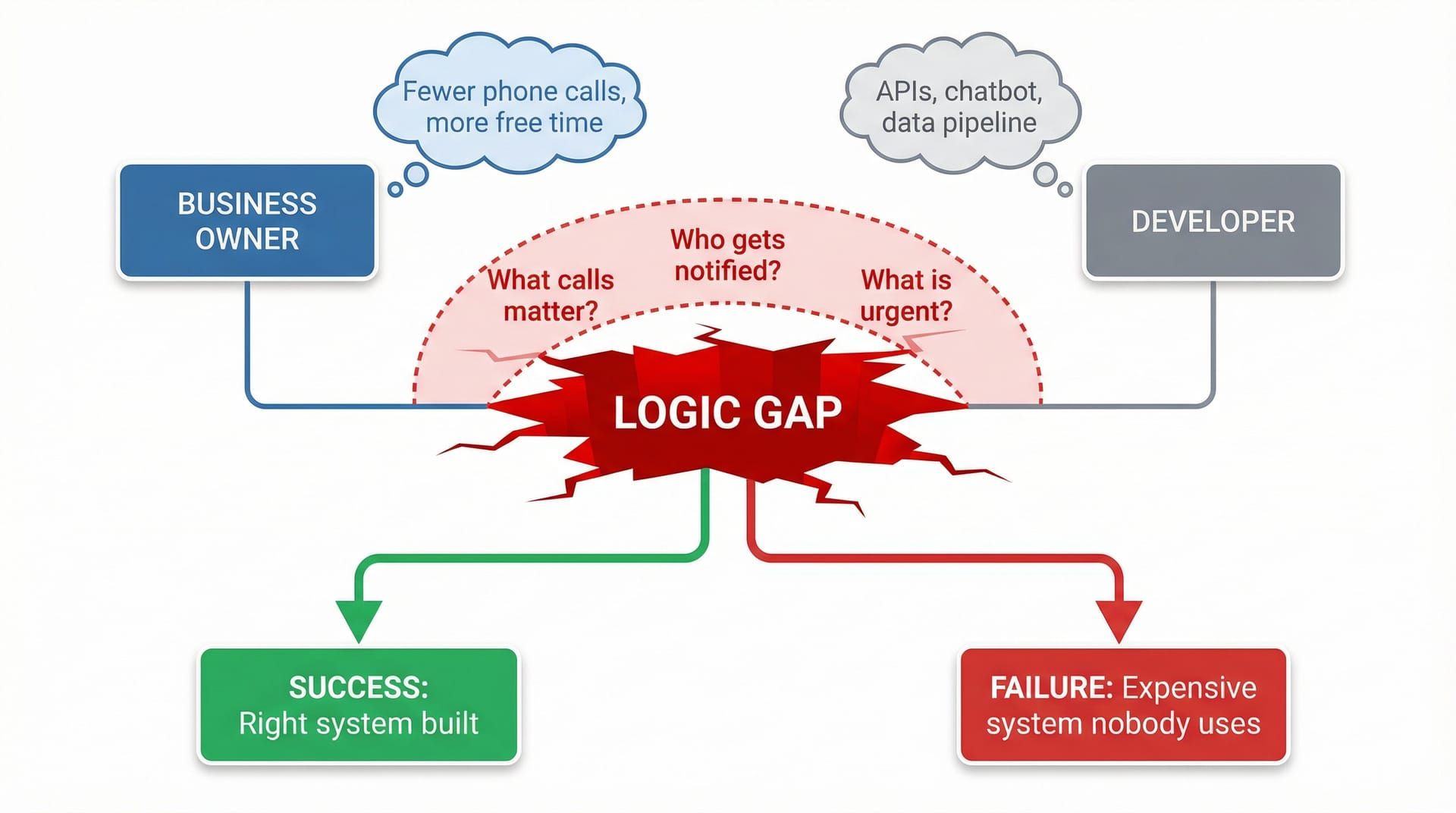
Here is what usually happens. A business owner tells a developer "we need AI to handle our customer enquiries." The developer says "great, we will build you a chatbot." Both nod. Both think they are on the same page. They are not.
The business owner is picturing fewer phone calls and more time to run the business. The developer is picturing code and APIs. Nobody has asked the basic questions. What kind of enquiries come in? Which ones actually need a human? What happens at 6pm on a Friday when no one is in the office?
Six weeks and $25,000 later, you have a chatbot that technically works but does not do what you need. It cannot tell the difference between a customer chasing a quote and someone reporting a burst pipe. Your staff still handles the same calls. The bot just adds another thing to manage.
That is not a technology problem. It is a "we skipped the homework" problem.
Step 1: Discovery. Working out if AI is even worth it.
Before we write a single line of code, we spend one to two weeks understanding your business. That is it. No building. No commitments beyond this step. Just questions, observation, and honest assessment.
What are we actually looking at?
We follow you through a normal week. Not literally (that would be odd), but we map out how work flows through your business. Where does information come in? Who handles it? What gets lost along the way?
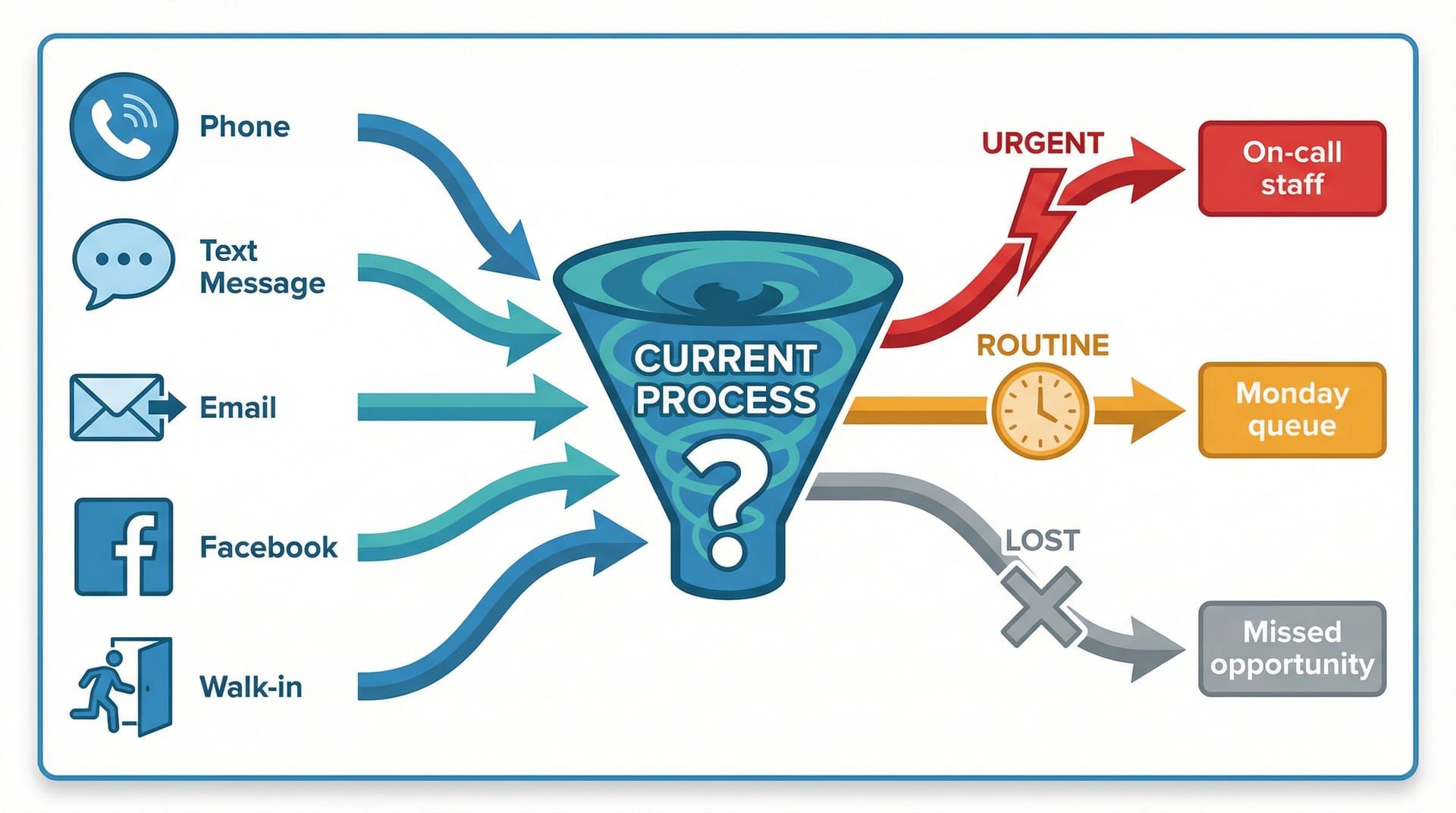
Take a plumber in the Hutt Valley. Calls come in by phone, text, email, and Facebook Messenger. His office manager writes job details on a whiteboard. The plumbers check the whiteboard in the morning and take photos of it on their phones. If a call comes in after 4pm, it goes to voicemail. He returns those calls the next morning, but by then half the callers have rung someone else.
That is a real situation. And you can see the problem is not that he needs a fancy AI system. The problem is that information gets stuck, delayed, and lost at specific points. Once you know where those points are, you can figure out whether AI is the right fix or whether the answer is something simpler.
What does it cost?
Discovery runs between $3,000 and $6,000 for most businesses. You get a written report that lays out three things:
- Where you are losing money or time (with real numbers, not guesses)
- Whether AI can fix it (honestly, sometimes it cannot)
- What it would cost to build, and what you would save
If the numbers do not stack up, we tell you. We would rather charge you $4,000 for the truth than $30,000 for a system you do not need.
What if AI turns out to be the wrong answer?
Good question, and it happens more than you would think.
A property manager in Wellington came to us wanting an AI system to sort tenant maintenance requests. Sounded like a perfect fit. During Discovery, we dug into the actual requests and found that 80% of them came from the same three properties. Same issues over and over. Dodgy hot water cylinders. Temperamental heat pumps.
The real problem was not sorting requests. It was fixing the things that kept generating them. We told them to spend $8,000 on a plumber and an electrician instead of $25,000 on software. Their request volume dropped 60%.
We charged them for Discovery and moved on. That is Discovery doing its job. Better to find out early than to build something that solves the wrong problem.
Step 2: Build. Turning the plan into a working system.
If Discovery shows the numbers work, we move to Build. This is where the software gets made. But unlike most tech projects, you already know exactly what you are getting and what it costs before we start.
How does pricing work?
We tie our price to half the annual cost of the problem we are solving. Simple maths.
If your business is losing $40,000 a year because of the issue we found in Discovery, our build price caps at $20,000. If the problem only costs $10,000 a year, we are not going to charge you $30,000 to fix it. We will either trim the scope to match or tell you it is not worth building.
Why half? Because it means you are cash-flow positive within 12 to 24 months. No guesswork. No "fingers crossed" ROI projections.
A plumbing company on the Kapiti Coast was missing 40% of their after-hours calls. We calculated that at $42,000 in lost work per year, based on their average job value and 18 months of call data. We built CallCover for $18,000. They broke even in 11 months.
What exactly gets built?
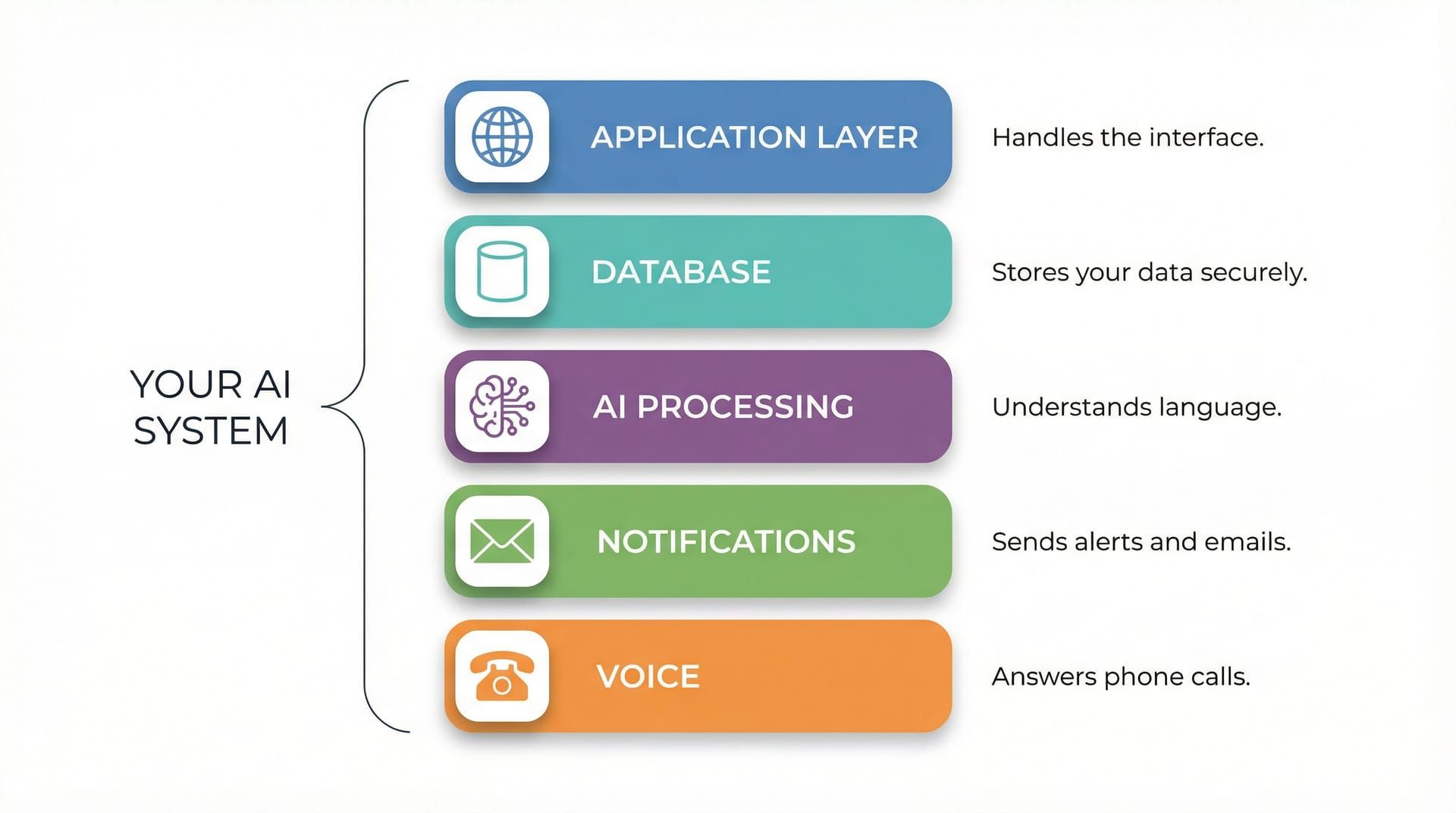
That depends entirely on what Discovery found. But the pattern is usually the same: we build a system that catches the information your business currently drops, sorts it, and puts it in front of the right person at the right time.
For the Kapiti plumber, that meant an AI phone agent that answers after-hours calls, works out whether the job is urgent (burst pipe) or routine (leaky tap), texts the on-call plumber for urgent ones, and queues the rest for Monday morning. No missed calls. No Saturday morning voicemail marathon.
The build runs on a fixed-price contract. You know the number upfront. No hourly billing that quietly balloons. No "just one more feature" that adds another month. The specification from Discovery is the specification for Build.
Step 3: Operate. Keeping it running after launch day.
This is the step most AI companies skip. They hand over the code, send the final invoice, and disappear. Then six months later, something changes (the AI provider updates their system, your business grows, a new type of request starts coming in) and the whole thing breaks. You are stuck ringing around trying to find someone who can fix code they did not write.
We do not do that. Operate is a monthly arrangement where we keep your system healthy, tuned, and improving.
What does that actually look like day to day?
Say you run a property management company and we built you an AI system that sorts tenant requests. Three months in, a few tenants start reporting "musty smell in bedroom." Your system has no rule for that. It sits in the general queue instead of being flagged as a possible moisture issue.
Under Operate, we spot that. We add "musty smell" to the rules that flag potential health and safety concerns. We check whether any past requests were mis-sorted. We let you know.
That is the practical difference. Without Operate, those requests sit in the wrong queue until someone complains loudly enough for you to notice. With Operate, we catch it early and fix it quietly.
Operate covers:
- Monitoring: If the system goes down at 3am, we know before you do.
- Tuning: AI providers update their systems regularly. We make sure your system still works properly after each update.
- Cost management: We watch your running costs and switch to cheaper options where quality does not suffer. One client saved 80% on AI processing costs just by using a lighter model for simple tasks.
- Small improvements: As you use the system, you will spot things you want changed. Operate handles the small stuff without a separate quote every time.
Monthly cost sits between $500 and $2,000 depending on how complex your system is.
How is this different from a normal support contract?
Normal support is reactive. Something breaks, you ring, someone fixes it. That works for a photocopier. It does not work for AI.
AI systems can fail without anyone noticing. They do not crash or show error messages. They just gradually get worse. An AI phone agent might start misunderstanding callers. A sorting system might slowly drift in how it classifies things. By the time you notice, the damage has been compounding for weeks.
Operate is proactive. We monitor accuracy, not just uptime. If the system starts getting things wrong more often, we fix it before your customers feel it.
Who is this a good fit for?
The three-step model works well if your business:
- Has a clear, repetitive task that eats up time or money
- Can roughly quantify what that problem costs (even a ballpark figure)
- Wants a system that runs reliably without needing a tech person on staff
- Values a long-term relationship over a one-off project
It is probably not the right fit if:
- You are not sure what problem you want to solve (that is fine, but we need a clear target)
- Your team cannot spare a few hours during Discovery to explain how things work
- The payoff is vague or years away
- You have your own developers and just need the AI piece built
If you are a bigger company with your own tech team, you probably only need Discovery and Build. We hand over the system with full documentation and your team takes it from there. No hard feelings.
But if you are a 10 to 15 person business where the owner is also the IT department (and the HR department, and the accounts department), the full three steps mean you are never stuck holding a system you cannot fix.
How long does the whole thing take?
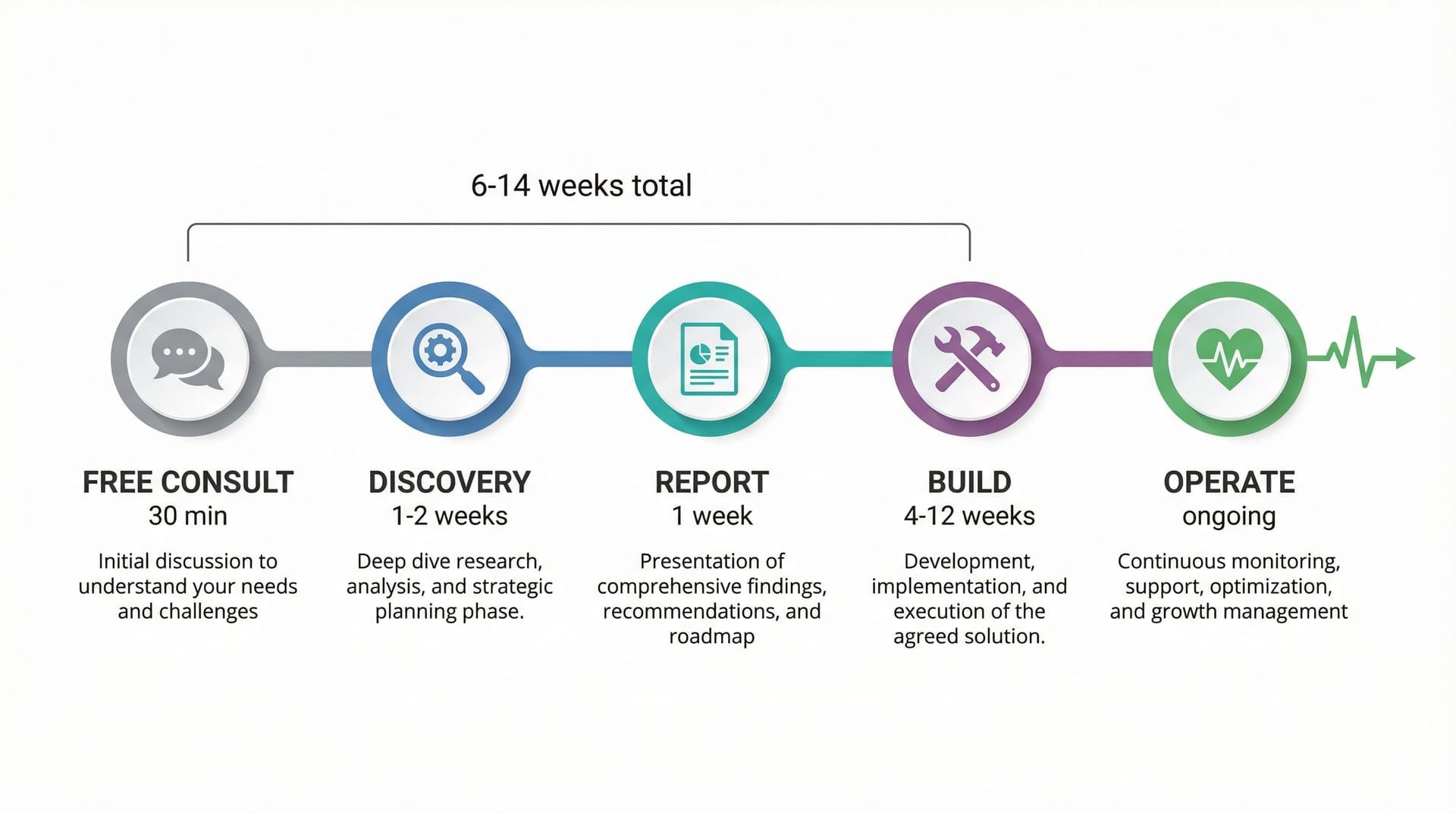
Here is a realistic timeline:
- Free consult: 30 minutes. We figure out if Discovery makes sense for you.
- Discovery: 1 to 2 weeks.
- Discovery Report: Delivered within a week. Full plan, pricing, honest recommendation.
- Build: 4 to 12 weeks depending on what is being built.
- Operate: Ongoing.
So from first conversation to working system: roughly 6 to 14 weeks. That is slower than a "move fast and break things" agency. It is also far less likely to waste your money.
For the CallCover project: first call on March 3rd. Discovery done March 17th. Contract signed March 24th. System live May 12th. Ten weeks.
What happens when something unexpected comes up during Build?
It always does. The specification from Discovery covers 95% of situations, but real life throws curveballs.
A property management AI we built handled every type of maintenance request perfectly until a tenant reported a possum living in their roof cavity. The system had no idea what to do with that.
We handle surprises like this with a simple rule: if we should have thought of it during Discovery, we fix it at no extra cost. Possums in Wellington roofs are common enough that we should have planned for it. Our mistake, our cost.
If it is genuinely something no one could have predicted, we park it and sort it out during Operate. No panic. No extra invoice mid-build.
Why work with a NZ company instead of going offshore?
You can get AI built cheaper overseas. The hourly rate is lower. But the hourly rate is not the real cost. The real cost is what happens when things go sideways.
A few things that matter when your AI system is talking to New Zealand customers:
- Language: Our AI systems understand "bach," "ute," and "she'll be right" without special training. Offshore teams building for the American market do not handle Kiwi English well.
- Context: A tradie in Christchurch runs their business differently from a contractor in Dallas. We understand how NZ businesses actually operate because we work with them every day.
- Time zone: When your system has a problem at 8am on Monday, we are awake. You are not waiting half a day for someone in another country to start their shift.
- Compliance: Privacy Act 2020, Fair Trading Act, data sovereignty. We build these in from day one, not as a fix-it-later afterthought.
You pay more per hour. You spend fewer hours. And you do not end up paying a second team to fix what the first team got wrong.
FAQ
How much does Discovery cost?
Between $3,000 and $6,000 for most NZ businesses. The average is around $4,000 to $4,500 for a one-week engagement. You get a written report with workflow documentation, cost analysis, a technical plan, and an honest go or no-go recommendation.
What if problems come up during Build that were not in the Discovery plan?
If we should have caught it during Discovery (a common scenario or workflow we missed), we fix it at no extra cost. If it is something genuinely unexpected, we note it and handle it during Operate. The test is simple: should we have seen this coming? If yes, it is on us.
Can we skip the Operate step?
You can. But for most small businesses, we would not recommend it. AI systems need regular tuning as AI providers change their technology and your business evolves. If you have developers on staff, we are happy to hand over with full documentation. If you do not, Operate means you are never stuck with a broken system and no one to call.
How do you calculate your Build pricing?
We cap it at half the annual cost of the problem we are solving. If Discovery shows your business is losing $40,000 a year to the problem, our build costs no more than $20,000. If the problem is smaller, we scale down to match. That way, you are cash-flow positive within 12 to 24 months.
What technology do you use?
We pick reliable, proven tools over trendy ones. Your business does not need the latest framework. It needs software that works at 2am when no one is watching. We document every technology choice and why we picked it, so you are never locked into something without understanding why.
Ready to find out if AI makes sense for your business?
If you have a clear, repetitive problem that costs you time or money, book a free 30-minute conversation. We will tell you whether Discovery is worth it, or whether there is a simpler fix.
No pitch. No pressure. Just a straight answer about whether AI can solve your specific problem, and what it would take to find out.
Related reading:
- Easy-Flow Plumbing case study - how a Kapiti plumbing company recovered $42K in missed after-hours calls
- Our services - full breakdown of Discovery, Build, and Operate
- ClaimPilot - AI claims sorting for NZ insurance and property management