
Trades businesses on the Kapiti Coast run on two things: getting to the job, and getting paid for the job. Everything in between is friction. Compliance paperwork and missed phone calls are two of the biggest sources of that friction, and they compound each other. Time spent filling out council forms is time not answering the phone. Time spent returning missed calls is time not completing paperwork. Easy-Flow Plumbing and Drainage lived this loop daily.
We delivered two automation solutions for Easy-Flow that attack both problems simultaneously: an interactive digital version of the NZS 4404:2010 Schedule 1B Contractor's Certificate, and a voice AI assistant that handles inbound calls when the team is on the tools. Together, they represent what trades automation looks like when you start from the actual pain rather than the technology.
Why do Kapiti tradespeople lose hours every week to compliance paperwork?
New Zealand trades businesses operating in infrastructure and drainage are required to complete NZS 4404:2010 Contractor's Certificates for council-consented work. These Schedule 1B forms certify that work has been completed in accordance with approved plans and specifications. For a plumbing and drainage firm like Easy-Flow, this is not optional paperwork. It is a compliance gate that determines whether the council signs off the job.
The traditional process involves printing a blank form, filling it out by hand, scanning it, and emailing it to the council or engineer. Every field that gets filled in wrong means reprinting, re-signing, and re-scanning. Contractor details that never change between jobs get written out fresh every time. Signatures require the physical presence of the right person at the right moment. For a business doing multiple consented jobs per month, the cumulative time cost is measured in full working days per year.
This is the kind of work that business owners do on evenings and weekends. Not because they want to, but because the working day belongs to billable hours. The paperwork gets squeezed into the margins, which means it gets done tired, which means errors, which means rework.
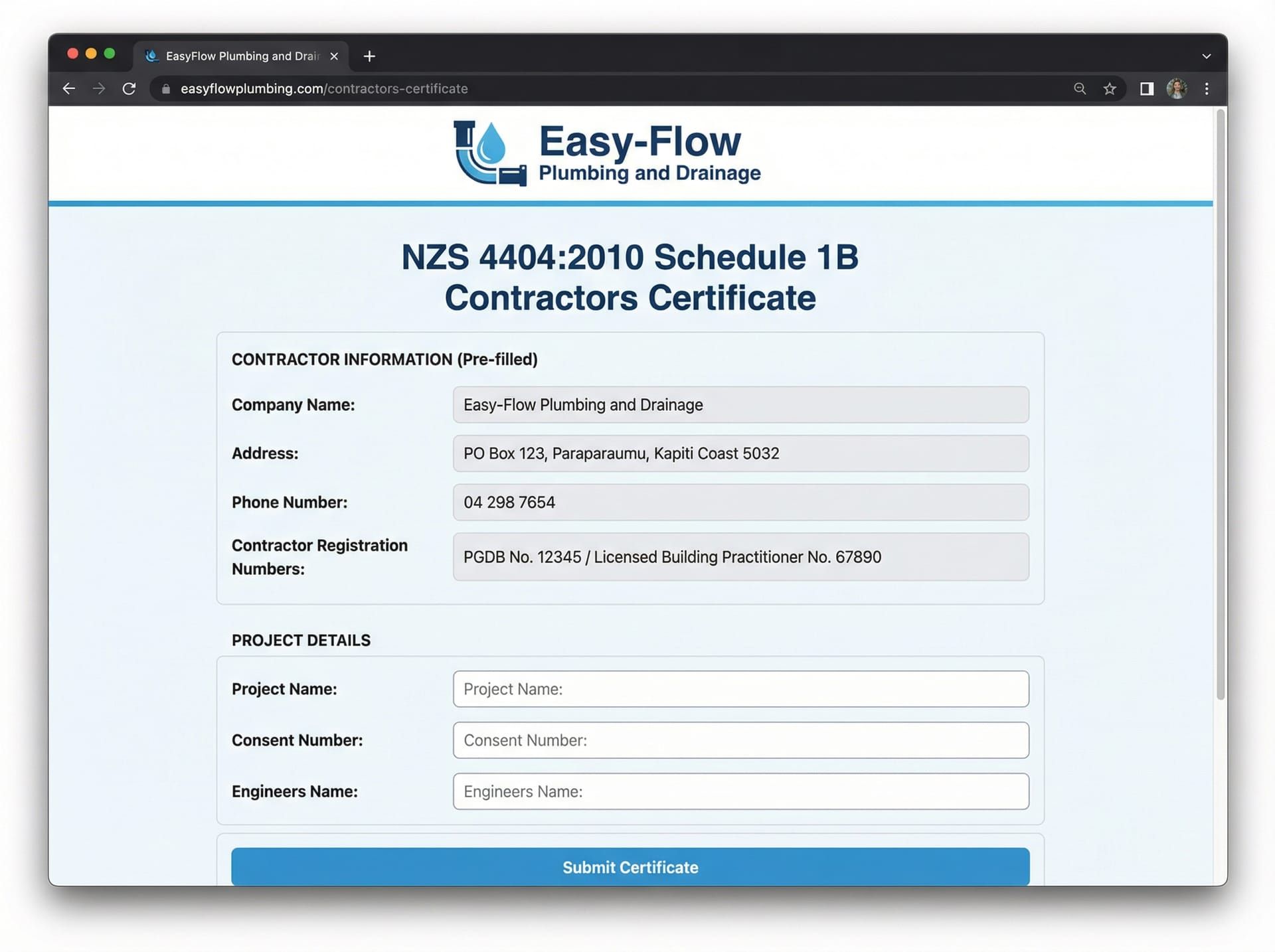
The interactive Schedule 1B form pre-fills Easy-Flow's contractor details, leaving only job-specific fields to complete.
The cost is not just time. It is cognitive load. A tradesperson who has been crawling under houses all day should not have to concentrate on getting form field formatting right at 8pm. The task is beneath their skill level but demands their attention anyway. That mismatch is where automation earns its keep.
How did we turn a PDF form into a smart document?
We rebuilt the NZS 4404:2010 Schedule 1B Contractor's Certificate as an interactive HTML document with Easy-Flow's branding, pre-filled contractor details, and intelligent field behaviour. The approach was to treat the form not as a document to fill in, but as a workflow to streamline.
EmbedAI's approach to trades automation starts from the outcome and works backward. The outcome here was a completed, signed, print-ready certificate with zero re-keying of static information. Working backward from that, we identified three layers of data in the form.
What stays the same on every form?
Static data: Easy-Flow's company name, address, contact details, contractor registration numbers. This information appears on every single certificate and never changes between jobs. In the manual process, someone types or writes this out fresh every time. In our build, it is pre-filled and locked. One source of errors eliminated entirely.
What changes per job but follows a pattern?
Variable data with structure: project name, consent number, engineer's name, date ranges. These fields change per job but follow predictable formats. We built them as clearly labelled input fields with appropriate validation. Date fields accept dates. Number fields accept numbers. The form prevents the kind of formatting inconsistencies that cause council queries.
How does the signature workflow actually function?
The signature requirement was the most interesting technical problem. Physical signatures on digital forms create a workflow bottleneck. The person who needs to sign has to be present, with access to the form, at the right moment. For a drainage contractor who might be on-site 50 kilometres from the office, this is a genuine constraint.
We implemented a dropdown signature selector that maps each authorised signatory to their embedded signature image. The user selects their name from a dropdown, and the corresponding signature renders into the signature field on the form. This is not an e-signature platform with legal ceremony. It is a practical solution for internal compliance documents where the authorised signatories are a known, fixed group.
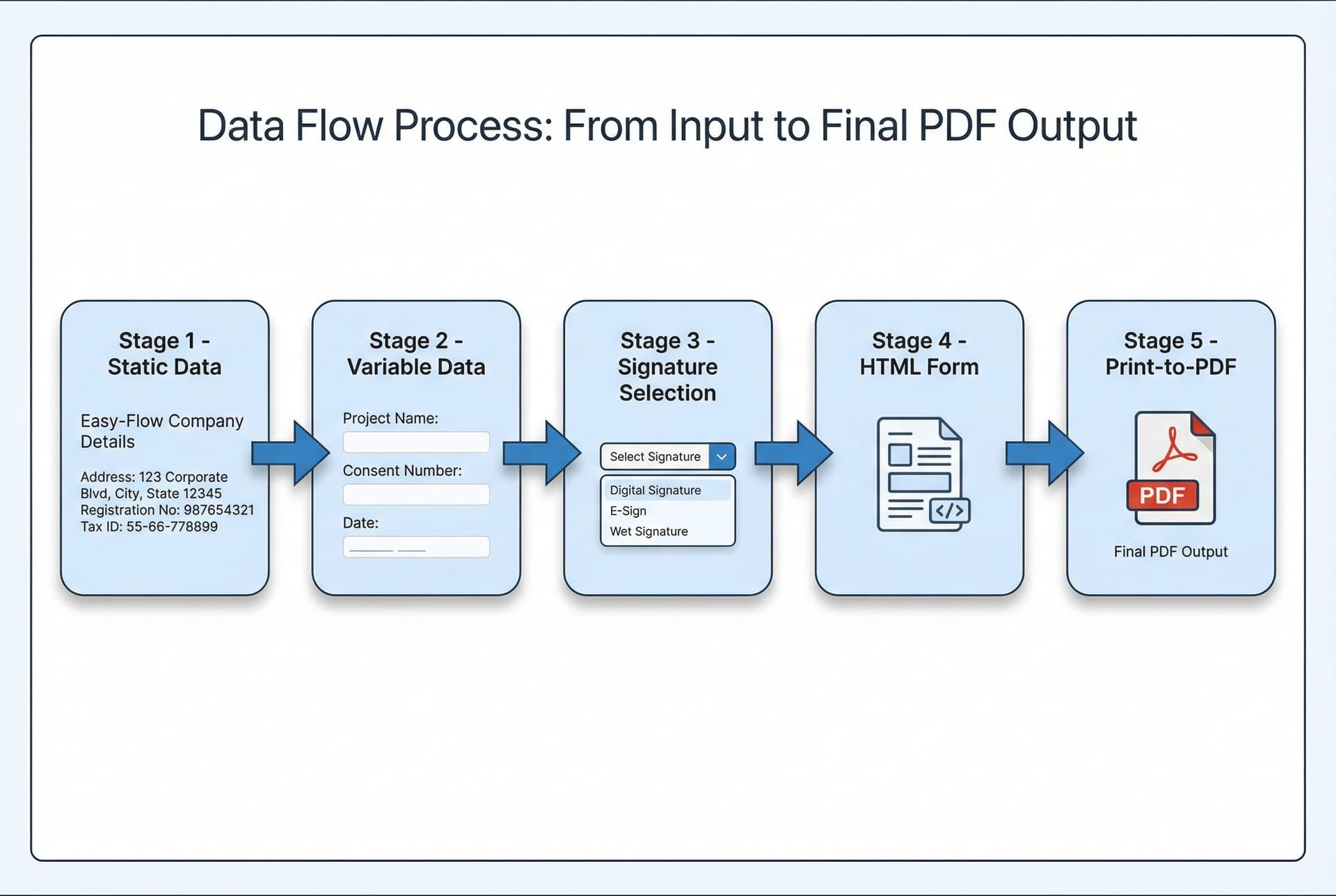
The form separates static, variable, and signature data into distinct layers, each with its own input method.
The print-to-PDF workflow uses the browser's native print functionality with a carefully designed print stylesheet. The HTML form renders to an A4 layout that matches the official NZS 4404 format. When the user hits print, the interactive elements collapse into their filled values, margins adjust, and the output is a clean PDF indistinguishable from a professionally typeset document.
The key design decision was treating this as three data layers rather than one form. Static data is configuration. Variable data is user input. Signatures are access-controlled selections. Each layer has its own input method and validation rules. This separation is what makes the form fast to complete rather than merely digital.
We also built a parallel PDF generation pipeline using Python and ReportLab for server-side certificate generation. This handles batch processing scenarios and provides a programmatic route to PDF output that does not depend on a browser. For a services engagement like this, giving the client multiple output paths means the solution adapts to their workflow rather than constraining it.
Why does a plumber need a voice AI assistant?
Easy-Flow operates across plumbing, drainage, and earthworks on the Kapiti Coast. Their team is on the tools for the majority of the working day. Excavators do not have pause buttons. Drainage trenches do not wait while you take a call. The phone rings, and it goes unanswered.
The economics of missed calls in trades are well documented. A single missed plumbing callout on the Kapiti Coast represents $150-$300 in lost revenue. Emergency drainage work runs higher. Across a week, the compound cost of three or four missed calls adds up to figures that would justify a part-time receptionist, except that a part-time receptionist does not answer calls at 6am when a pipe bursts.
We built Easy-Flow a voice AI assistant that answers their phone when the team cannot. The system handles three distinct call types that map to Easy-Flow's actual business.
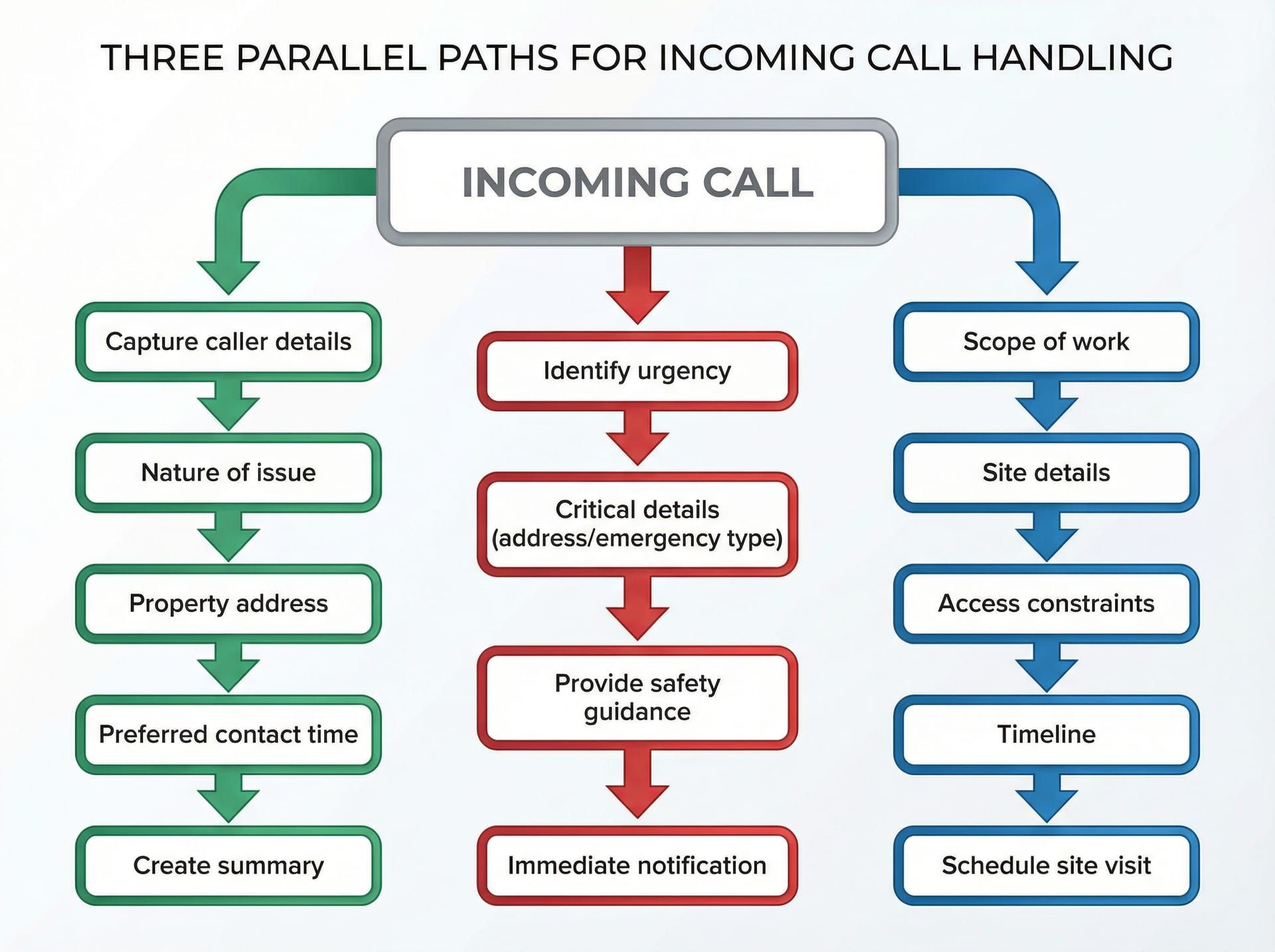
The assistant triages calls into three categories, each with its own conversation flow and information capture requirements.
How does the assistant handle different call types?
Service enquiries, emergency callouts, and quote requests each follow a different conversation path. This matters because the information needed from each caller is different, and the urgency varies dramatically.
For service enquiries, the assistant captures the caller's details, the nature of the issue, the property address, and preferred contact times. It provides basic information about Easy-Flow's service areas and capabilities. The output is a structured summary that Easy-Flow can action when they are ready.
Emergency callouts follow a faster path. The assistant identifies the urgency, captures the critical details (address, nature of emergency, whether water or gas needs to be isolated), and provides immediate safety guidance where appropriate. The notification to Easy-Flow is immediate and prioritised.
Quote requests capture scope information: what work is needed, site details, access constraints, and timeline expectations. This gives Easy-Flow enough context to provide a preliminary response or schedule a site visit without a return phone call just to gather basic information.
What makes the system prompt effective for a trades business?
The voice AI system prompt was engineered specifically for Easy-Flow's business context. It knows their service area (Kapiti Coast and surrounding regions). It understands the difference between plumbing, drainage, and earthworks enquiries. It uses language that matches how their customers actually talk about problems.
This specificity matters. A generic answering service asks generic questions. An AI assistant built for a drainage contractor asks about site access for excavators, whether the property is on council sewer or septic, and whether there is standing water. These are the questions that Easy-Flow would ask if they answered the call themselves. The AI captures the context that makes the callback productive rather than just another round of information gathering.
When building a voice AI assistant for a trades business, map every question the assistant asks to a decision the tradesperson needs to make. If a question does not help them decide whether to take the job, schedule the job, or price the job, remove it. Callers tolerate about four questions before they start getting impatient.
What do these two solutions look like working together?
The form automation and voice AI serve different operational problems, but they share a common principle: removing low-value repetitive work from the business owner's day. A plumber's expertise is in pipe systems, drainage design, and earthworks logistics. Their time should be spent on diagnosis, installation, and client relationships. Not on re-entering their company address into a PDF form for the fourteenth time this month, and not on playing phone tag with a customer who called while they were in a trench.
Together, the two deliverables represent a pattern we see across trades and SME businesses: the highest-impact automation targets are not the complex, glamorous problems. They are the mundane, repetitive tasks that individually take five minutes but collectively steal hours every week.
The Schedule 1B automation reduces a 20-30 minute paperwork task to under 5 minutes. The voice AI captures calls that would otherwise be lost entirely. Neither solution required Easy-Flow to change how they run their business. The form works in their browser. The AI answers their existing phone number. The technology sits behind the workflow they already have.
That is the measure we use for successful trades automation at EmbedAI: the business owner should not have to learn a new system. The system should learn the business.
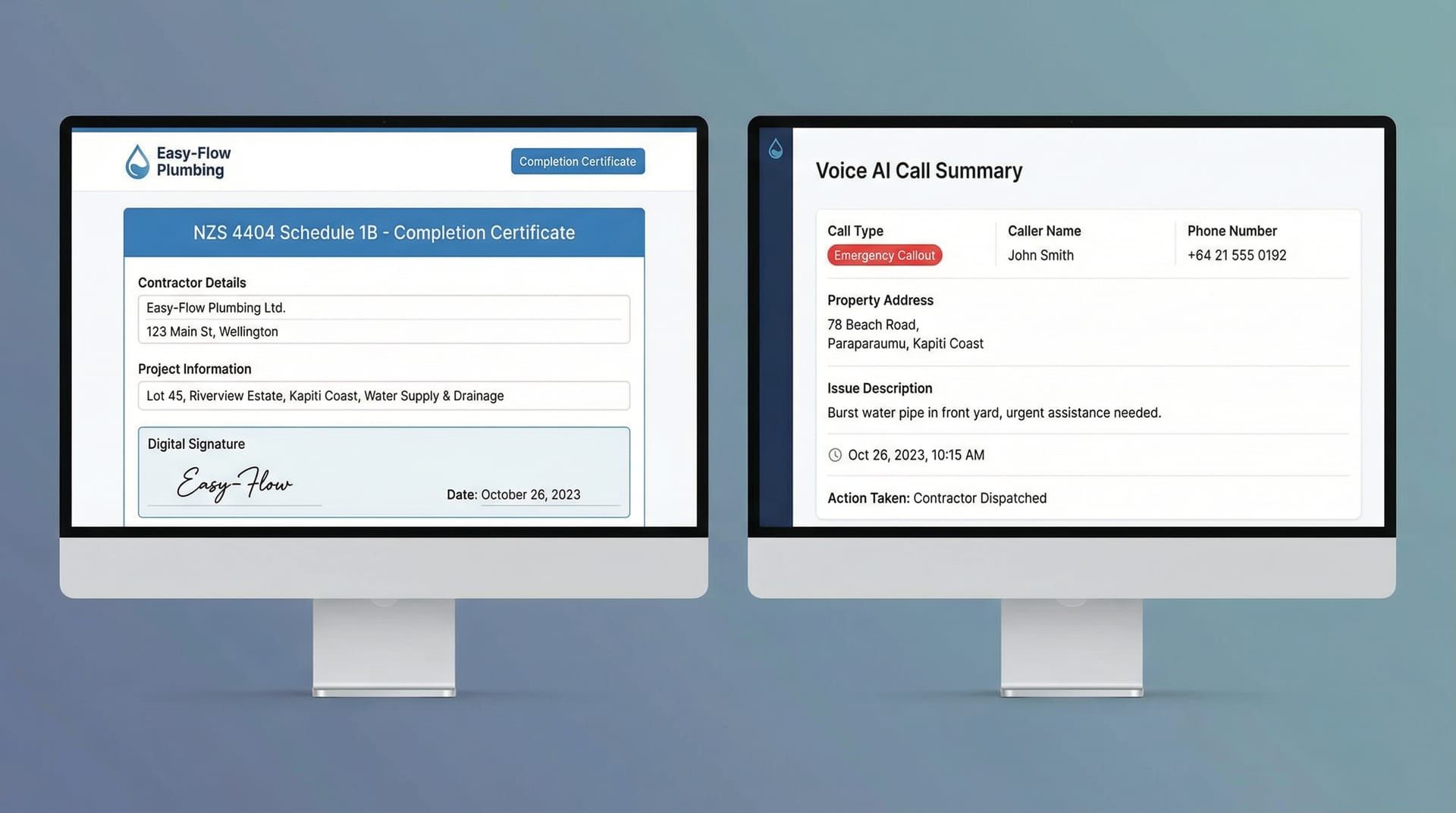
Two deliverables solving two problems with the same principle: remove repetitive low-value work from the tradesperson's day.
What technology powers each deliverable?
HTML / CSS / JavaScript — Interactive Schedule 1B form with print stylesheet, pre-filled fields, dropdown signature selection, and responsive layout matching NZS 4404:2010 format.
Python — Server-side scripting for batch processing and data handling in the PDF generation pipeline.
ReportLab — Programmatic PDF generation for Schedule 1B certificates, enabling server-side output independent of browser rendering.
Voice AI — Conversational phone agent handling inbound calls with three-path triage: service enquiries, emergency callouts, and quote requests.
Custom System Prompt Engineering — Business-specific conversation design covering Easy-Flow's service areas, trade specialisations, and Kapiti Coast context.
FAQ
Can the Schedule 1B form automation work for other NZ council compliance forms?
Yes. The approach of separating static, variable, and signature data applies to any structured compliance document. Other NZS forms, building consent applications, and site-specific safety plans can all be built using the same pattern. The key requirement is a form with predictable structure and repeated static fields.
How does a voice AI assistant handle calls outside a plumber's service area?
The assistant is configured with Easy-Flow's service boundaries. When a caller describes a location outside the Kapiti Coast region, the assistant acknowledges the request, explains the service area, and suggests the caller contact a local provider. This prevents wasted callbacks on jobs the business cannot service.
What happens if the voice AI cannot understand a caller's request?
The system is designed to gracefully handle ambiguity. If the assistant cannot confidently classify or understand a request after clarifying questions, it captures whatever information is available, flags the call as requiring human review, and ensures Easy-Flow receives the recording and transcript for manual follow-up.
Is this kind of automation cost-effective for a small trades business?
For a business losing even two or three calls per week, the voice AI pays for itself within the first month. The form automation has a fixed development cost and zero ongoing expense since it runs in the browser. For trades businesses doing consented work regularly, the time savings on paperwork alone justify the investment within the first quarter.
Can I get similar automation for my trades business in another region of New Zealand?
Yes. While this project was built for a Kapiti Coast plumbing and drainage firm, the same patterns apply to trades businesses anywhere in New Zealand. The voice AI adapts to your service area, trade specialisation, and business rules. The form automation works with any structured compliance document. Contact EmbedAI to discuss your specific requirements.