A candidate applies for a senior role at 9:40 on a Sunday night. By the time a recruiter clears Monday's client meetings and picks up the phone on Tuesday afternoon, that candidate has spoken to two other agencies, one of which called within the hour. Recruitment is a speed game wearing a relationship game's clothes, and the screening call is where the speed dies.
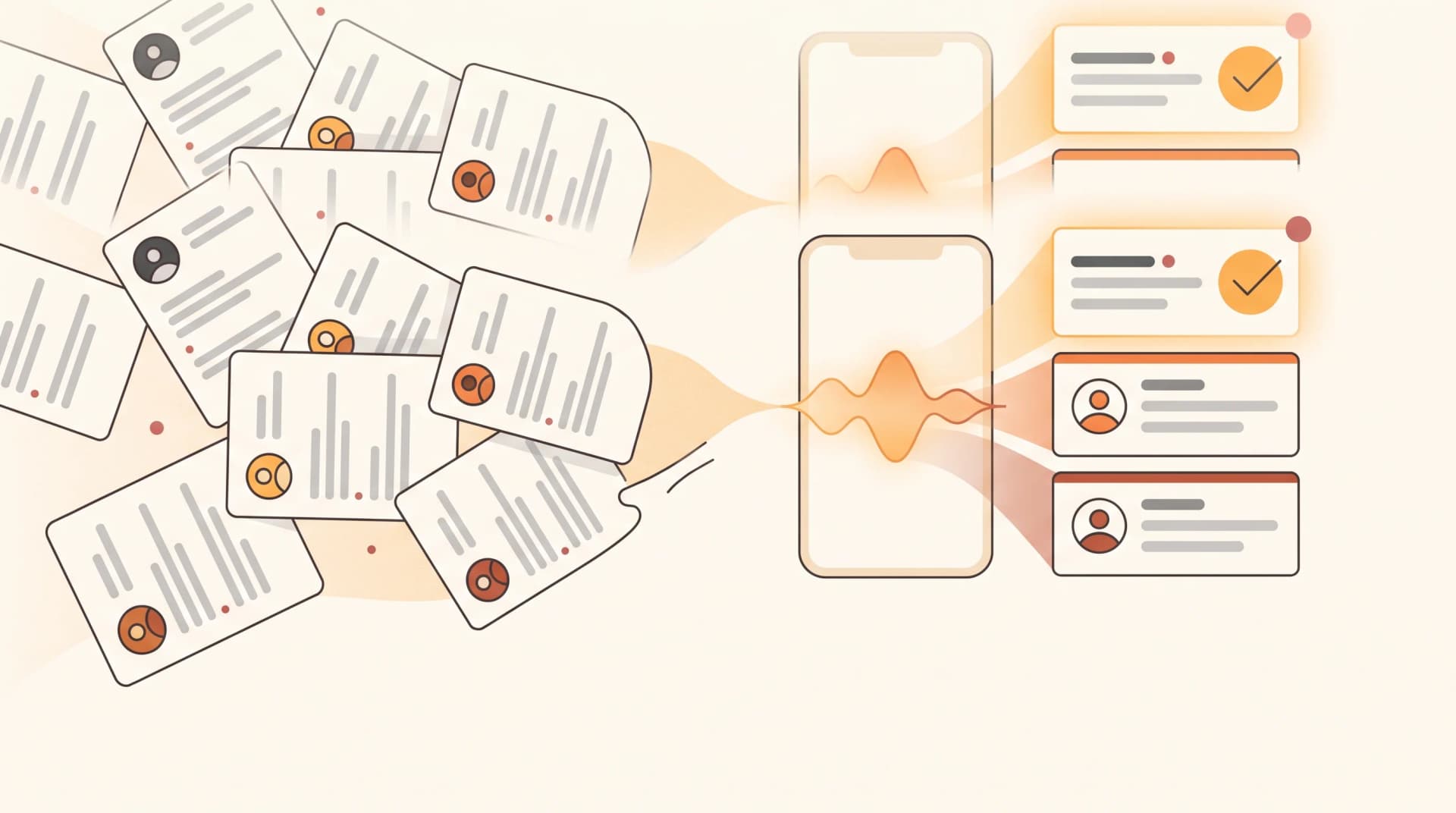
AI candidate screening closes that gap. An AI voice agent can ring a new applicant within minutes of the application landing, run a structured first-pass screen, and file the answers into the ATS before the competing agency has opened the CV. The recruiter walks in the next morning to a shortlist with availability, notice periods and salary expectations already attached.
We build these systems, including candidate intelligence for a boutique legal recruitment firm where autonomous agents help keep thousands of candidate records current. This post covers where screening time goes, what an agent can screen without damaging the candidate experience, how the same machinery keeps a database from going stale, and how to judge whether it stacks up for your desk.
Why does candidate screening eat recruiter weeks?
Because every placement sits on top of a pyramid of conversations that mostly go nowhere. A single role can draw sixty applications, of which perhaps ten deserve a proper conversation and three deserve the client's time. Someone has to make the sixty-to-ten cut, and the honest tool for that cut is a phone call, at fifteen to twenty minutes each.
Do the arithmetic on a modest desk. Four live roles, forty applicants each, a first-pass call to even a third of them: that's over twenty-five hours of screening for one round of roles. It gets done in the gaps, which means it gets done late, and late is the one thing screening cannot afford to be.
What does slow first contact cost an agency?
Placements. Good candidates are in play the moment they apply, and they build loyalty with whichever recruiter treats them like a priority first. When the first real conversation happens three days after the application, the agency is negotiating for second place. The CV was in your inbox the whole time. The fee walked out the door anyway.
Why do candidate databases go stale?
Because people move and databases don't. Candidates change jobs, cities, salary expectations and phone numbers roughly every two to three years, and a record nobody has spoken to since 2023 is an archaeology exhibit. Most agency databases are a thin layer of live candidates sitting on thousands of records that are quietly wrong.
Stale records cost real money twice over. Recruiters burn hours ringing dead numbers when a role needs filling fast, and the candidates who would have been perfect never hear about the role because their record says they're settled. The database is the agency's core asset, and it depreciates every week nobody maintains it.
What can an AI agent screen without wrecking the candidate experience?
The logistics layer: availability, notice period, salary expectations, work rights, location and licensing. These are structured questions with structured answers, they're the same for every candidate, and they're the bulk of every first-pass call. The judgement layer stays with the recruiter, because that's the part candidates and clients are paying for.
The split matters enough to write down:
| The agent handles | The recruiter keeps |
|---|---|
| Availability and notice period | Motivation and career story |
| Salary and rate expectations | Cultural and team fit |
| Work rights and location | The hard conversation about a gap |
| Licences and certifications | Coaching before the client interview |
| Interview scheduling | Negotiation and the close |
| Database refresh calls | The relationship |
The agent does the logistics. The recruiter does the relationship. Every agency we've spoken to already runs this split informally; the difference is that the logistics half currently costs twenty-five recruiter hours a round, and it doesn't need to.
What does the screening call sound like to a candidate?
Prompt, short and honest. The agent introduces itself as the agency's screening assistant, confirms it's a good time, and runs eight to ten structured questions in about five minutes. Candidates can ask about the role and get accurate answers from the brief. Anything nuanced gets noted for the recruiter, and the call ends with a clear next step.
The timing does the heavy lifting. A structured call five minutes after applying reads as an agency that has its act together. The candidate has applied, the phone rings, the process is moving. Momentum is its own candidate experience.
How does an AI agent keep a candidate database current?
By treating database maintenance as a standing outbound programme. The agent works through the database in scheduled rounds: a short call or text confirming current role, availability, salary expectations and contact details. Answers write back to the ATS with a freshness date, and candidates who've moved get flagged for a recruiter follow-up.
The refresh call is softer than a screen. It's a check-in from an agency the candidate already knows: still at the same firm, still happy, open to hearing about anything? Two minutes. Being remembered by a recruiter two years after a placement is rarer than it should be.
The compounding effect is the point. In our candidate intelligence work for legal recruitment, the value comes from the record being trustworthy at the moment a role lands: when a client briefs a role on Monday morning, the search runs across data with a recent conversation behind it. The agency that can say "we spoke to her in March, she'd move for the right partnership track" wins the brief before the longlist exists.
Privacy is a design input, and it runs on the same rails as our other voice work. Candidate data sits inside the Privacy Act 2020: collect what the placement process needs, disclose that calls are recorded, store data in NZ or Australian regions, honour every request to be updated or removed. A refresh programme done properly strengthens consent, because every record carries a recent, documented conversation.
What should an agency owner do with this information?
Measure the two delays before buying anything: how long a new applicant waits for first contact, and how long since the median database record had a conversation attached. Those two numbers are your speed problem and your decay problem, and they decide whether AI screening is worth pricing.
If first contact runs past a day and the median record is over a year cold, the case is usually strong. A screening and refresh build typically comes in between $10,000 and $18,000 NZD depending on ATS integration, with running costs of $300 to $500 a month. One placement that would otherwise have gone to the faster agency covers the year. The pattern is the same one we've built for law firm client intake: a structured conversation, captured the moment interest is highest, filed where the professional can act on it.
We scope this the way we scope every engagement: a short discovery against your ATS and your live roles, a narrow first build, and expansion only once the first piece proves itself. If your screening queue is the bottleneck, talk to us about what a first build would look like on your desk.
Five numbers that make or break the business case
1. Hours from application to first phone contact?
Under an hour is winning. Over a day is donating candidates to faster agencies.
2. Screening calls per placement?
Count last quarter's calls against placements made. That ratio is your logistics tax.
3. Percentage of database contacted in the last 12 months?
Under a quarter means the core asset is depreciating unattended.
4. Recruiter hours per week on first-pass screens?
This is the time an agent buys back. Price it at your billers' hourly value.
5. Placements lost to "already working with another agency"?
Every one of these is a speed loss wearing a relationship costume.
Frequently asked questions
- Will candidates talk to an AI screening agent?
- Most will, provided the agent discloses what it is, calls promptly, keeps the conversation short and structured, and offers a path to a human. Speed matters more than who dials the phone. The pattern across our voice AI work is that follow-through, having the answers land somewhere and lead to a next step, decides the experience.
- Does AI screening introduce bias into recruitment?
- An agent used properly reduces one common source of inconsistency, because every candidate gets the same structured questions regardless of when they apply or how busy the desk is. The agent records answers and never rejects anyone autonomously. Shortlisting judgements stay with the recruiter, which is where accountability under NZ employment and human rights law belongs.
- Which ATS platforms can an AI screening agent integrate with?
- Any platform with a usable API, which covers the common agency systems in NZ and Australia, including JobAdder, Bullhorn and Vincere. Screening answers, transcripts and freshness dates write back to the candidate record. Where API access is limited, the agent starts against exported lists and a shared sheet while the integration is built.
- What does AI candidate screening cost for a small agency?
- A typical build for a boutique agency comes in between $10,000 and $18,000 NZD depending on ATS integration depth, with running costs of $300 to $500 a month. Measured against a single placement fee, most agencies find the build cost is covered by one placement that faster first contact saved from a competitor.