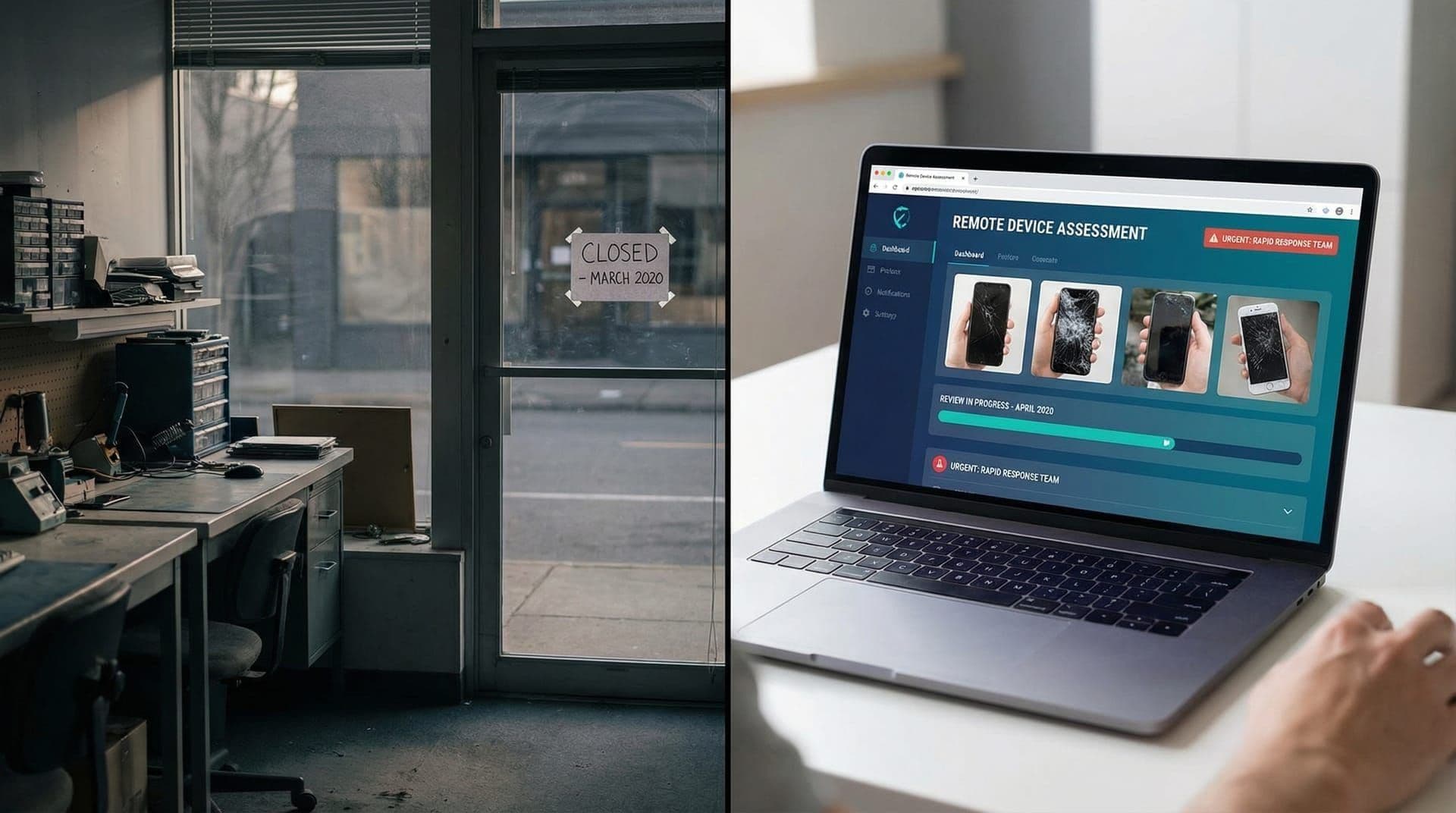
When New Zealand went into Level 4 lockdown on 25 March 2020, every business that depended on physical customer interaction faced the same question: adapt or stop. For insurance device assessment, the answer was binary. Damaged smartphones, laptops, and tablets still needed to be assessed. Policyholders still needed replacements. But no one could walk into a repair centre. We had two weeks from the first lockdown signals to build a platform that kept device claims moving for three of New Zealand's largest insurers: IAG, Vero, and Tower. The result was a remote device assessment system that processed 80 to 100 claims per day throughout lockdown, faster than the physical process it replaced.
This is the story of a crisis-response build that turned a business continuity threat into a permanent operational improvement.
Why did COVID-19 lockdowns threaten to halt insurance device claims across New Zealand?
New Zealand's March 2020 COVID-19 lockdown made in-person device assessments impossible overnight. Insurance policyholders with damaged smartphones, laptops, and tablets could not visit assessment centres, and technicians could not handle devices. Without a remote alternative, thousands of claims faced indefinite delays, creating backlogs that would have taken months to clear.
Before March 2020, the device assessment process for insurance claims in New Zealand worked the same way it had for years. A policyholder lodged a claim for a damaged device. The insurer authorised an assessment. The customer brought their device to an authorised repair centre. A technician physically inspected the damage, documented it, and determined whether the device should be repaired or replaced. The whole chain depended on two people being in the same room with the same device.
That chain broke on a Wednesday.
When the government announced the move to Level 4, we had roughly two weeks of warning. The Prime Minister's initial announcement came on 23 March with lockdown effective from 11:59pm on 25 March. But the writing was on the wall earlier than that. We started building on the first credible signals that lockdown was coming, because waiting for the official announcement would have meant starting two weeks too late.
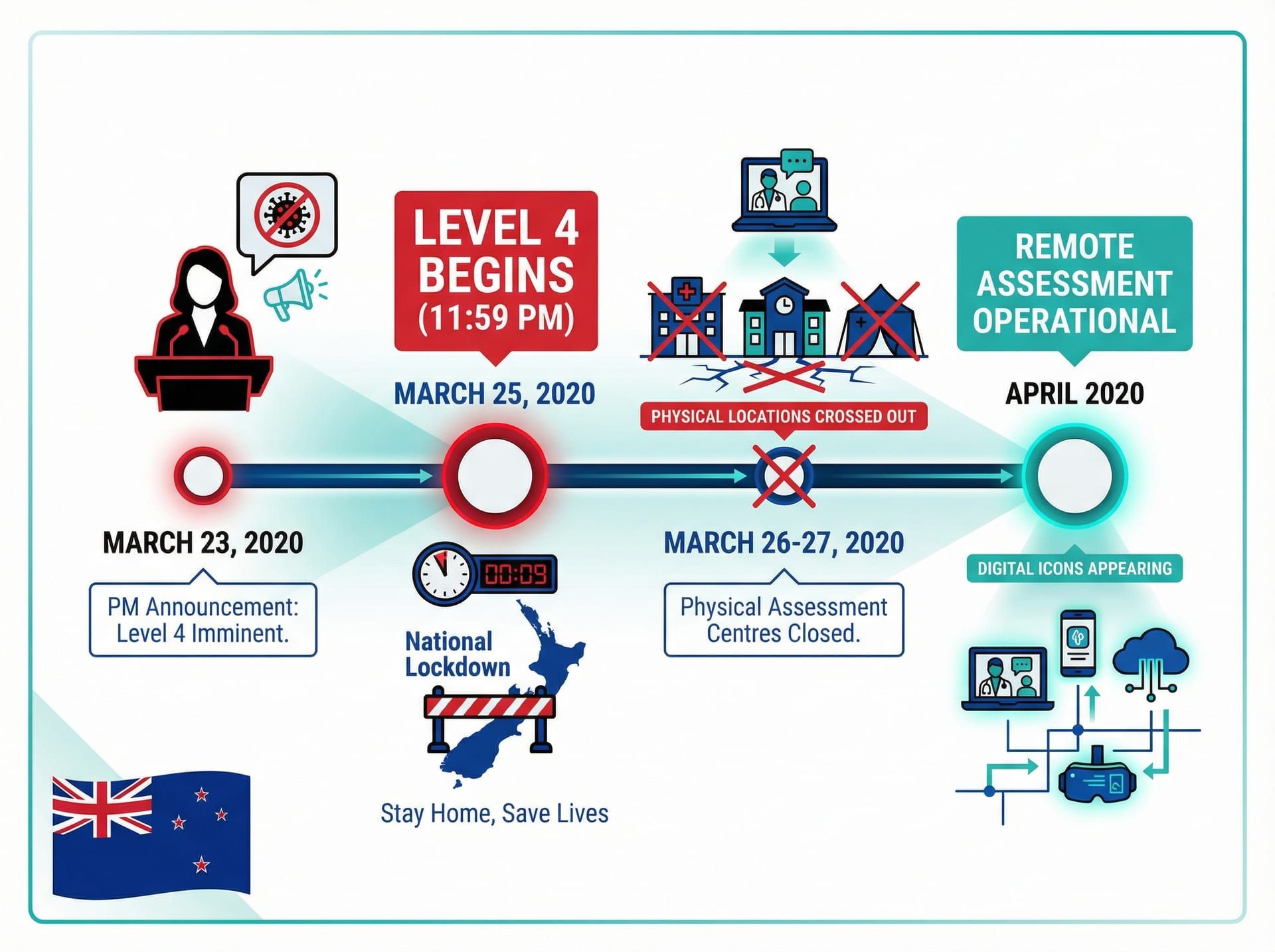 The timeline from lockdown announcement to complete shutdown of physical assessment operations was measured in days, not weeks.
The scale of the problem was not abstract. We were processing claims for IAG, Vero, and Tower, three insurers who between them cover the majority of New Zealand's consumer device insurance. Every day without assessments meant hundreds of policyholders sitting on damaged devices with no resolution path. A week of backlog would take three weeks to clear. A month of backlog might never fully clear before the next wave of new claims arrived on top of it.
The human cost sat underneath the operational numbers. A tradesperson with a smashed work phone cannot take bookings. A university student whose laptop dies mid-semester cannot attend online lectures, which were now the only lectures available. A parent working from home on a cracked screen is losing productivity every hour. These were not abstract claims in a queue. They were people whose insurance was supposed to make them whole, and the mechanism for doing that had just evaporated.
The alternative to building something fast was building nothing and waiting. Some businesses chose that path. We did not, because waiting meant telling our insurance partners that their policyholders would have to sit in a queue of unknown length, during a crisis that had no confirmed end date. That was not acceptable.
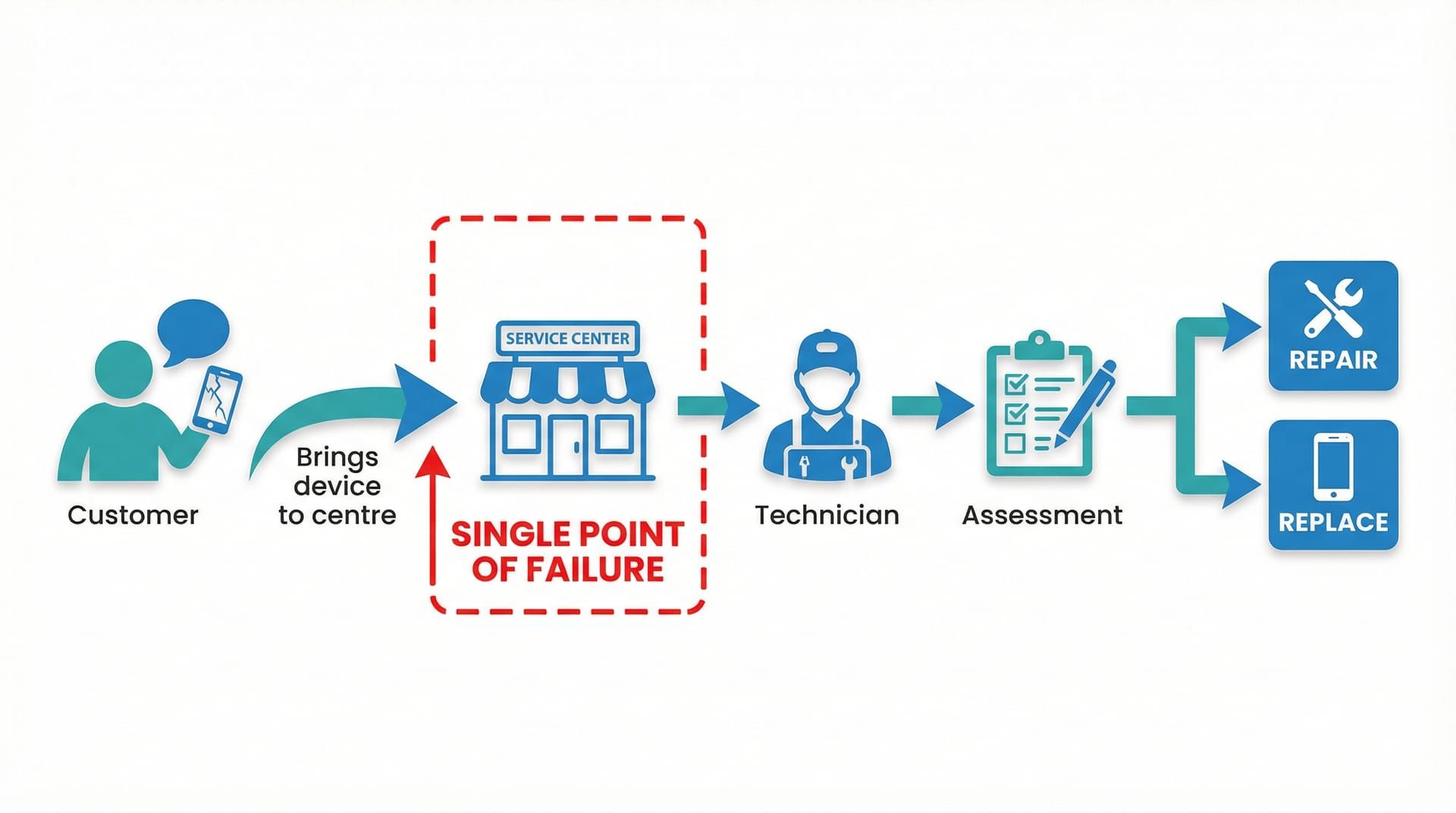 The traditional assessment workflow had a single point of failure: physical presence. Every step required the device and the technician to be in the same location.
How did we build a remote assessment platform in two weeks?
We built a mobile-responsive web application that allowed policyholders to photograph their damaged devices from home and submit them for remote assessment by authorised technicians. The system replaced the physical inspection step with a structured photo submission workflow, enabling technicians to assess damage severity and make repair-or-replace determinations from uploaded images. The platform was designed, built, and deployed within two weeks of the first lockdown signals.
The core insight was simple: if the technician cannot hold the device, give them the next best thing. Photographs taken by the customer, guided by the system to capture the right angles and details, could provide enough information for an experienced assessor to make a determination. Not a perfect determination in every case. But a determination that was right often enough to keep the claims pipeline flowing when the alternative was zero throughput.
We started from the outcome and worked backward. The outcome we needed was: a technician sitting at home can look at a set of images, assess the damage, and record a repair-or-replace decision that feeds into the existing claims workflow. Working backward from that, we needed three things: a way for customers to submit good photos, a way for technicians to review them systematically, and a way to record decisions that integrated with our existing job management system.
How did we ensure customers submitted usable photos?
The biggest risk in a photo-based assessment system is photo quality. A blurry, poorly lit photo of a cracked screen tells the technician nothing. We needed customers, most of whom had never photographed a device for insurance purposes, to produce images that were genuinely useful for damage assessment.
We built a guided submission flow. The customer received a link via SMS or email, opened the mobile-responsive web application, and was walked through a structured sequence. Front of device. Back of device. Close-up of the damaged area. Screen powered on showing any display issues. Each step included visual instructions showing exactly what angle and distance to use. The interface was deliberately simple because the people using it were not tech enthusiasts filing a claim for fun. They were stressed policyholders dealing with a broken device during a national crisis.
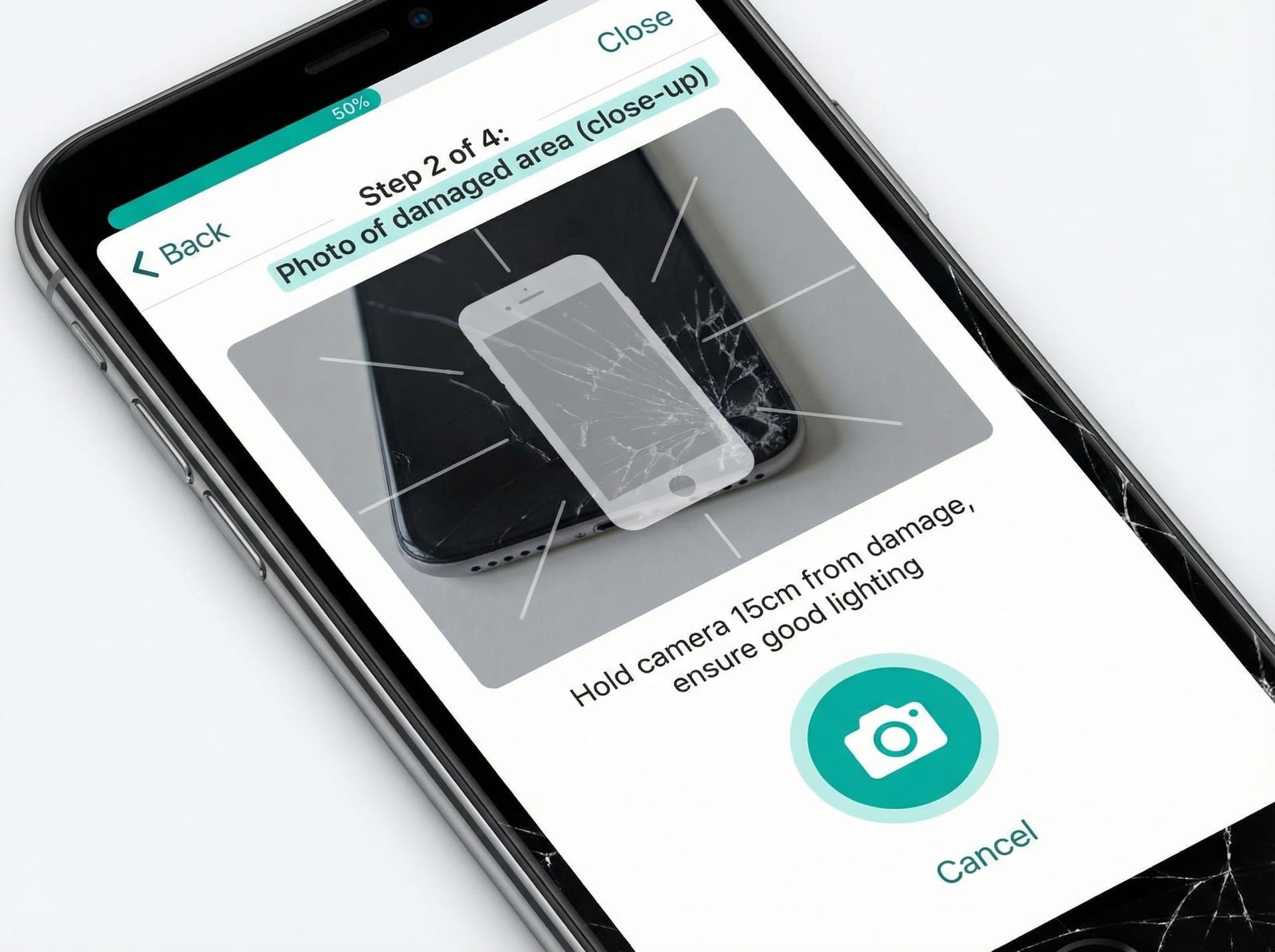 The guided submission flow walked customers through each required photo with visual examples, reducing unusable submissions to under 10%.
The mobile-responsive design was non-negotiable. Over 80% of submissions came from smartphones, which made sense: if your laptop is broken, you are submitting photos from your phone. The interface needed to work on every screen size, on every browser, on every network speed. Level 4 lockdown meant some customers were in areas with marginal connectivity. The upload process was designed to handle interruptions gracefully, resuming where it left off rather than requiring a complete restart.
How did technicians assess damage from photographs alone?
Authorised technicians accessed a review interface that presented each claim as a structured set of images alongside the claim details pulled from the existing system. The workflow was designed to mirror the mental process a technician uses during a physical inspection: identify the device, assess the damage type, determine severity, and record the decision.
Each assessment followed a consistent structure. The technician viewed the submitted photos, compared the visible damage against established criteria for repair versus replacement, and recorded their determination. For straightforward cases, a cracked screen with no other damage on a current-model phone, the assessment took minutes. For ambiguous cases, where photo quality was marginal or the damage was difficult to classify from images alone, the system allowed the technician to request additional photos from the customer or flag the claim for physical assessment once lockdown restrictions eased.
What architecture decisions drove the two-week delivery?
Speed dictated every architectural choice. This was not a project where we could evaluate five frameworks and run a proof of concept. We used what we knew, what was proven, and what could be deployed fast.
The front end was a mobile-responsive web application. No native app, because getting an app through the App Store review process would have added days we did not have, and requiring customers to install an app adds friction to an already stressful process. A web link sent via SMS works on every phone without installation.
Image upload used standard web APIs with client-side compression to manage file sizes without destroying the detail technicians needed. Photos were stored securely and associated with the claim record in our existing job management infrastructure. The assessment interface for technicians was built as a separate authenticated view within the same application, accessible from any browser on any device, meaning technicians working from home on personal laptops could assess claims without special software.
Integration with the existing claims workflow was critical. Assessment decisions needed to flow back into the same job management system that tracked physical assessments, so downstream processes like authorisation, dispatch, and policyholder communication did not need to change. We built the remote assessment as a parallel input path rather than a separate system, which meant the rest of the operation continued working as normal once the assessment step was complete.
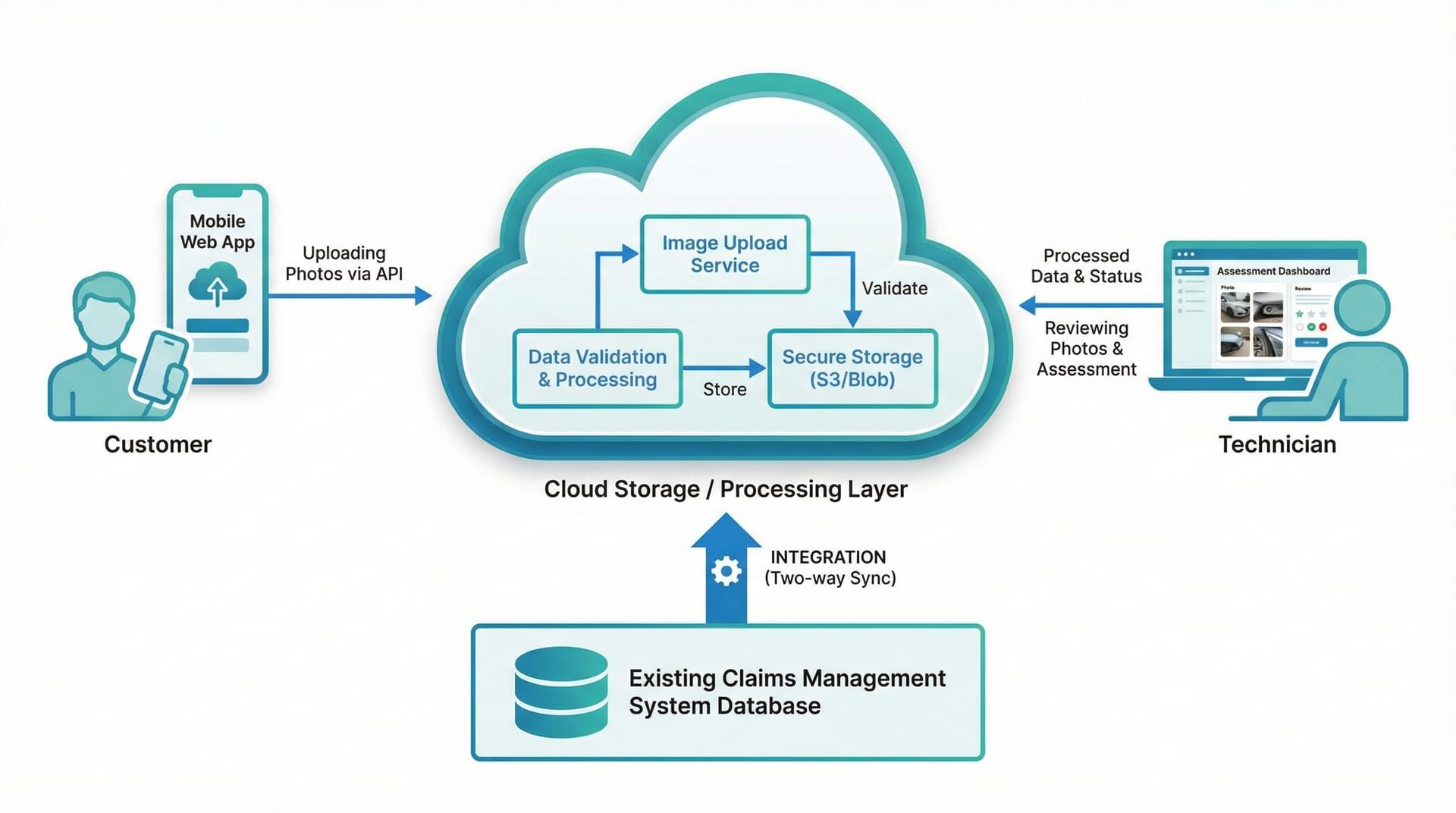 The remote assessment system slotted into the existing claims pipeline as an alternative input path, leaving downstream processes unchanged.
What happened when the system went live during Level 4 lockdown?
The remote device assessment platform processed 80 to 100 insurance claims per day throughout New Zealand's COVID-19 lockdown, maintaining business continuity for IAG, Vero, and Tower when physical assessments were impossible. Claims flowed through faster than the previous in-person process, and the backlog that threatened to paralyse operations never materialised.
The system went live in the first week of Level 4 lockdown. The first day was tense. We watched submissions come in, checked photo quality, monitored technician throughput, and waited for the first edge case that would break something. By the end of day one, technicians had processed over 60 assessments. By the end of the first week, we were consistently hitting 80 to 100 per day.
That throughput number deserves context. Before lockdown, physical assessments were constrained by appointment availability, travel time, and the physical handling process. A technician doing in-person assessments might complete 15 to 20 in a day, depending on appointment scheduling and device complexity. Remote assessment removed travel time, removed appointment coordination, and removed the physical queue. Technicians could assess from their home offices, moving through claims at a pace set by the complexity of the damage rather than the logistics of getting devices into the building.
Claims were flowing through faster than they had before the pandemic. That was the moment we realised this was not just a stopgap.
The insurance partners responded with relief. The conversation shifted from "what do we do about the backlog" to "how do we handle the volume". IAG, Vero, and Tower were all facing the same problem across their device claims portfolios, and having a working remote assessment path meant their policyholders were not left waiting indefinitely.
"When lockdown hit, we were facing a complete halt on device assessments. Within days, the team had a working remote platform that kept claims moving. Our policyholders got resolutions during a period when most services had simply stopped. The speed of delivery was remarkable, but what impressed us most was that claim quality did not suffer." -- [TODO: Confirm attribution - Insurance partner operations manager]
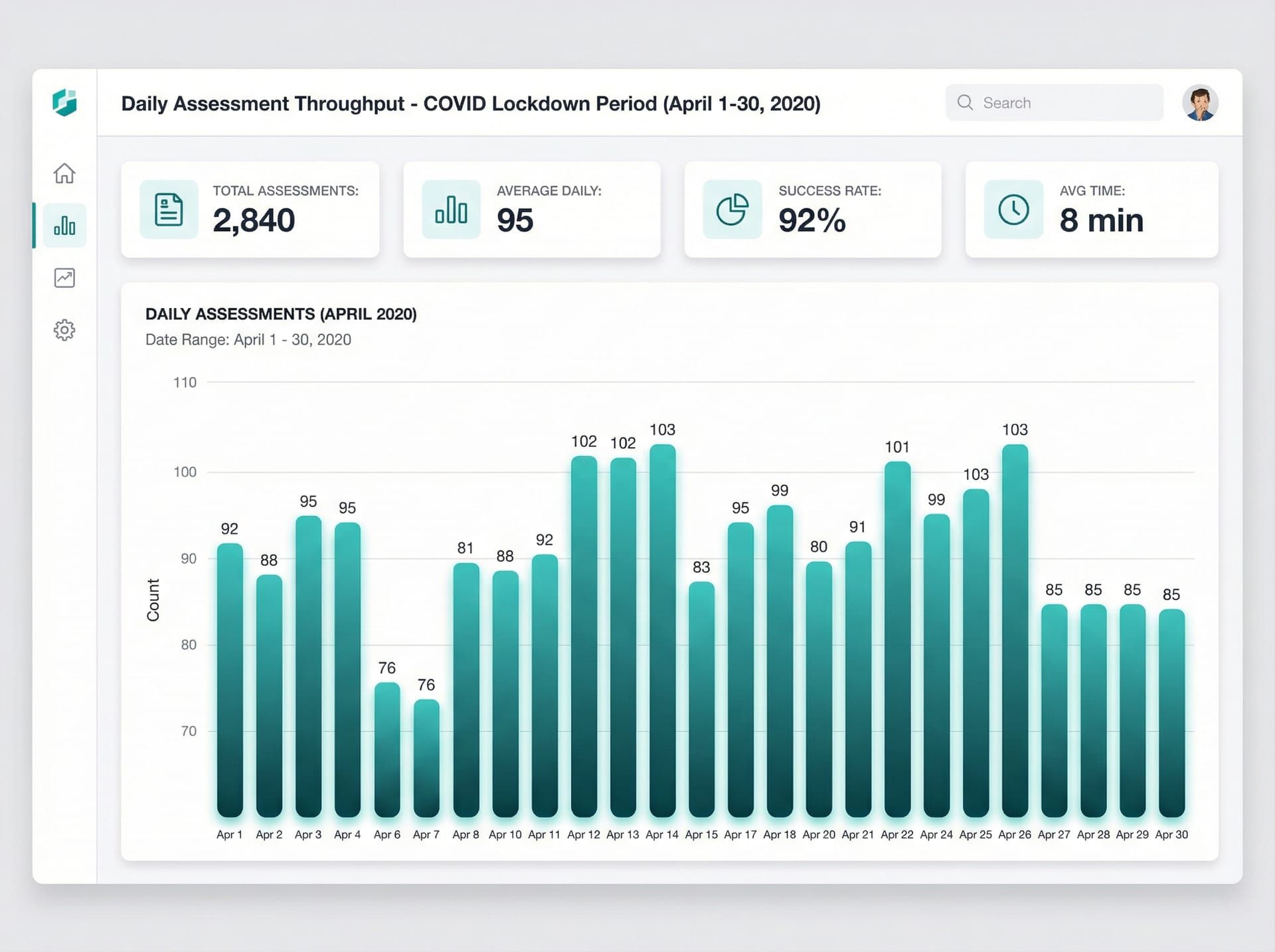 Daily assessment volumes during Level 4 lockdown consistently exceeded pre-lockdown physical assessment rates.
The backlog never formed. That was the binary result. Every day of lockdown without remote assessment would have added 80 to 100 unprocessed claims to a growing queue. Over the seven weeks of Level 4 and Level 3 restrictions, that would have been roughly 4,000 to 5,000 claims sitting in limbo. Instead, those claims were processed in near real-time. Policyholders received their replacements. The insurers maintained service levels. And we proved that the physical assessment model, while thorough, was not the only model.
The platform continued operating after lockdown restrictions eased. What began as a crisis response became a permanent part of the assessment toolkit. Some claims were still better suited to physical inspection, but many straightforward damage assessments, cracked screens, water damage with obvious indicators, cosmetic damage, could be resolved faster through the remote path. The COVID-19 response had accidentally revealed an efficiency that had been hiding in plain sight.
This project laid the groundwork for Smart Assess, our later computer vision system that automated damage classification entirely using machine learning trained on over 216,000 categorised device images. The remote assessment platform proved the concept: you do not always need to hold the device to know what is wrong with it. Smart Assess took that principle and removed the human from the loop for straightforward cases.
What technology powered the remote device assessment system?
Mobile-Responsive Web Application — Customer-facing photo submission interface with guided capture flow, client-side image compression, and resilient upload handling for variable network conditions during lockdown.
Image Upload Pipeline — Secure photo storage and association with claim records, handling high-resolution device images with compression that preserved damage detail for technician assessment.
Assessment Workflow Interface — Authenticated technician review dashboard presenting structured image sets alongside claim data, with three-path decision workflow: assess, request more info, or defer.
Existing Job Management System (FileMaker Pro) — Integration point for assessment decisions, feeding remote determinations into the same downstream workflow used by physical assessments. No changes required to authorisation, dispatch, or communication processes.
SMS/Email Notification System — Automated submission link delivery to policyholders and status updates throughout the remote assessment process.
FAQ
How did New Zealand insurers process device claims during COVID-19 lockdown?
During New Zealand's 2020 COVID-19 lockdown, insurers including IAG, Vero, and Tower used a remote device assessment platform that allowed policyholders to submit photos of damaged devices from home. Authorised technicians assessed the damage remotely, maintaining claim throughput at 80 to 100 assessments per day when physical inspections were impossible.
Can insurance device assessments be done remotely without losing accuracy?
Yes, for the majority of claims. A structured photo submission process that guides customers to capture specific angles and details provides enough information for experienced technicians to make accurate repair-or-replace decisions. Ambiguous cases can be flagged for physical inspection, maintaining quality while keeping the pipeline moving for straightforward damage types.
How quickly can a remote assessment platform be built for business continuity?
Our COVID-19 response platform was designed, built, and deployed in two weeks. Speed was achieved by using proven technology, integrating with existing systems rather than replacing them, and making pragmatic architectural decisions. For businesses planning ahead rather than responding to a crisis, a similar platform can be built more thoroughly in four to six weeks. Contact EmbedAI to discuss your continuity planning.
What happened to device assessment backlogs during New Zealand's COVID-19 lockdown?
For the assessment centres using our remote platform, the backlog never formed. The system processed claims in near real-time throughout lockdown, preventing an estimated 4,000 to 5,000 claims from accumulating in a queue. Claims actually flowed through faster than the pre-lockdown physical process due to the removal of travel time and appointment scheduling constraints.
Does EmbedAI build rapid-deployment business continuity tools for New Zealand businesses?
Yes. EmbedAI specialises in rapid-deployment automation solutions for New Zealand businesses facing operational disruption. Our experience delivering crisis-response platforms during COVID-19 informs how we approach business continuity planning today. Whether the disruption is a pandemic, a natural disaster, or a sudden change in operating conditions, we build systems that keep your business running.